
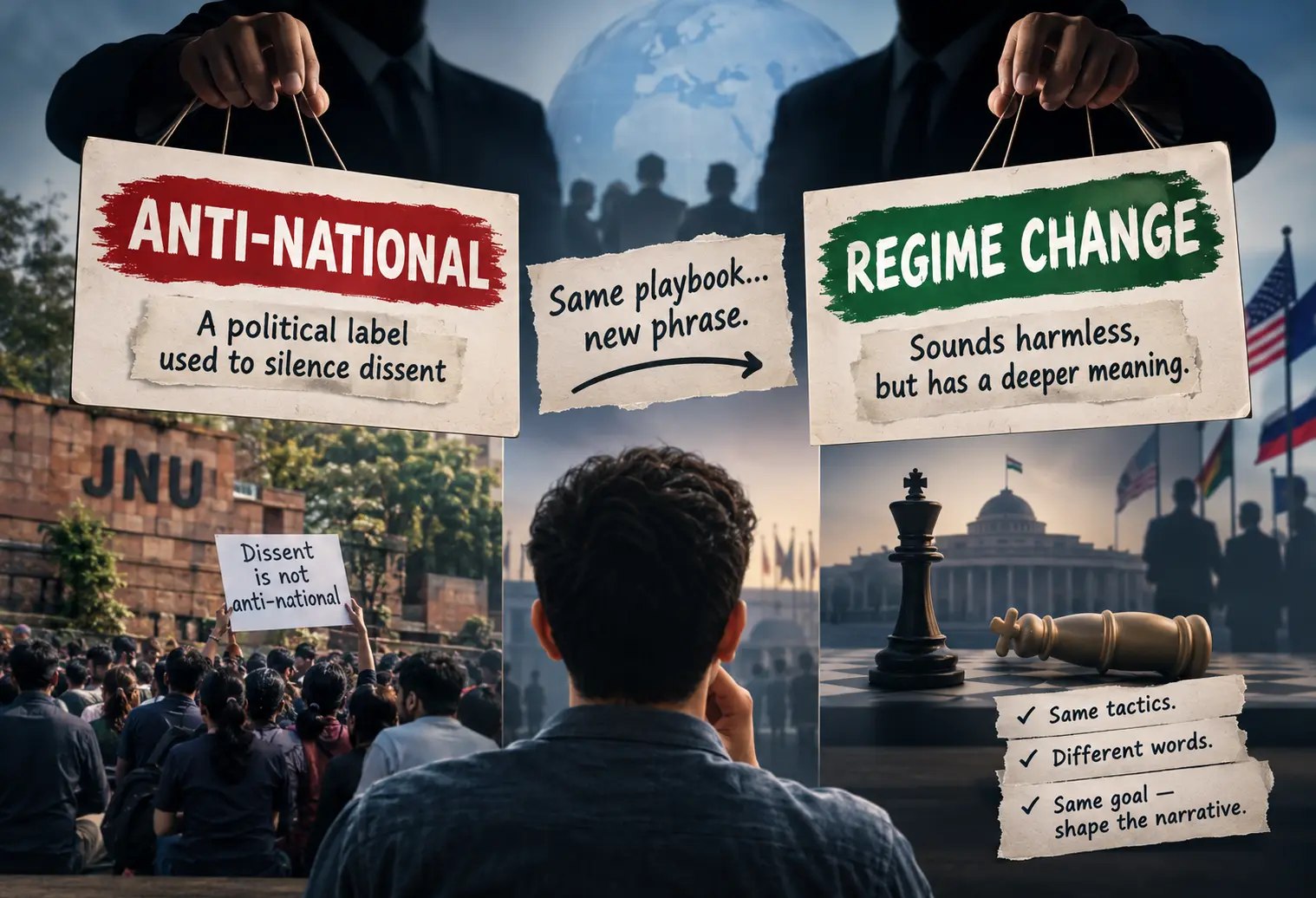
Political discourse has a familiar playbook, take a phrase with serious implications, wrap it in respectable language, repeat it often enough, and eventually hope society stops questioning what it actually means. India witnessed this exercise during the JNU controversy, when attempts were made to turn the label ‘anti-national’ into an inherently legitimate term, even senior news editors wrote articles saying they are anti-national. Today, a similar effort appears to be underway with the phrase ‘regime change’.
Let us be clear. Regime change is not simply another fashionable expression for political disagreement, democratic debate or peaceful protest. In international politics, the term refers to replacing a country’s existing government or political leadership, sometimes through external pressure, covert operations or military intervention. Its meaning depends on the circumstances, but its implications can be profound, particularly when foreign powers attempt to determine who governs a sovereign nation.
Yet, there are growing attempts in political conversations in India to present the phrase as something entirely innocuous, obviously from Indian opposition. Question the intentions behind calls for regime change, and you risk being accused of misunderstanding democracy. Ask who is pushing for it, who stands to benefit, and what happens to the country’s sovereignty, and suddenly you are supposedly defending the establishment. Yeah, if we are defending Indian democracy, we are stooges of someone, sure.
This is precisely where the wordplay becomes dangerous. Democracy allows citizens to oppose their government, demand accountability and campaign for political change. Indeed, peaceful transfers of power through elections are the foundation of democratic governance. But there is a fundamental difference between citizens choosing their government and external actors attempting to engineer its replacement.
India has seen similar arguments before. During the JNU controversy, the national debate became entangled in competing attempts to define patriotism, dissent and the meaning of the term ‘anti-national’. The argument was not merely about a word, it was about who gets to define the boundaries of acceptable political discourse.
Today, the same battle over word play risks obscuring a much larger question, whether India’s political future should be decided by its electorate or shaped by those outside its borders.
India does not need to accept every fashionable phrase simply because it arrives wrapped in the language of freedom, democracy or human rights. Nor does defending national sovereignty require unquestioning support for any government. A citizen can oppose the ruling party and still reject foreign interference.
India did not abandon its right to question political narratives during the JNU controversy. It should not surrender that right now.
WORDS MATTER, and ‘regime change’ phrase does matter. This exposes the intentions of the ones running the current protests.

