
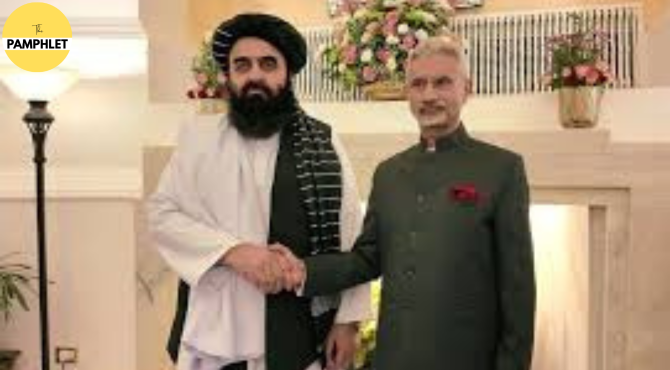
In a landmark diplomatic development, India has officially reopened its embassy in Kabul, Afghanistan, four years after shutting it down following the Taliban’s takeover in 2021. The announcement was made by External Affairs Minister S. Jaishankar during his meeting with Afghanistan’s acting Foreign Minister Amir Khan Muttaqi, who is on an official visit to India after receiving a travel exemption from the UN Security Council.
The move upgrades India’s limited technical mission—which had continued to manage humanitarian, medical, and trade assistance—into a full-fledged embassy, signaling a renewed phase of diplomatic engagement with Afghanistan under Taliban rule.
During the meeting, S Jaishankar said, “India remains committed to Afghanistan’s sovereignty, stability, and development priorities. Reopening our embassy is a step toward closer cooperation.”
Strategic and political significance
The decision represents a significant recalibration in India’s Afghanistan policy. The reopening underscores India’s pragmatic approach amid shifting regional geopolitical realities, particularly the deterioration of Kabul-Islamabad ties.
The visit of Amir Khan Muttaqi also marks the first high-level diplomatic contact between India and the Taliban government since 2021. Discussions are expected to focus on trade, connectivity, and the restoration of India-funded development projects, many of which were stalled after the Taliban’s return to power.
India has reaffirmed its support for counter-terrorism cooperation and the continuation of development assistance, emphasizing mutual interests in regional stability and curbing cross-border threats.
Regional context and geopolitical shift
By reopening its embassy, India joins a select group of countries—including China, Russia, Iran, and Turkey—that maintain diplomatic missions in Kabul. However, Russia remains the only country to have formally recognized the Taliban administration.
Analysts view India’s move as a strategic necessity rather than a policy reversal. As the Taliban seeks economic legitimacy through regional engagement, India’s presence ensures its strategic and security interests in Afghanistan remain safeguarded, especially in light of Pakistan’s diminishing influence in Kabul.
Rebuilding development ties
India has historically been one of Afghanistan’s largest regional development partners, having invested over $3 billion in infrastructure, education, and healthcare projects before 2021. The renewed diplomatic presence is expected to accelerate the restoration of these projects and ensure direct oversight of new initiatives.
By reopening its mission, India aims to reinforce its long-term commitment to Afghanistan’s economic recovery, particularly in sectors like infrastructure, minerals, and humanitarian aid.
India’s decision to reopen its embassy in Kabul marks a turning point in South Asian diplomacy, signaling a pragmatic shift toward engagement over isolation. While maintaining its stance of non-recognition of the Taliban, New Delhi’s move reflects a calculated strategy to preserve influence, boost economic cooperation, and contribute to Afghanistan’s stability in a rapidly evolving regional landscape.
The embassy’s reopening not only restores India’s diplomatic footprint in Afghanistan but also underscores a broader strategic objective—to shape regional stability through development, dialogue, and decisive diplomacy.

