
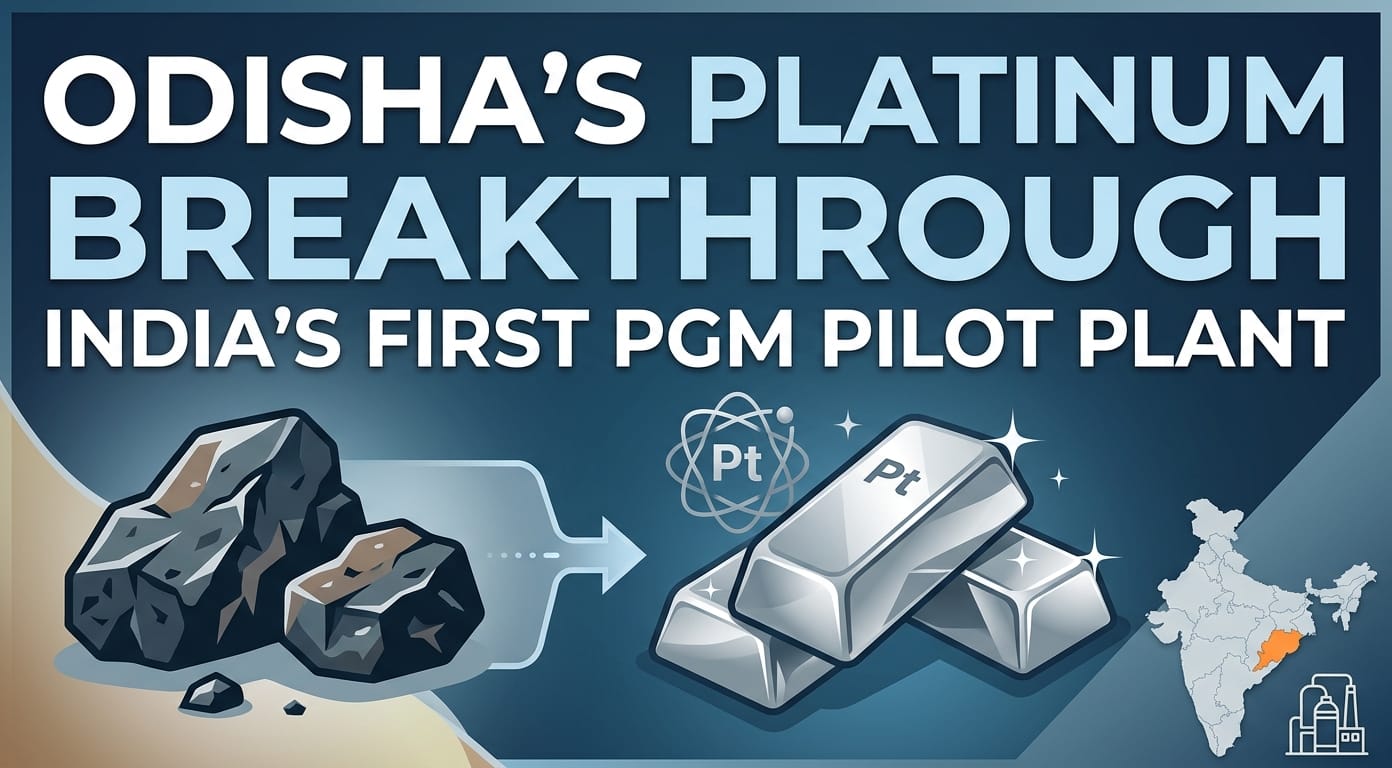
OMC’s Bhubaneswar facility, developed with IMMT and South Africa’s Mintek, is a trial run that could pave the way for commercial recovery of platinum group elements from chromite ore.
Odisha’s latest pilot plant is being seen as a breakthrough in India’s critical minerals strategy because it targets platinum group metals, or PGMs, from local chromite ore resources. The trial run was conducted at the Institute of Minerals and Materials Technology, Bhubaneswar, and is intended to test whether these metals can be recovered consistently and economically at scale.
The plant has been developed under a ₹10 crore, two-phase research and development programme led by Odisha Mining Corporation in collaboration with CSIR-IMMT and South Africa’s Mintek. The facility is designed as a one-tonne-per-hour pilot unit, which will be used to validate recovery rates, concentrate quality and operational feasibility before any move toward commercial expansion.
This development matters because platinum, palladium, rhodium, iridium, osmium and ruthenium are not just precious metals; they are also strategic inputs for a wide range of industries. They are used in catalytic converters, hydrogen fuel cells, electronics, medical devices, petrochemical processes, defence equipment and advanced manufacturing, making secure domestic access to them increasingly important.
India has long depended heavily on imports for these metals, which exposes industry to price volatility and supply-chain risks. The Odisha project could begin to change that by establishing an integrated beneficiation and smelting ecosystem inside the country, something that would be both technologically significant and economically useful if it proves viable beyond the pilot stage.
The location also gives the project a strong strategic edge. Odisha holds the bulk of India’s chromite reserves and is already the country’s main chromite producer, so the state offers a natural base for PGM recovery from ore bodies that were previously valued mainly for chromium.
According to reporting on the project, studies have indicated that Odisha’s chromite belt is rich in platinum and palladium, and the state accounts for a major share of India’s identified PGM resources. That makes the pilot plant more than a symbolic achievement; it is a practical attempt to turn geological advantage into industrial capability.
If the trial succeeds, the plant could create a new value chain in mineral processing, support downstream industries and strengthen India’s position in the global critical minerals race. For Odisha, it also reinforces the state’s role as a hub for strategic mineral innovation at a time when countries around the world are trying to secure supply chains for energy transition and high-tech manufacturing.

