
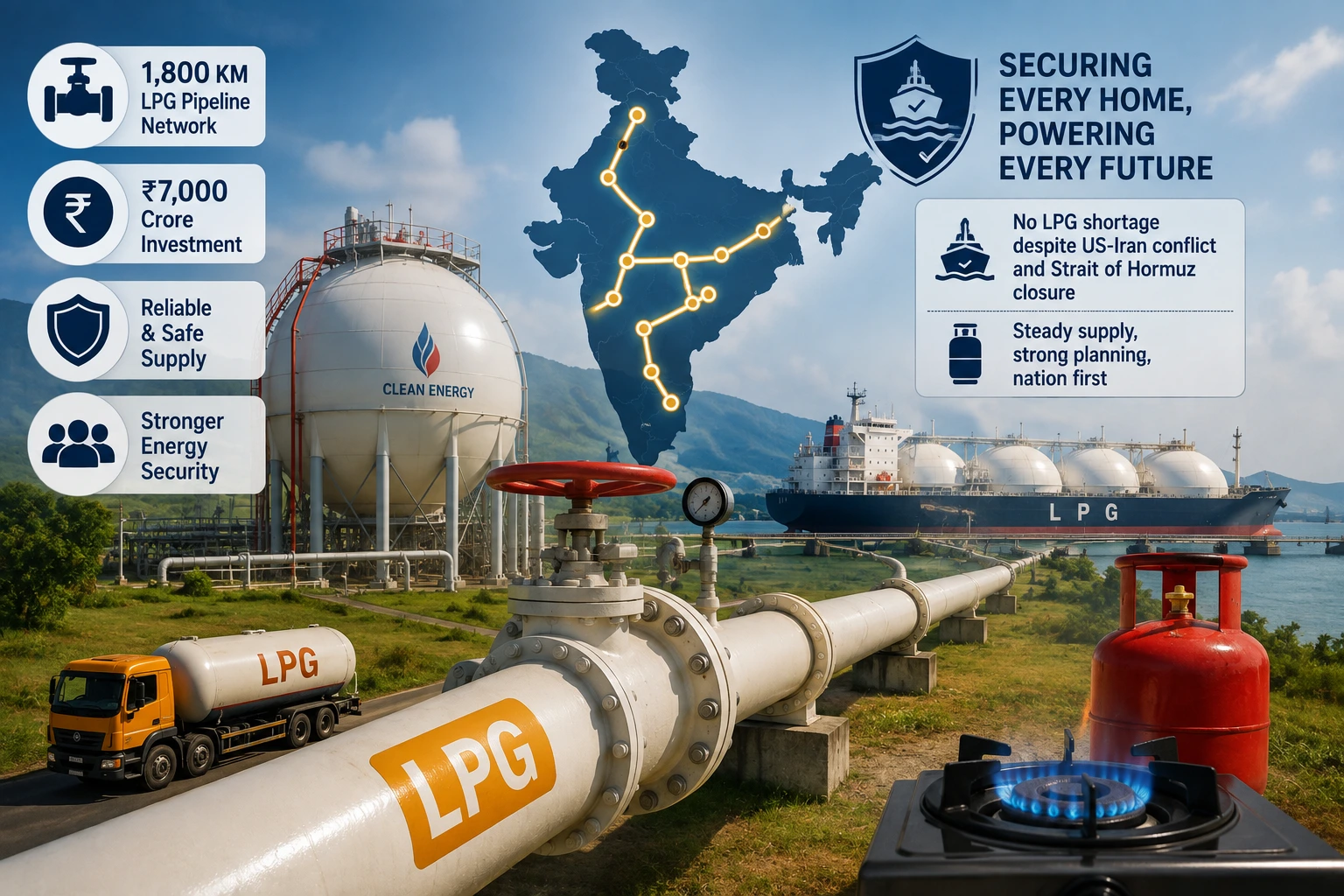
India is set to significantly strengthen its LPG distribution infrastructure after the Petroleum and Natural Gas Regulatory Board (PNGRB) approved around 1,800 km of new LPG pipelines involving an investment of nearly ₹7,000 crore. The projects will pass through six states, namely Telangana, Maharashtra, Uttar Pradesh, Uttarakhand, Karnataka, and Goa, and are expected to make LPG transportation faster, safer and more reliable.
The new network will reduce India’s dependence on road tankers for transporting LPG while improving connectivity among import terminals, refineries, bottling plants, and major consumption centres. The expansion is expected to take the country’s authorised common-carrier LPG pipeline network from roughly 7,700 km to nearly 9,500 km. Besides lowering logistics costs, pipelines can provide an operational buffer by storing LPG within the network, strengthening supply resilience during disruptions like the one we have seen in recent months due to the war in West Asia.
The investment assumes greater significance against this backdrop of the US-Iran conflict and the closure of the Strait of Hormuz, a critical route for India’s energy imports. India imports around 60% of its LPG requirement. Before the crisis in West Asia, nearly 90% of its imported LPG came through the Strait of Hormuz.
Despite the unprecedented disruption, India took a series of emergency measures to protect domestic consumers from any LPG shortage. The government directed refineries to maximise LPG production and channel their available propane and butane output towards domestic cooking-gas requirements. According to the Petroleum Ministry, domestic LPG production increased by 28% within days of the crisis measures. The government also diversified imports, increased supplies from alternative sources and closely monitored stocks and distribution.
The result was that India was able to maintain LPG availability across the country despite the disruption to its traditional supply routes. The government also warned consumers against panic buying and monitored hoarding, black marketing and diversion of cylinders. Two Indian LPG ships were also able to cross the Strait during the crisis.
India has subsequently accelerated efforts to diversify its LPG sources, with the US emerging as a major supplier as Gulf shipments were disrupted.
The ₹7,000-crore pipeline expansion therefore goes beyond an infrastructure project. It is part of a broader strategy to build a more resilient domestic fuel supply chain, reduce dependence on road transportation and ensure that geopolitical shocks do not translate into cooking-gas shortages for Indian households.

