
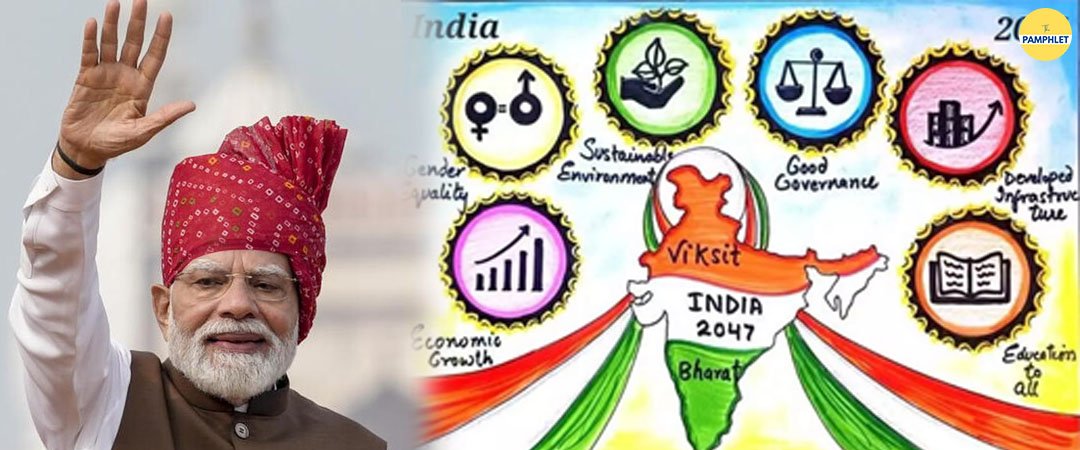
Standing at the ramparts of the Red Fort this Independence Day, Prime Minister Narendra Modi did not just deliver a speech—he laid out a ledger. Looking back at the past 12 years while outlining the roadmap to a developed India by 2047, or Viksit Bharat, the Prime Minister used numbers to describe a structural shift: from an economy heavily dependent on imports and basic safety nets to one seeking greater domestic manufacturing, technological capability and self-reliance.
The scale of that transition is visible across welfare, industry, digital infrastructure and strategic sectors. But whether these gains can translate into productive employment, higher incomes and durable prosperity for a young population will determine the success of the next phase.
Changing lives
At the heart of the government’s narrative are welfare measures that directly affect household life. The Prime Minister said 25 crore people had been lifted out of poverty over the past decade. He also highlighted the acceleration in delivery of basic amenities: the pace of providing tap-water connections has increased 15-fold, LPG connections six-fold, toilet construction four-fold and permanent housing three-fold compared with the earlier period.
Manufacturing and the Self-Reliance Push
The more consequential part of the transformation, however, lies in production. The government’s Aatmanirbhar Bharat agenda seeks to move India from being primarily a large consumer market towards becoming a manufacturing and export base.
The figures cited by Modi are striking: defence production has risen nearly four-fold, electronics manufacturing nearly seven-fold, railway coach production 21-fold and mobile-phone manufacturing 35-fold.
Defence offers an even clearer measure of the change. Defence production reached a record ₹1.78 lakh crore in FY 2025–26, compared with ₹43,746 crore in FY 2013–14. Defence exports rose to ₹38,424 crore from just ₹686 crore over the same period, and Indian defence products are now exported to more than 80 countries. The private sector contributed about ₹42,000 crore, or roughly 24%, of total defence production in FY 2025–26.
The self-reliance approach also extends to agriculture. To protect farmers from international fertiliser-price volatility, the government has kept domestic prices substantially below global levels. The Prime Minister cited urea costing around ₹3,000 a bag internationally but being supplied to farmers for about ₹300, while DAP priced at around ₹5,000 globally is supplied at ₹1,350.
In aerospace, the Made-in-India C-295 programme represents another attempt to develop domestic manufacturing capability in a sector historically dominated by imports.
From Chips to Code
India’s transformation is equally visible in the digital economy. Internet users have quadrupled, patent grants have increased four-fold and digital transactions have grown roughly 100-fold, according to figures cited by the Prime Minister. UPI has become a particularly visible manifestation of this change, extending digital payments from large businesses into small shops, street markets and everyday transactions.
The next frontier is semiconductor manufacturing. Modi highlighted three domestic semiconductor plants already in production and exporting chips, marking an initial foothold in a strategically critical industry. The government has approved 12 semiconductor projects, with further plants expected to come online in the coming years.
Solar Revolution
The same strategy is visible in energy. India’s solar capacity has risen from roughly 2 GW to 160 GW—an 80-fold increase. The PM Surya Ghar scheme has reached around 50 lakh households, bringing rooftop solar into millions of homes. City Gas Distribution has expanded from around 70 to 700 cities, while the railway network has achieved 100% electrification.
The railway figure is particularly significant: according to the Prime Minister, only about 30% of the network had been electrified during the first 90 years after electrification began in 1925; the remaining expansion to full electrification was achieved in roughly a decade.
The government is also looking beyond renewables. It has set a target of 100 GW of nuclear capacity by 2047, while announcing plans to begin five new nuclear reactors within the current decade.
The Road to 2047
The numbers point to substantial capacity creation, but they do not eliminate the challenges ahead. India must still generate millions of productive jobs, raise household incomes and improve the quality and accessibility of healthcare and education, particularly outside the largest urban centres.
The next phase will also require manufacturing to move beyond assembly towards design, research and high-value production. The foundations for that transition are being built: the Prime Minister cited more than 2.5 lakh registered startups, nearly 650 new universities added over the past 10–12 years and more than 10,000 Atal Tinkering Labs aimed at developing innovation among young people.
That makes Viksit Bharat 2047 less a declaration of completion than a deadline. Ultimately, the success of India’s transformation will not be measured by how many numbers can be cited from the Red Fort, but by what those numbers mean in the lives of ordinary Indians. The next two decades will determine whether the foundations laid over the past 12 years can support the developed India envisioned for 2047.

