
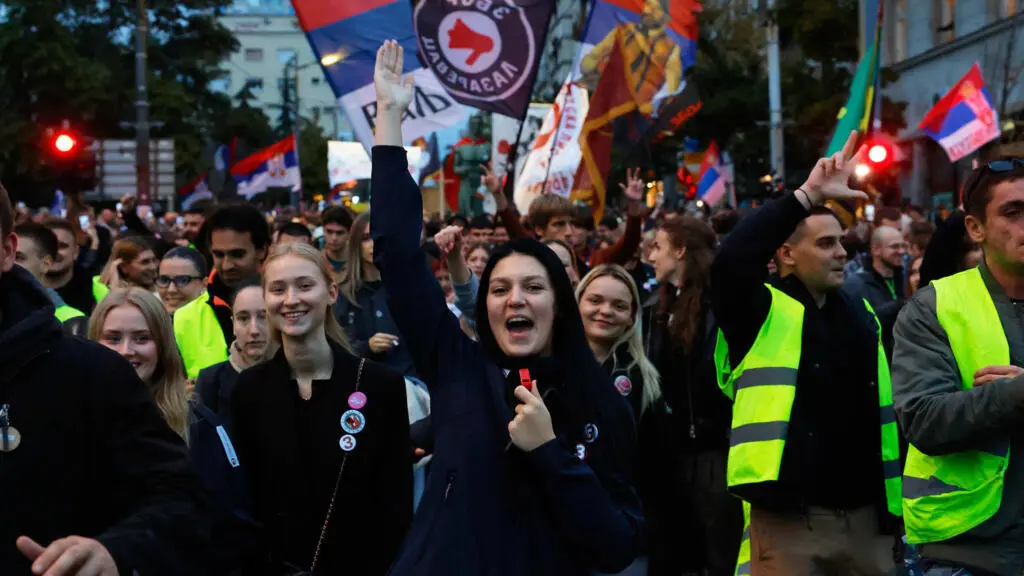
If Nepal and Bangladesh were held up as examples of how Gen-Z-led street protests could change governments, Serbia has now supplied the Indian opposition with another international case study.
Aleksandar Vučić, the Balkan country’s dominant political leader for more than a decade, has conceded defeat after a student-led movement swept the country. For opposition parties elsewhere, the temptation to draw parallels will be difficult to resist. Especially in India, where opposition was already salivating after the change of government in Nepal and Bangladesh.
But Serbia’s story also carries a lesson that extends beyond the spectacle of street demonstrations.
Vučić resigned as president on September 27, 2026, ahead of snap parliamentary elections, intending to return as prime minister if his party retained power. The decisive development came on October 25, when the student-backed Student List defeated his Serbian Progressive Party-led alliance. With almost all votes counted, the students’ candidates secured 52.7% of the vote and 139 seats in the 250-member parliament, while Vučić’s alliance won 97 seats. Vučić acknowledged the defeat.
The movement began after a railway station canopy collapsed in Novi Sad in November 2024, killing 16 people. What started as demands for accountability and transparency gradually developed into a nationwide mobilisation against alleged corruption, political interference and the weakening of institutions. Students were joined by sections of civil society, turning a tragedy into a sustained political challenge. Vučić and his party have denied accusations of corruption and repression.
For India’s opposition, which has frequently invoked political upheavals abroad while criticising the Modi government, Serbia presents an intriguing comparison. Yet the central feature of the Serbian story was not simply that students took to the streets. It was that a protest movement translated public anger into an electoral platform and secured a parliamentary majority. Is India’s opposition willing to go to the ballot to challenge PM Narendra Modi? We don’t think so.
Demonstrations can command attention, disrupt routine politics and expose public grievances. But they do not automatically establish a popular mandate to govern. Serbia’s students still face the formidable task of turning their campaign into a coherent administration, with questions about leadership, policy and foreign relations unresolved.
The Indian opposition may find inspiration in Nepal, Bangladesh or Serbia, but foreign political upheavals cannot simply be transplanted into India’s vastly different democratic and electoral landscape.
Ultimately, the Serbian result demonstrates that public dissatisfaction can become decisive when it finds an organised political expression and wins votes. For any opposition seeking to challenge an incumbent, the question is not merely how to mobilise crowds, but how to persuade citizens across the country to support an alternative at the ballot box.
Street protests may create momentum. Elections determine whether that momentum can be converted into power.

