
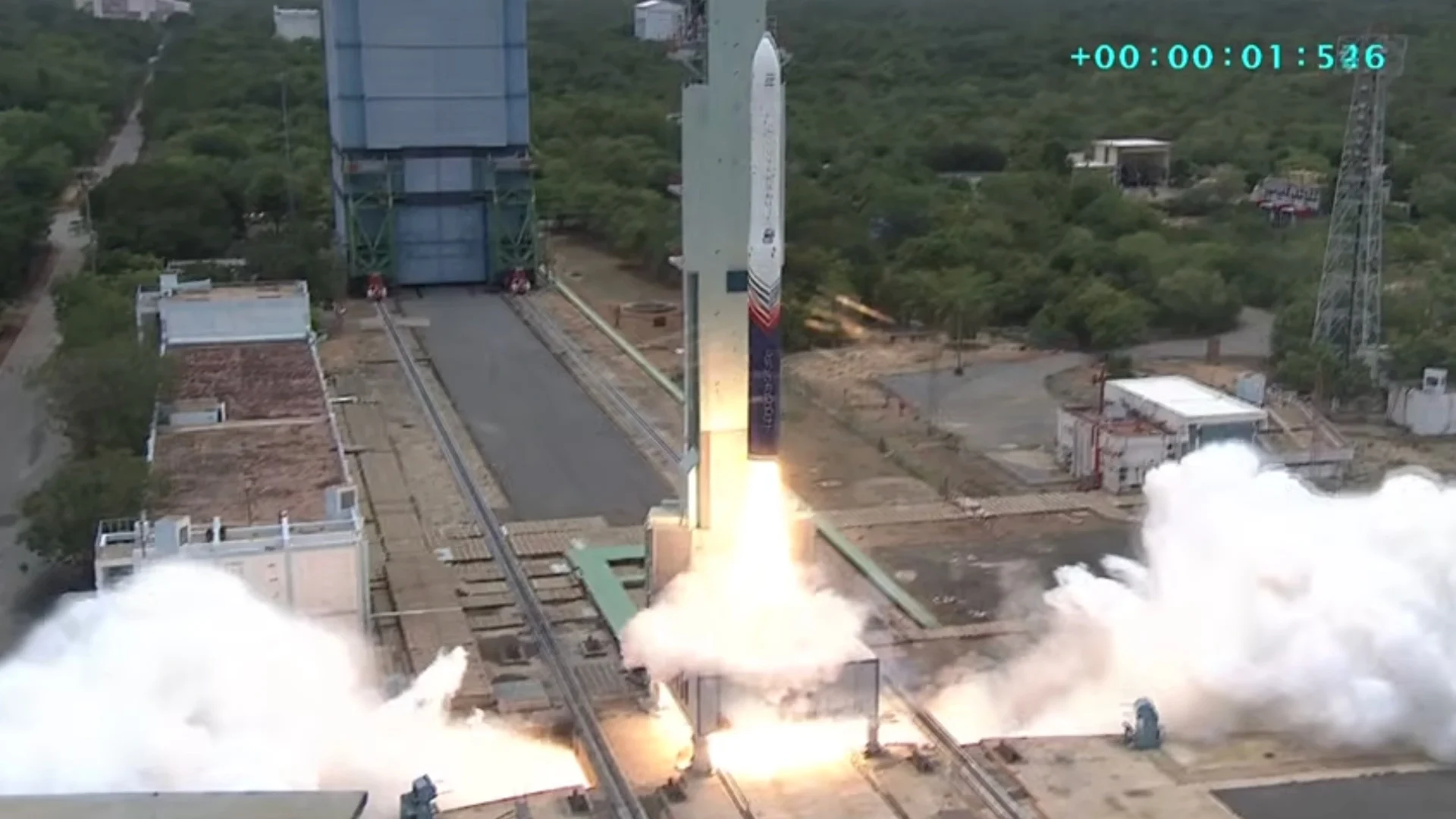
On July 18, India’s space journey entered a historic new chapter with the successful launch of Vikram-1, India’s first privately developed orbital launch vehicle. The mission, named Mission Aagaman, meaning arrival, marks the entry of India’s private sector into the elite club of companies capable of placing satellites into orbit. Till now only US and Chinese companies had this capability.
It is a milestone that reflects how India’s space ecosystem has evolved from being driven almost entirely by the Indian Space Research Organisation (ISRO) to one where private innovation is taking centre stage. It further shows how in India, public and private companies are working together.
Developed by Hyderabad-based Skyroot Aerospace, Vikram-1 is named after Dr. Vikram Sarabhai, the father of India’s space program. While ISRO has spent decades building India’s reputation as a reliable space power, Mission Aagaman demonstrates that Indian private companies are now ready to complement and expand that legacy.
The launch is significant not just because a rocket reached orbit, but because it shows that years of investment in private space technology is bearing results. Until recently, Indian private firms largely served as suppliers to ISRO. Policy reforms over the past few years, including the creation of IN-SPACe as a regulatory and promotional body and the opening of the space sector to private participation, have transformed the landscape. Notably, the Indian government has created the Indian National Space Promotion and Authorisation Centre (IN-SPACe), as a single-window, independent, nodal agency which functions as an autonomous agency in Department of Space.
The Vikram-1 rocket uses advanced carbon composite structures, 3D-printed components and modern propulsion systems, showcasing the technological maturity achieved by Indian startups. It is designed to place small satellites into Low Earth Orbit, a market witnessing rapid global growth due to increasing demand for Earth observation, communication, defence and scientific missions.
Mission Aagaman also signals India’s ambition to become a major player in the global commercial launch market. As the number of satellites being launched every year continues to rise, there is growing demand for cost-effective, reliable launch services. Indian private launch providers can leverage the country’s engineering talent, competitive costs and ISRO’s decades of expertise to compete internationally.
The success of Vikram-1 is expected to encourage greater private investment in the Indian space sector. Venture capital firms, manufacturing companies and technology startups now have proof that India possesses the capability to build globally competitive launch systems. It is also likely to generate high-skilled employment across aerospace design, electronics, propulsion and advanced manufacturing.
Mission Aagaman represents the beginning of a new era where government and private industry work together to expand India’s presence in space, the new frontier. Just as India’s IT and telecom sectors flourished after liberalisation, the space sector now appears poised for similar growth.
With Vikram-1’s successful launch, Mission Aagaman has lived up to its name. It is not merely the arrival of a new rocket, but the arrival of Indian private enterprise as a serious force in orbital spaceflight, opening the door to a future where India becomes a global hub for commercial space launches.

