
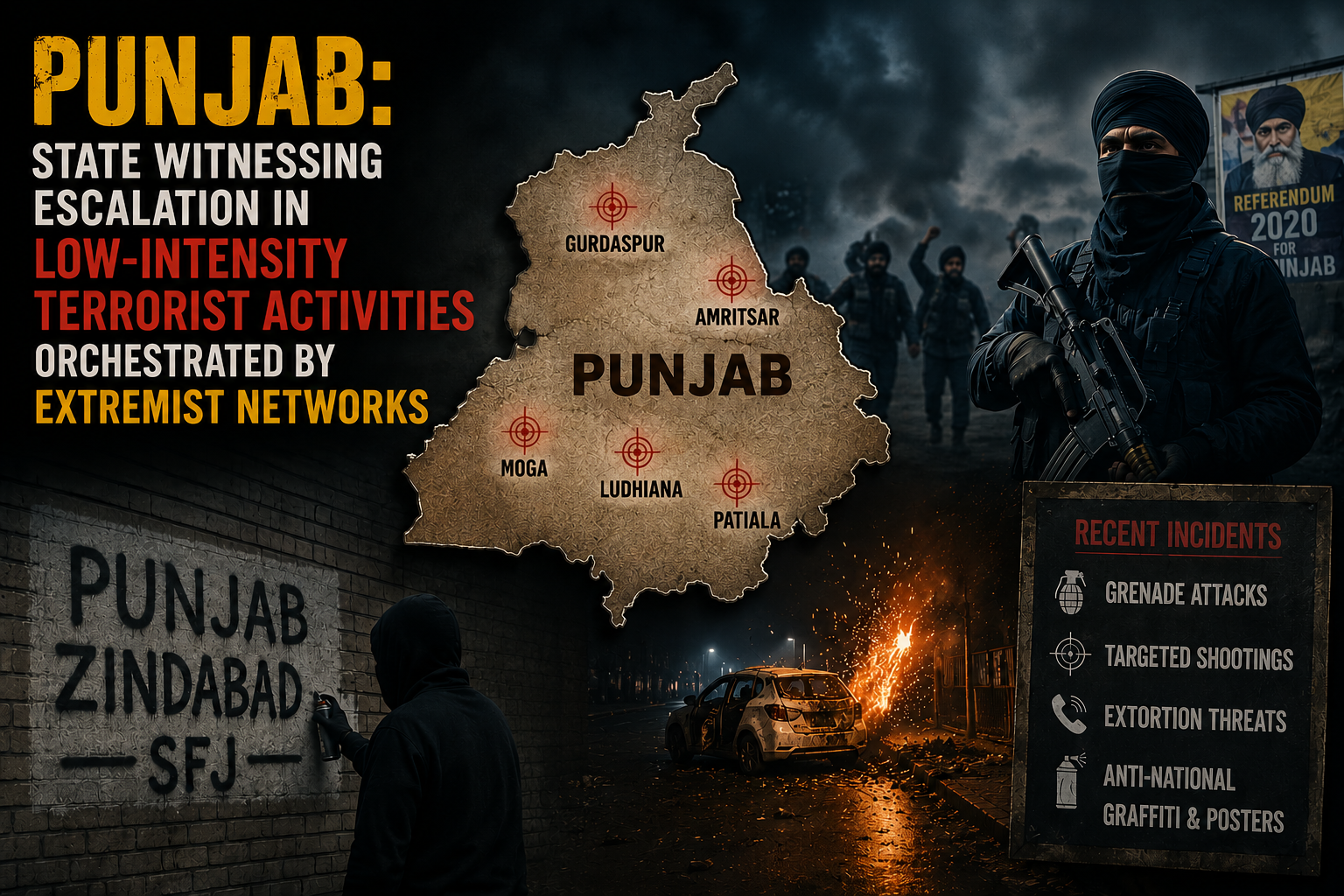
Punjab is experiencing an escalation in low-intensity terrorist activities orchestrated by Khalistani extremist networks, often in tandem with foreign-based gangsters and Pakistan-backed handlers. According to partial data compiled by the Institute for Conflict Management (ICM), since the start of 2026, the state has recorded at least eight low-intensity blasts, targeting critical infrastructure such as railway tracks, police stations, political offices, military-linked sites and, most recently, escalating to medical infrastructure.
On June 22, 2026, two unidentified youths hurled a petrol bomb at a clinic owned by Dr. Tarsem Garg on Mela Ram Road in Bathinda District. The clinic is situated directly opposite a recently inaugurated Rashtriya Swayamsevak Sangh (RSS) office. No injuries were reported in the attack. Dr Garg’s family had recently shifted political allegiance from the Aam Aadmi Party (AAP) to the Bharatiya Janata Party (BJP). His wife, Dr. Rajni Jindal, had contested the recent municipal council elections as a BJP candidate.
CCTV footage from the scene showed two persons arriving at the clinic, one with his face covered, before the petrol bomb was thrown into the premises. Nearly two hours after the attack, Dr. Rajni Jindal received a WhatsApp call from a foreign number. The caller allegedly identified himself as Pakistan-based terrorist Shahzad Bhatti and later sent two messages, including one bearing his name and a casual “Hi”. In this case, as of June 28, 2026, Police have arrested three accused identified as Nikhil Kumar, Gurwinder Singh, and Sandeep Singh.
According to Police, the trio had been promised INR 3,000 each to carry out the attack. Preliminary investigations indicated that Sandeep Singh was in contact with a criminal network. Police have also booked Pakistan-based terrorist Shahzad Bhatti. Tehreek-e-Taliban Hindustan (TTH), a proxy network backed by Pakistan’s ISI, claimed responsibility for the attack, which is being verified.
The first incident of June occurred on June 2, 2026, when a low-intensity grenade was hurled at Multani Hospital, a private healthcare facility near the bus stand in Kalanaur town, Gurdaspur District. The explosion damaged property, shattering window panes and the glass door of the emergency ward, but caused no casualties. Following the attack, Police arrested Dharmendra alias Dharminder alias Tindy, who is linked to foreign-based gangster Jaswinder Singh alias Manu Agwan alias Baghi. Agwan, a Greece-based operative of Babbar Khalsa International (BKI) and a key figure in ISI-backed networks, later claimed responsibility for the attack through social media.
These two attacks signal a possible shift toward softer civilian targets, including the healthcare infrastructure; earlier blasts focused on security and strategic assets. Key prior incidents include:
May 5, 2026: Low-intensity Improvised Explosive Device (IED) blasts near the Border Security Force (BSF) Punjab Frontier Headquarters in Jalandhar District. One BSF trooper suffered splinter injuries. A delivery person (Gurpreet) was also reported injured in some accounts, though there were no fatalities. The Khalistan Liberation Army (KLA) claimed responsibility for the attack, while the Punjab Police arrested at least two suspects, Umar Deen and Anil. Investigations point to possible ISI-linked networks.
May 5, 2026, a low-intensity explosion near the Army cantonment boundary wall (suspected IED or thrown device) was reported in Amritsar District. No casualties were reported.
April 27, 2026: A powerful explosion occurred on the Dedicated Freight Corridor (DFC) railway track near Bothonia village, between Shambhu and Rajpura in Patiala District, killing the suspected bomber, Jagroop Singh, while he was attempting to plant an Improvised Explosive Device (IED). The incident marked the second attack on the DFC in the first four months of 2026. In the immediate aftermath, Punjab Police arrested four highly radicalised operatives – Pardeep Singh Khalsa, Kulwinder Singh alias Bagga, Satnam Singh alias Satta, and Gurpreet Singh alias Gopi – linked to a Pakistan-based, ISI-backed pro-Khalistan terrorist module. Security forces recovered pistols, hand grenades, Royal Demolition Explosive (RDX), IED components, a Rocket-Propelled Grenade (RPG) launcher, communication devices, and other incriminating materials. Investigations revealed that the module maintained operational links with handlers based in Pakistan, Malaysia, and the United States. The investigation expanded through a series of subsequent arrests that significantly disrupted Khalistan Zindabad Force (KZF)-linked networks. On June 17, 2026, the National Investigation Agency (NIA) arrested Gurjinder Singh alias Baba Beant in connection with the April 27 blast. Two days later, on June 19, Punjab Police secured the deportation of Gurwinder Singh and Manjeet Singh from Malaysia, both accused of involvement in the January 23 and April 27 IED attempts targeting the DFC. According to NIA, a total of seven accused has been arrested so far in the broader case (RC-21/2025/NIA/DLI), highlighting the role of cross-border terrorism financing, logistics, and operational support from foreign-based handlers.
April 1, 2026, a low-intensity explosion occurred outside the Punjab BJP headquarters (HQ) in Chandigarh. The banned BKI claimed responsibility for the attack. Five people were arrested in this case.
March 30, 2026, A low-intensity blast occurred at around 1:30 am outside Bhindi Saidan Police Station in Amritsar District. KLA claimed responsibility for the attack. No fatality was reported and six accused were subsequently arrested.
January 23, 2026, DFC blast near Sirhind in Fatehgarh Sahib. One locomotive pilot was injured, though no fatality was reported. Investigations determined that KZF was involved in this case.
Khalistani outfits such as BKI, KZF, KLA and TTH, the last reportedly linked to Pakistan-based Shahzad Bhatti, are increasingly driving terrorist activities in Punjab, often acting as proxy groups with support from Pakistan’s ISI. These groups recruit local youth to carry out attacks and destabilise the security situation. While BKI and KZF have long been designated as proscribed organisations with a well-established history of terrorism in Punjab, KLA is often described as a separatist group associated with the Khalistan movement that was active during the 1980s and 1990s in Punjab. It is a faction group of the Khalistan Liberation Force (KLF). In recent reports, Indian security agencies have identified KLA as one of the most organised, well-trained and heavily armed proxy groups to emerge in recent years, under the broader Khalistani terrorist umbrella. At present, it remains uncertain whether KLA has been formally reactivated or whether the name is being used by loosely connected or unrelated individuals/groups.
TTH represents a new trend in Punjab’s evolving terrorism landscape. The group has claimed several violent incidents in 2026, including the killing of Punjab Police Assistant Sub-Inspector (ASI) Joga Singh in the Majitha area of Amritsar District on May 24, 2026; and the February 22, , killing of two Punjab Police personnel – ASI Gurnam Singh and Home Guard Ashok Kumar – at the Adhian Police Outpost near the India-Pakistan border in Gurdaspur District.
Security assessments indicate that Khalistani networks, backed by Pakistan-based handlers and transnational terrorist elements, have cultivated such proxy formations to sustain and expand terrorist operations in India.
The shift to softer targets, alongside symbolic ones (RSS office, BJP HQ, security forces) suggests a strategy of “persistent low-level pressure” to normalise disruption and force diversion of resources. Limited casualties reduce scrutiny while building operational confidence and propaganda value.
Meanwhile, in a significant joint operation on June 5, 2026, the Uttar Pradesh Anti-Terrorism Squad (ATS), along with the Punjab Special Task Force (STF), arrested Mohammad Mohtsim alias Mohtasim from Bachiti village in the Deoband area of the Saharanpur District of Uttar Pradesh. The arrest is linked to the 2021 Mohali RPG attack on the Punjab Police Intelligence Headquarters in Sahibzada Ajit Singh Nagar (Mohali). According to officials, Mohtsim is a suspected associate of the Pakistan-backed terrorist organization, Jaish-e-Mohammed (JeM). He was under investigation for allegedly facilitating communication between local operatives and Pakistan-based handlers via WhatsApp, sharing OTPs and other technical details. Security agencies recovered electronic devices and suspicious materials from the accused, which are being examined. The case highlights the hybrid terror strategy involving sporadic attacks combined with efforts to radicalise and mobilise local support networks.
These networks recruit disaffected or financially vulnerable local youth (including minors) for execution of local operations, while foreign handlers provide direction and funding, and make claims of responsibility via social media. Convergence with organised crime is critical: narcotics smuggling, hawala financing, and arms trafficking sustain operations. A defining feature of the current threat in Punjab is the deep convergence between Khalistani terrorist modules, foreign-based gangsters, and organised criminal rackets. These hybrid networks rely heavily on social media for recruitment, arms procurement, coordination, and claims of responsibility, with hawala channels funnelling proceeds from drug trafficking to finance terrorist activities. Moreover, according to a report in early June, 54 minors had been arrested in the preceding 14 months across Punjab’s border districts (Amritsar, Tarn Taran, Ferozepur, and Fazilka), with 32 linked to drug trafficking and 22 to Arms Act violations, highlighting the increasing involvement of juveniles in cross-border smuggling.
The Punjab Police and central agencies have shown proactive intensity. In a series of swift actions, authorities dismantled multiple cross-border networks. On June 25, 2026, seven persons, including an Afghan national and a juvenile, were arrested in Amritsar for their role in a cross-border arms, narcotics, and hawala network, with recoveries of 10 sophisticated weapons [including two Submachine Guns (SMGs)], 5.048 kilograms of heroin, and INR 3.038 million in hawala money. On June 8, four persons including an Afghan national were arrested along with eight sophisticated pistols and seven cartridges. On June 5, 2026, four accused including Afghan national Baz Mohammad and two juveniles were nabbed with 1.035 kilograms of heroin, five pistols (including Glocks), and INR 500,000 in drug money. In June 2026, Punjab Police carried out a three-day statewide crackdown targeting hawala operators. According to the Director General of Police (DGP) Gaurav Yadav, the operation led to the arrest of 73 persons involved in hawala networks and the recovery of approximately INR 100 million in illicit funds. The action marks a broader expansion of the state’s anti-drug and anti-financial crime campaign, with hawala networks identified as a key focus area.
Punjab is locked in a protracted shadow war where transnational Khalistani networks and Pakistan-linked handlers have fused into a dangerous hybrid terrorist-criminal ecosystem. The ongoing low-intensity campaign deliberately limits casualties while intentionally expanding targets and enhancing operational sustainability. Sustained domestic crackdowns, coupled with decisive international cooperation will be critical to dismantling these networks, severing their funding channels, and averting a dangerous escalation that could destabilise the region.
Punjab’s stability is not merely a state-level concern but a litmus test for India’s capacity to counter hybrid transnational terrorism in the digital age. Vigilance, resilience, and coordinated action across multiple fronts remain essential to ensure this low-intensity shadow war does not cast a longer and darker shadow over the state.
Author: Ruchika Kakkar – Research Assistant, Institute for Conflict Management

