
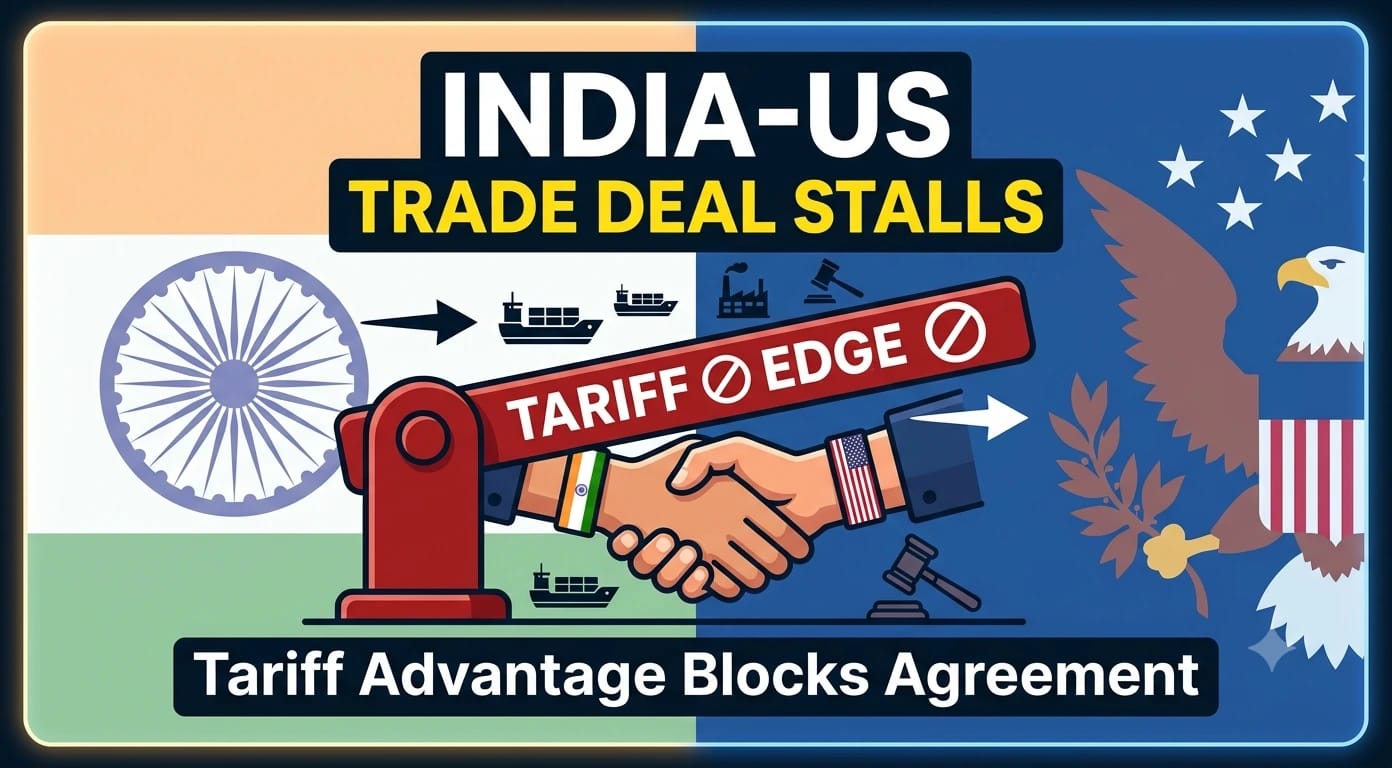
The trade talks between India and the US are moving forward, but the final step is still blocked by one simple issue: Tariff advantage. Commerce Minister Piyush Goyal has said that the deal can enter into force only when the tariff structure gives a clear competitive edge over other manufacturing countries and nearby rivals.
In direct terms, the idea is not just to sign any agreement, but to make sure the arrangement is fair enough to help local exporters stand stronger in the global market. That is why the talks may look nearly complete on paper, yet still remain stuck in practice.
Recent discussions with United States Trade Representative Jamieson Greer added new momentum to the process. The two sides reviewed the main parts of the proposed agreement, including market access, digital trade, supply-chain strength, fewer non-tariff barriers, and cooperation in important sectors.
Officials on both sides have described the talks as advanced, and there is a shared feeling that most of the framework is already in place. Even so, the final form of the deal still depends on how the tariff question is solved.
The central message from Goyal is quite clear: a trade deal should not begin unless the tariff terms protect the competitive position of local businesses. He pointed to countries such as Vietnam, Thailand, the Philippines, China, Malaysia, Bangladesh, Sri Lanka, and others in the same cost zone, saying the arrangement must compare well against them.
In simple language, the concern is that if the duty structure is not favourable enough, the deal may look good in name but weak in real effect. That is why the minister has stressed comparative advantage again and again.
A big reason for the delay is the changing legal and tariff situation on the American side. The earlier understanding reached in February was built around a tariff framework that later faced legal complications after a United States Supreme Court ruling. After that, the temporary tariff environment changed again, which forced both sides to revisit the design of the agreement. The result is a kind of pause in the final stretch, where both parties seem close, but must still agree on a legally valid and commercially useful tariff structure.
There is also a deadline factor. The temporary 10% tariff arrangement in the United States is set to expire on July 24, which adds pressure to complete the process soon. This makes the current round of talks more urgent than before. The two sides are trying to avoid a situation where the deal is announced without the right tariff balance, because that would weaken the purpose of the entire negotiation. In this sense, the talks are not just about speed, but about getting the numbers and rules right.
Another important point is that both sides seem willing to continue. The language coming out of the meetings has been positive, with references to substantial progress and a balanced, commercially meaningful agreement. That means the gap is no longer about whether a deal is possible, but about how it should be structured. The remaining gap is narrow, yet it matters a lot because even a small difference in tariff treatment can change the advantage between competing exporters.
This is a negotiation about fairness, timing, and benefit. A trade pact may sound like a formal document, but its real value depends on whether it helps producers, sellers, and consumers in actual business life. That is why the current deadlock should be seen not as failure, but as a careful attempt to avoid a weak arrangement. The final outcome will likely depend on whether both sides can turn this near-complete framework into a deal that works in real markets, not just in headlines.
The larger picture is simple. The talks are close, the political will appears present, and the technical work has advanced well, but the final move depends on tariff clarity. A strong agreement will not be judged by how quickly it is signed, but by how well it protects competitive balance and supports trade on fair terms. That is the real test now, and the coming days may decide whether this long discussion finally becomes a working deal.

