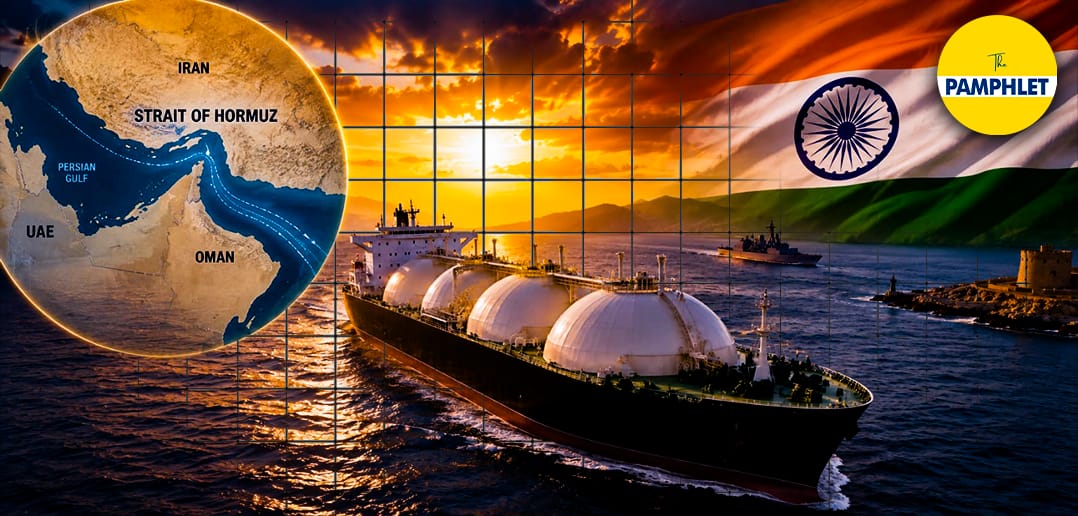
A quiet but significant moment unfolded in the Persian Gulf as the liquefied natural gas tanker Disha sailed through the Strait of Hormuz, marking the first time an Indian-flagged vessel has exited the region in more than three months.
This movement came shortly after President Donald Trump announced a provisional peace agreement between the United States and Iran, one that promises to remove the US naval blockade and reopen the strategically vital waterway. The tanker, carrying over 62,000 metric tonnes of LNG loaded at Qatar’s Ras Laffan facility in early March, had been stuck west of the strait amid heightened tensions and security concerns.
Now en route to Petronet LNG’s Dahej terminal in Gujarat, the vessel is expected to arrive by June 18, bringing a sense of relief to energy importers who have been watching the situation closely.
The Strait of Hormuz is one of the world’s most critical shipping chokepoints, through which roughly one-fifth of global oil supply and significant volumes of liquefied natural gas pass daily.
Its closure since late February, following US and Israeli strikes in West Asia, disrupted shipping routes and left nearly 600 vessels stranded in the Persian Gulf. Trump’s announcement on Truth Social stated that the agreement is complete and will be formally signed on June 19 in Geneva, Switzerland, with the strait reopening “within days.”
He authorized a toll-free opening and immediate removal of the naval blockade, urging ships worldwide to “start your engines” and let oil flow again. However, details of the deal remain unclear, and shipowners, crews, and traders have responded with caution, awaiting more information on security conditions before rushing to resume normal operations.
The Disha’s passage is seen as a test of the new reality, a cautious but hopeful step toward restoring normal shipping flows. While the agreement includes an immediate and permanent suspension of military operations on all fronts, including in Lebanon, negotiations on broader issues such as Iran’s nuclear programme and sanctions relief will continue over the coming 60 days.
Port operations across the country remain normal with no congestion reported, according to shipping ministry officials. The successful transit of the Disha offers a tangible signal that the blockade is easing, even as the broader geopolitical situation remains uncertain. For import-dependent regions, this movement represents more than just a single ship—it is a reminder how quickly global energy markets can shift with diplomatic breakthroughs.
The story of the Disha is also a story of patience and resilience. For over three months, the tanker waited in limbo, its cargo of clean energy unable to reach its destination. Now, as it moves through the strait toward the Gulf of Oman, it carries not just LNG but also the hope of stabilized trade routes and reduced energy prices.
The peace deal between Washington and Tehran, though still provisional, has already begun to change the rhythm of shipping in the region. While hundreds of empty vessels wait on the other side of the strait and thousands more remain inside the Gulf, the Disha’s journey shows that movement is possible again. It is a small but meaningful step toward restoring the flow of energy that powers homes, industries, and economies across the world.
As the world watches, the question remains whether this cautious reopening will lead to full normalization or if security concerns will continue to slow the pace of recovery. What is clear, however, is that the Disha’s passage has already shifted expectations. For those dependent on Gulf energy supplies, the message is simple: the blockade is lifting, and the engines of trade are starting to turn again.