
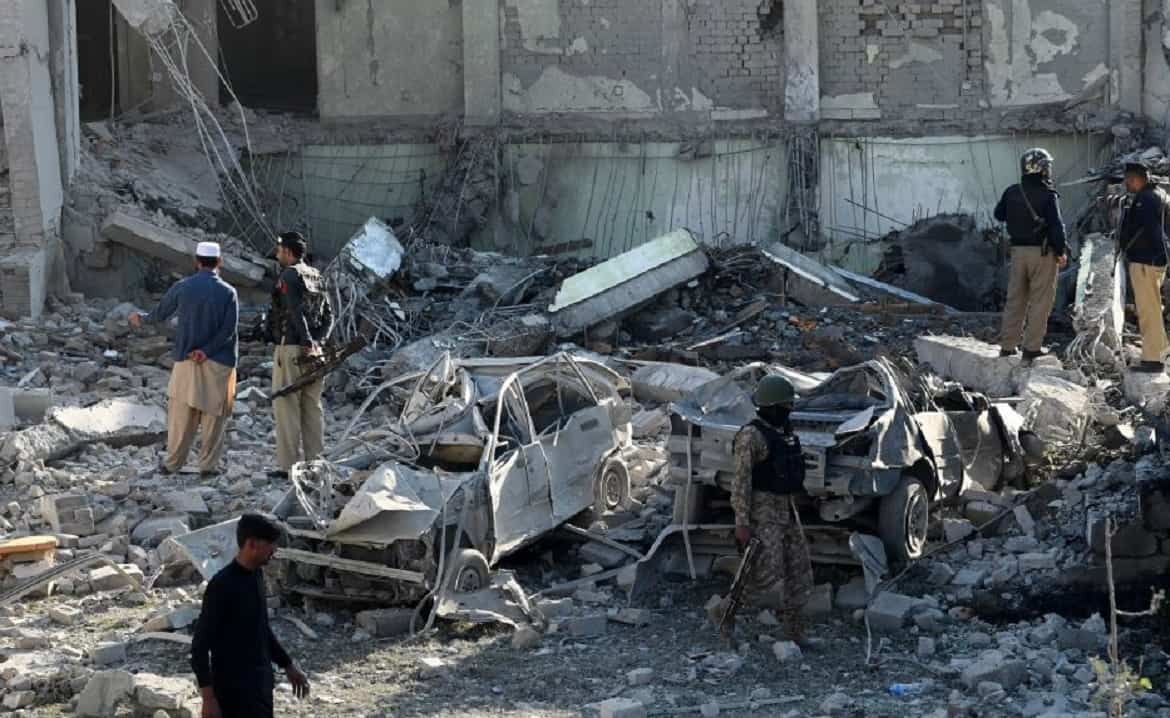
On June 11, 2026, a Government Middle School was destroyed in an explosion caused by a device planted by unidentified persons in the Sheri Khel area under the Shahbaz Khel Police Station in the Lakki Marwat District of Khyber Pakhtunkhwa (KP), Pakistan. Though no causalities were reported, the blast caused extensive damage to the building, rendering the educational facility unusable.
On June 11, 2026, a Government High School was destroyed after unidentified persons reportedly planted explosives in the vacant building, causing a powerful blast that levelled the structure in the Mamandkhel area of Bannu District.
On June 9, 2026, unidentified persons targeted the Janan Kot Government Girls’ High School with explosives, in the Karki Kot area of Wana in South Waziristan District. Police said the explosives were placed near the main gate and boundary wall, and the blast completely destroyed the building. The school was closed at the time of the explosion, so no casualties were reported.
According to partial data compiled by the South Asia Terrorism Portal (SATP), Khyber Pakhtunkhwa in Pakistan has recorded at least 11 incidents of attacks on educational institutes, in which 10 terrorists were killed and three civilians injured, in the first five months and 14 days of 2026 (Data updated till June 14, 2026).
During the same period of the preceding year, there was only one such incident of attack on an educational institution, in which three school children were injured. The data indicates a definite increase in the level of terrorist violence targeting educational institutions. The whole of 2025 recorded 11 incidents of such attacks, in which three persons were injured.
Attacks in Educational Institute in Khyber Pakhtunkhwa: 2006-2026*
| Year | No. of Incidents | Killed | Injured |
| 2006 | 1 | 0 | 0 |
| 2007 | 15 | 0 | 0 |
| 2008 | 54 | 52 | 34 |
| 2009 | 66 | 14 | 18 |
| 2010 | 85 | 5 | 9 |
| 2011 | 101 | 10 | 22 |
| 2012 | 98 | 15 | 12 |
| 2013 | 32 | 10 | 11 |
| 2014 | 19 | 159 | 5 |
| 2015 | 14 | 3 | 4 |
| 2016 | 10 | 26 | 36 |
| 2017 | 6 | 13 | 37 |
| 2018 | 19 | 0 | 7 |
| 2019 | 0 | 0 | 0 |
| 2020 | 1 | 2 | 0 |
| 2021 | 2 | 0 | 4 |
| 2022 | 2 | 2 | 3 |
| 2023 | 0 | 0 | 0 |
| 2024 | 10 | 0 | 0 |
| 2025 | 11 | 0 | 3 |
| 2026 | 11 | 10 | 3 |
| TOTAL | 557 | 321 | 208 |
Source: SATP, * Data till June 14, 2026.
Since 2006, at least 557 attacks targeting educational institutions have been recorded, resulting in 321 fatalities and 208 persons injured. [Since media access is heavily restricted in the most disturbed areas of KP, and there is only fitful release of information by Government agencies, the actual figures could be much higher.]
The first documented attack on an educational institution occurred on December 25, 2006, when a bomb explosion damaged a girls’ school in the Noor Ali Kalay area of Darra Adamkhel tehsil (revenue unit) in Kohat District. The blast, which took place at approximately 12:45 am, completely destroyed three rooms of the school building. Prior to the attack, extremists had reportedly circulated threatening letters to several middle and high schools, warning school authorities to stop girls from studying beyond Class IV or face the destruction of school facilities and the killing of school principals.
The wave of coordinated militant attacks on educational institutions in KP began in early 2007, particularly in the Swat Valley and adjoining tribal regions. The Swat chapter of the TTP, commonly known as the Swat Taliban, then led by Maulana Fazlullah aka Fazal Hayat aka Mullah Radio, imposed severe restrictions on girls’ education and systematically targeted schools, portraying them as symbols of state authority and influence.
Although the TTP frequently justified such attacks as retaliation for military operations in the tribal areas, the campaign was rooted in a broader ideological objective. Reflecting this stance, TTP Bajaur spokesperson Maulvi Omar warned on February 19, 2009, “We would take action and destroy all the buildings of educational institutions if Security Forces continued their operation against our fighters.”
Beyond these stated justifications, however, the systematic targeting of schools formed a central component of the TTP’s strategy to impose its extremist ideology, curtail access to modern education, particularly for girls, and consolidate its influence in areas under its control.
In one of the most reprehensible and premeditated acts of terrorism targeting education advocates, the Swat chapter of TTP attacked 14-year-old Malala Yousufzai, on October 9, 2012. She was shot while returning home from school in Mingora, the headquarters of Swat District.
The TTP subsequently claimed responsibility for the attack. Yousufzai subsequently emerged as an international children’s rights activist and was awarded Pakistan’s National Peace Prize on December 19, 2011, in recognition of her campaign against the TTP-imposed ban on girls’ education in Swat in 2009.
She is the youngest Nobel Prize laureate in history, receiving the Peace Prize in 2014 at age 17. She also gained prominence through her contributions to the Urdu-language online diary of the British Broadcasting Corporation (BBC), where she documented the impact of militant restrictions on girls’ education and life under Taliban rule in the region.
The deadliest attack on an educational institution in Pakistan’s history occurred on December 16, 2014, when a seven-member TTP suicide squad stormed the Army Public School (APS) in Peshawar, the capital of KP. In one of the most horrific terrorist atrocities the country has witnessed, at least 135 students, 10 school staff members – including the principal – and three soldiers were killed.
A further 121 people, including 118 students and three staff members, were injured in the assault. The attack began at approximately 10:00 a.m. (PST) and continued for more than eight hours before Security Forces (SFs) successfully eliminated all seven attackers. During the rescue and clearance operation, nine personnel of the Pakistan Army’s Special Services Group (SSG), including two officers, were also injured. The massacre marked a watershed moment in Pakistan’s counterterrorism campaign, drawing widespread national and international condemnation and underscoring the devastating impact of militant violence on the country’s education sector.
In the aftermath of the APS massacre, the Government of Pakistan unveiled a series of measures aimed at strengthening the country’s counterterrorism framework. These included lifting the moratorium on the death penalty in terrorism-related cases and advancing the implementation of the National Internal Security Policy (NISP), among other initiatives. In January 2015, the Government also approved the 20-point National Action Plan (NAP), designed to “root out terrorism,” and released a list of approximately 5,400 suspected terrorists to facilitate a nationwide crackdown on sympathizers, financiers and facilitators of proscribed terrorist organisations.
Following the removal of the moratorium on the death penalty, at least 24 convicted prisoners were executed in terrorism-related cases. The Government also intensified counterterrorism operations in the tribal border regions. These efforts were built on the already ongoing military offensive, Operation Zarb-e-Azb (“sharp and cutting”), which was launched in North Waziristan on June 15, 2014, several months before the APS attack. Together, these measures marked a significant escalation in Pakistan’s campaign against Islamist extremism and terrorism.
Despite the array of counterterrorism measures introduced by the Government, terrorist groups continued to target educational institutions. The trauma of the APS massacre was still fresh when terrorists launched an assault on the Bacha Khan University in the Charsadda District of KP on January 20, 2016. The attack claimed at least 21 lives and injured another 35 people. Those killed included 17 students, a professor, two gardeners, and a caretaker. The siege lasted for nearly three hours before security forces neutralised all four attackers. Responsibility for the attack was claimed by Khalifa Umar Mansoor aka Aurangzeb, a commander of the TTP’s Geedar faction and the alleged ‘mastermind’ behind the APS Peshawar massacre, through a statement posted on his Facebook page. The assault underscored the continued vulnerability of educational institutions to terrorist violence despite intensified security and counterterrorism efforts.
Further on February 22, 2017, Pakistan launched the nationwide counterterrorism Operation Radd-ul-Fasaad (“Elimination of Discord”) to eliminate residual as well as emerging threats posed by militant and terrorist groups. The Operation served as a major enforcement mechanism for the NAP, which had been formulated in the aftermath of the APS Peshawar massacre. Conducted jointly by the Pakistan Army, Air Force, Navy, Civil Armed Forces, provincial police departments, and intelligence agencies, the campaign sought to consolidate earlier counterterrorism gains and strengthen internal security across the country. Despite these extensive efforts, terrorist groups continued to demonstrate their ability to strike educational institutions. On December 1, 2017, TTP militants attacked the Agricultural Training Institute (ATI) in Peshawar, killing at least nine people, including six students, and injuring another 37 students.
After the Peshawar APS and up to ATI attacks, according to partial data compiled by the SATP, at least 30 attacks on educational institutions have been recorded, resulting in 33 deaths and 40 injuries, excluding casualties in the APS and ATI attacks.
The implementation of Operation Radd-ul-Fasaad, which officially continued until July 22, 2024, substantially weakened terrorist networks and their operational capacity. Consequently, attacks on educational institutions declined significantly, remaining in single digits and falling to only a handful of incidents annually between 2020 and 2022, before dropping to zero reported incidents in 2023.
However, the return of the Afghan Taliban to power in Afghanistan in 2021 emboldened the TTP and its allied groups, many of whose cadres had taken refuge in Afghanistan’s border regions. While the Afghan Taliban institutionalized restrictions on girls’ education, their ideological counterparts in the TTP were unable to impose similar measures in Pakistan’s tribal areas. Nevertheless, the group continued to target educational institutions as part of its long-standing strategy to disrupt schooling and deter children from attending school. A media report dated July 21, 2024, cited a leaked telephone conversation allegedly involving TTP ‘chief’ Noor Wali and one of his associates, in which plans for attacks on schools, hospitals, and security forces were discussed. In the purported recording, Noor Wali is heard instructing his associate to target government schools and healthcare facilities using explosives, while also advising that responsibility for such attacks should not be publicly claimed.
After almost disappearing in 2023, attacks on educational institutions resurfaced in 2024, with 10 incidents reported that year. The trend continued into 2025, which saw a marginal rise to 11 attacks, underscoring the sustained nature of the threat. 11 such incidents have already been recorded within the first five months and 13 days of 2026, indicating an escalation of this pattern.
Despite years of counterterrorism operations against militant and radical groups, KP continues to face a formidable challenge in ensuring universal access to education, particularly in the most disturbed merged tribal districts. According to an October 2025 report by the Benazir Income Support Programme (BISP), approximately 4.7 million children in the province are currently out of school. The report highlights that the crisis is especially acute in the merged tribal Districts – formerly the Federally Administered Tribal Areas (FATA) – where poverty, entrenched cultural barriers, persistent insecurity, and inadequate educational infrastructure combine to severely restrict access to schooling. The findings also indicate a pronounced gender disparity, with 74.4 per cent of girls and 38.5 per cent of boys in these areas remaining outside the formal education system. Districts such as Kohistan, North Waziristan, and Bajaur were identified among the worst affected, underscoring the enduring educational challenges confronting some of Pakistan’s most conflict-affected regions.
In an effort to address the longstanding developmental challenges in Khyber Pakhtunkhwa’s merged districts, particularly in the education sector, a high-level meeting chaired by Chief Minister Muhammad Sohail Afridi was held on January 6, 2026, to finalise a comprehensive education-focused development package for the region. The proposed plan includes the establishment of 1,245 new primary schools, the upgradation of several existing educational institutions, the rehabilitation of 1,340 damaged schools, the recruitment of 11,500 teachers, and the rollout of multiple scholarship programmes. These measures are aimed at expanding access to education, improving institutional capacity, and strengthening long-term human development outcomes across the merged Districts.
Despite sustained counterterrorism operations and policy interventions, Pakistan continues to face recurrent militant threats against the educational infrastructure, particularly in vulnerable regions. Although overall attacks declined during certain periods, the recent resurgence highlights persistent ideological hostility and security challenges, which are unlikely to subside in the near future.
Author Tushar Ranjan Mohanty is a Research Associate at Institute for Conflict Management

