
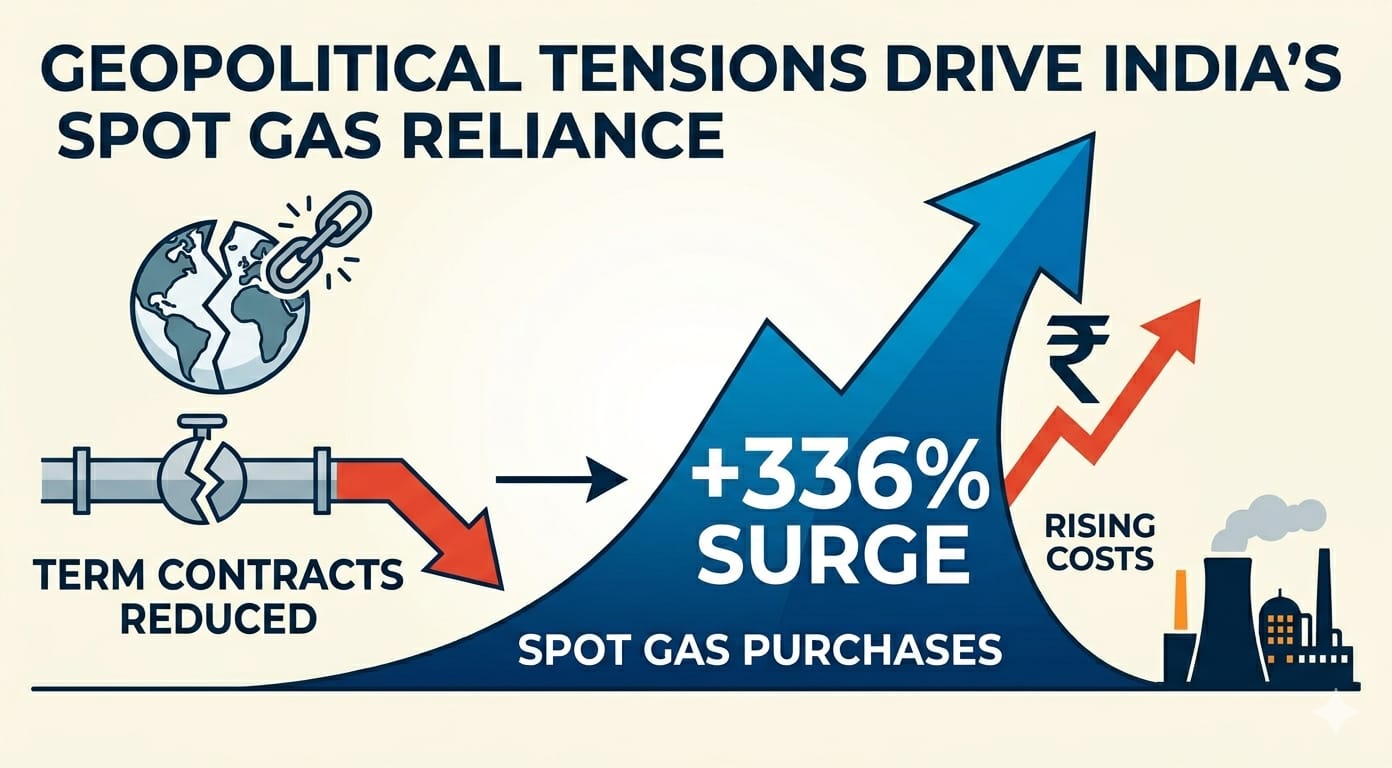
A quiet but significant shift is unfolding in India’s power sector as gas-based power plants turn urgently to the spot market for natural gas. The trigger is the ongoing conflict in West Asia, which has hampered imports under long-term contracts, particularly from Iran.
With those steady supply lines disrupted, generators have scrambled to fill the gap by purchasing gas directly from the spot market this summer. Between April 1 and May 26, power-sector entities bought 44,67,850 million Metric British Thermal Units (MMBtu) of natural gas from the spot market. This volume stands 336.5% higher than the same period in 2025, more than double what was purchased in 2024, and nearly 140 times the level recorded in 2023 .
The surge is visible across both months. In April alone, power companies purchased 15,67,950 MMBtu, a year-on-year increase of 260.5% from just 435,000 MMBtu in April 2025. This sharp rise came alongside a major shift in fuel sourcing strategy.
In April 2025, nearly 38% of LNG requirements were met through long-term contracts, but that proportion has dwindled as spot-market purchases now dominate. The trend intensified in May, where purchases from May 1 to May 26 reached 28,99,900 MMBtu, compared to 5,88,550 MMBtu in the same period last year. That marks a nearly five-fold increase of 392.7% .
What makes this surge even more striking is that it happened despite a dramatic rise in spot-market gas prices. Supply disruptions from the West Asia conflict pushed prices upward sharply. The average spot gas price stood at Rs 1,606 per MMBtu in April, up 43.5% from Rs 1,119 per MMBtu a year earlier. Prices climbed further to Rs 1,856 per MMBtu in May, a jump of 77.4% over Rs 1,046 per MMBtu in May 2025. Even with these higher costs, spot-market purchases by gas-based generators reached the highest levels seen in recent years, according to data from the Indian Gas Exchange (IGX), the country’s leading gas-trading bourse .
The conflict has cast a deep shadow over gas availability for India’s gas-based power plants. The government has responded by deciding to prioritize certain sectors during shortages, meaning power generation is not always at the top of the list. This prioritization adds pressure on generators to secure gas independently, driving the reliance on the spot market. The situation reflects a broader vulnerability in India’s energy infrastructure, where long-term contracts that once provided stability are now fragile due to geopolitical unrest.
The power sector’s pivot to spot purchases is a direct adaptation to this uncertainty, ensuring plants can keep running even when contractual supplies fall short .
The numbers tell a story of urgency and adaptation. Power plants are no longer waiting for contracted gas to arrive; they are actively buying whatever is available on the spot market, regardless of price. This behavior shows how deeply the West Asia conflict has rippled into India’s energy sector. The surge in purchases is not just a statistical anomaly; it represents a fundamental change in how power generators are securing fuel.
As regional tensions continue, the reliance on spot markets may become a permanent feature, reshaping India’s energy landscape in ways that will affect electricity costs and supply stability for everyone. The story of gas purchases is, in essence, the story of how global conflict touches daily life through the lights in homes and the power in factories .
In the end, the West Asia conflict has pushed India’s power plants to rely heavily on spot-market gas, with purchases jumping over 336% as long-term imports from Iran falter. Despite prices rising nearly 80%, generators keep buying to keep plants running, showing how global unrest directly affects energy security and electricity availability.
This shift signals a lasting change in India’s power sector, where spot-market dependence may become normal, reminding everyone that distant conflicts can quietly shape the lights in homes and the power in factories.

