
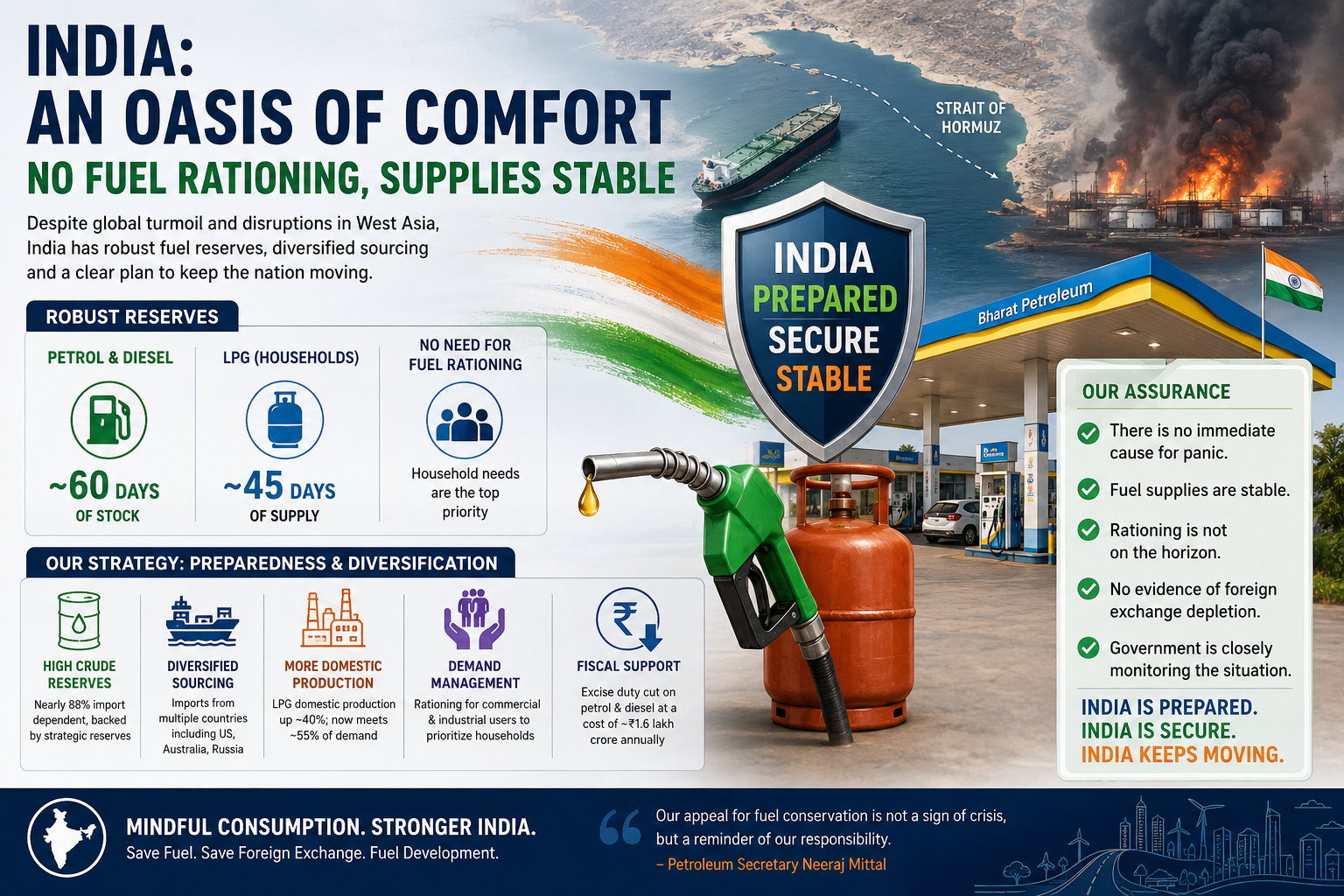
Amid rising global anxiety over fuel shortages triggered by the ongoing West Asia conflict, India has positioned itself as relatively stable, with the government firmly stating that there is no need for fuel rationing. Petroleum Secretary Neeraj Mittal emphasized that India currently maintains robust reserves, including approximately 60 days of petrol and diesel stocks and around 45 days of LPG supply for households.
Speaking at the CII Annual Business Summit 2026, he described India as an “oasis of comfort” at a time when several countries are grappling with fuel rationing and supply disruptions.
This assurance comes in the backdrop of escalating tensions in West Asia, particularly the disruption in the Strait of Hormuz, a critical global energy chokepoint through which nearly one-fifth of the world’s oil and gas flows. For India, the stakes are particularly high, as nearly 40% of its crude oil imports and about 90% of its LPG imports are linked to this route. Despite these vulnerabilities, the government has managed to maintain supply continuity through a mix of strategic reserves, diversified sourcing, and diplomatic efforts.
Mittal clarified that Prime Minister Narendra Modi’s recent appeal for fuel conservation should not be misinterpreted as a sign of crisis or impending shortages. Instead, it was a reminder of India’s import dependence and the importance of mindful consumption, especially when global prices are volatile.
The idea, he explained, is that saving fuel also means saving valuable foreign exchange, which can be redirected toward development priorities. Contrary to speculation circulating over the past few days, there is no evidence to suggest that India’s foreign exchange reserves are depleting due to the current situation.
India’s dependence on imported crude oil remains high at nearly 88%, making it sensitive to global price shocks. However, the government has taken proactive steps to cushion the impact, including reducing excise duties on petrol and diesel.
This move, while providing relief to consumers, comes at a significant fiscal cost, estimated at around Rs 1.6 lakh crore annually. At the same time, oil companies have secured additional cargoes and increased procurement from existing suppliers to stabilize supply chains.
One of the more challenging areas has been LPG, where India relies on imports for about 60% of its demand. With disruptions in traditional supply routes, refiners have ramped up domestic production significantly, achieving a nearly 40% increase compared to pre-conflict levels.
As a result, domestic production now meets about 55% of demand, up from 40% earlier. Additionally, India has diversified its sourcing by importing LPG from countries such as the United States, Australia, and Russia, while diplomatic efforts have helped release Indian tankers stuck in the Persian Gulf.
To prioritize household needs, the government has implemented demand management measures, including rationing LPG supplies for commercial and industrial users. This ensures that domestic consumers continue to receive uninterrupted cooking gas supplies, which remains a critical concern for millions of households.
Overall, India’s current fuel management strategy reflects a combination of preparedness, diversification, and calibrated policy intervention. While global markets remain volatile and uncertainties persist, the government’s message is clear: there is no immediate cause for panic. Fuel supplies are stable, rationing is not on the horizon, and concerns around foreign exchange depletion appear overstated in the present context.

