
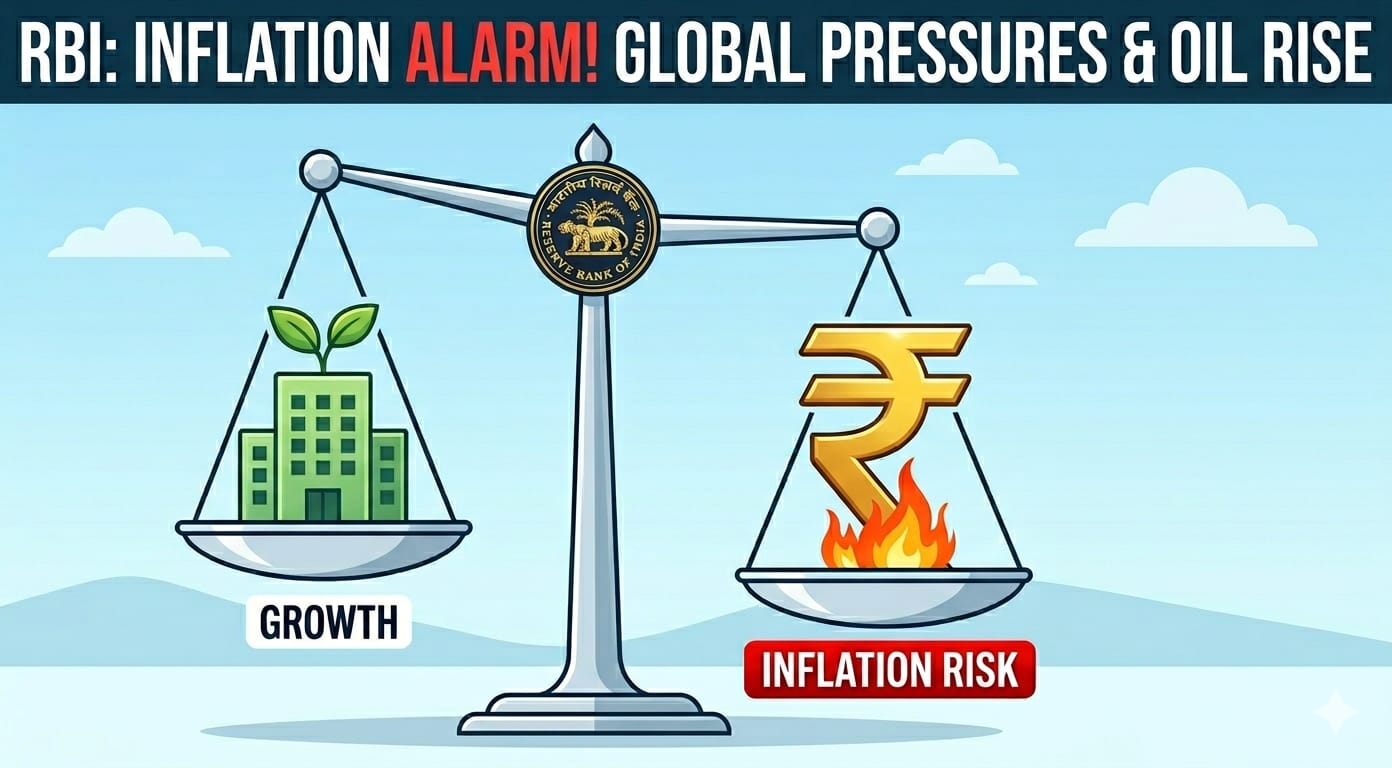
The Reserve Bank of India’s latest Monetary Policy Committee (MPC) minutes point to increasing worry about inflationary pressures resulting from global uncertainties, especially energy prices, the West Asia conflict, and the threat of El Niño conditions.
RBI Governor Sanjay Malhotra has identified these factors as the major supply-side risks that are likely to make takeaway policy very tricky in the next few months. While the repo rate was left unchanged at 5.25% during the April 8 meeting, the central bank admitted that external shocks have become major factors influencing inflation outlook and growth path.
Malhotra emphasized that the current inflation risk is mostly from supply disruptions rather than demand-pull inflation, underlying inflation is not much at risk. However, he warned that a long-lasting geopolitical conflict could complicate the efforts of central banks to tame inflation expectations without derailing economic growth.
This situation is a typical example of the policy dilemma in which tightening monetary policy to control inflation leads to a slowdown in economic growth. The Reserve Bank of India (RBI) has forecast that India’s GDP growth will slow down to 6.9% in the 2026-27 fiscal year, compared to 7.6% in the previous year, due to the ripple effects of global headwinds.
At the same time, retail inflation is expected to stand at an average of 4.6%, remaining within the centre bank’s tolerance band but susceptible to the external shocks. The West Asia conflict in particular has become an important channel of uncertainty through a number of channels including exports, commodity supplies, remittances and overall demand in the global economy.
One of the most critical issues of concern in the MPC minutes is the volatility of global energy markets. Disruptions in critical routes such as the Strait of Hormuz could result in sustained increases in crude oil prices, which will directly affect the import bill and domestic inflation of India.
The pass-through effect is already visible in the rising prices of fuels such as LPG, premium petrol and industrial diesel. Higher energy costs also raise input costs across industries, thus exerting cost pressures on production and eventually retarding the pace of economic activity. In addition to energy risks, the possibility of El Nino poses a threat to agricultural output which could further fuel food inflation and weaken rural demand.
Supply chain disruptions that have already been worsened by the said geopolitical tensions may take a longer time to normalize, which creates inflationary pressures while depressing growth simultaneously. The MPC noted that such conditions create a stagflation-like risk environment that is characterized by higher prices and slower growth.
External sector vulnerabilities also remain a concern. The MPC members noted that the current account deficit (CAD) could widen because of increased crude oil imports and imports of precious metals, while export growth is hampered by a feeble global economy. Rupee depreciation and volatile capital flows associated with tightening global financial conditions may further complicate on macroeconomic stability.
Global inflationary pressures have also constrained the ability of the major central banks to ease rates, with a possible reduction in capital inflows into emerging markets such as India. Still, the RBI has a positive but careful view of the Indian economy. Growth is supported by strong domestic fundamentals, among them resilient private consumption, improving rural demand, sustained public ‑investment, and a gradual pick-up in private capital expenditure.
Sectors such as services and agriculture, coupled by relatively healthy corporate and banking balance sheets, provide a buffer against the external shocks. Overall the MPC minutes point to a fine balancing act for policymakers.
With inflation risks tilted to the upside and growth exposed to external pressures, the RBI is likely to be cautious with its policy measures, and will closely watch global developments while economic stability is maintained at the macro-level.

