
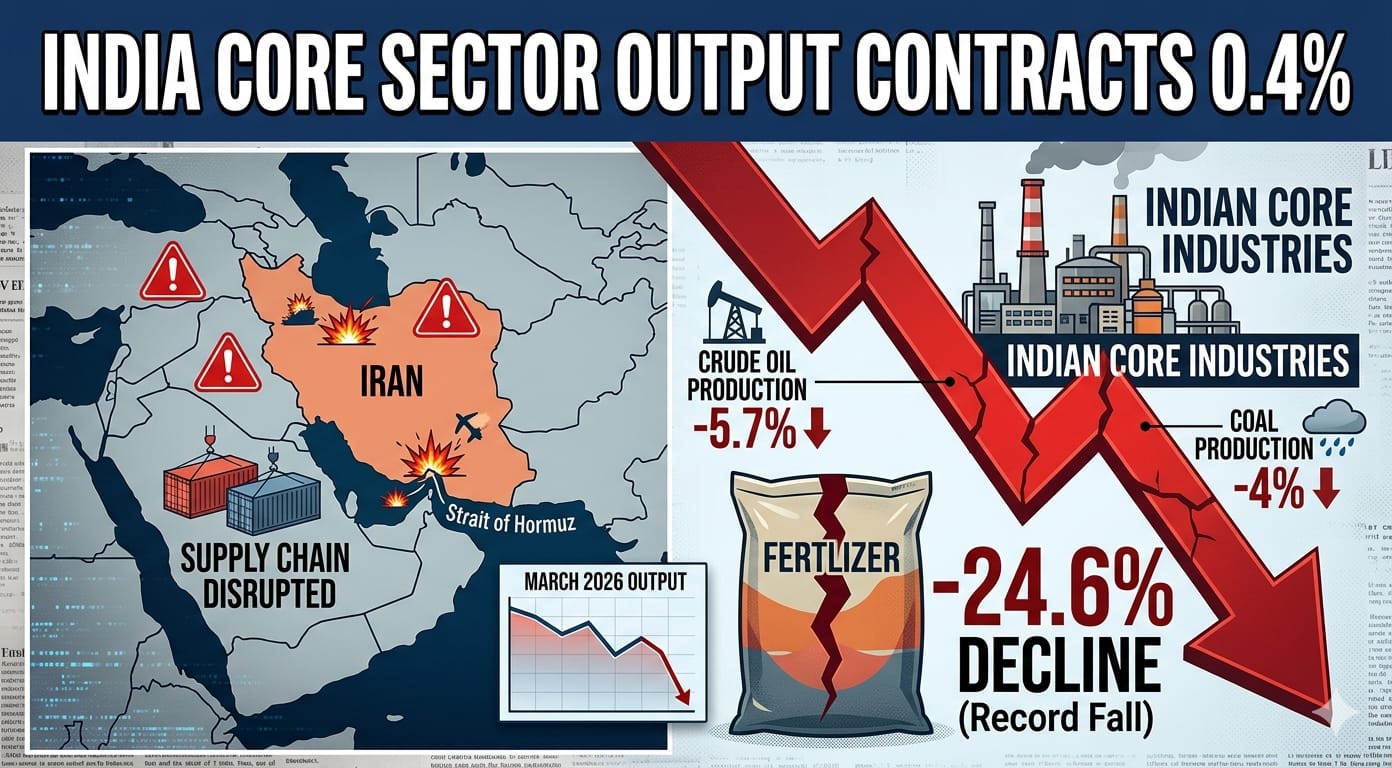
India’s industrial engine showed its first visible strain from the ongoing West Asia conflict in March, as the output of the country’s eight core industries contracted by 0.4% year-on-year, the sharpest fall since August 2024, when it had declined 1.5%.
The data, released by the Ministry of Commerce & Industry on Monday, marks the first contraction since October 2025 and ends what had been a fragile recovery, with February having posted a 2.8% rise. More worryingly, the annual performance for FY26 tells a deeper story: for the full year 2025-26, the combined output of these eight sectors grew just 2.6%, the weakest since the pandemic-devastated year of 2020-21, when it had actually fallen by 6.4%.
At the heart of March’s decline is a staggering 24.6% crash in fertilizer production, the largest single-month drop on record since data collection began. The trigger is unmistakably geopolitical. The escalating conflict involving the US, Israel, and Iran and Iran’s subsequent retaliatory actions, including the closure of the Strait of Hormuz and strikes on Gulf nations sent energy prices soaring and choked the supply of key petrochemical inputs into India’s manufacturing ecosystem. The impact was swift and measurable.
Data released last week revealed that wholesale ammonia gas prices in India jumped 22% in March alone compared to February itself, the highest month-on-month surge in records going back to 2012. Since ammonia is the backbone of fertiliser manufacturing, the ripple effect on production was both immediate and severe. For a country where agriculture feeds over half the population, a disruption this sharp in fertilizer supply carries consequences well beyond factory floors.
Crude oil production added to the gloom, declining 5.7% in March, the seventh consecutive month of year-on-year contraction. This persistent downtrend in domestic oil output is a structural concern that the West Asia disruption has now made more urgent. Coal production, meanwhile, fell 4%, its first year-on-year decline in five months and, strikingly, the first time in data going back to April 2012 that India’s coal output has fallen specifically in the month of March.
Meteorological data from the India Meteorological Department offers a partial explanation: the country recorded 14% above-normal rainfall in March, which likely hampered mining and transportation operations. Electricity generation, the fourth sector to see a decline, dipped 0.5%, also partly attributable to the same weather anomaly reducing thermal power demand and affecting logistics.
Not all sectors, however, were swept up in the downturn. Natural gas production surged 6.4% in March, its strongest growth in 22 months and the first increase since June 2024 offering a rare bright spot amid the gloom. Steel and cement, two key proxies for construction and infrastructure activity, held firm with output growth of 2.2% and 4% respectively, suggesting that domestic demand-driven sectors are still showing resilience. Petroleum refinery products posted a marginal 0.1% rise, barely staying in positive territory.
What makes March’s data particularly significant is the timing. India is entering a high-stakes moment: the kharif sowing season lies ahead, global supply chains remain under stress, and the geopolitical situation in West Asia shows no sign of a swift resolution. If fertiliser prices and energy costs stay elevated through April and May, the pressure on farm input costs and consequently food inflation could intensify considerably.
The 2.6% full-year growth for FY26’s core sectors is not just a number; it is a signal that India’s industrial resilience is being tested on multiple fronts simultaneously, and the government’s response to both the external shock and domestic supply vulnerabilities will be closely watched in the months ahead.

