
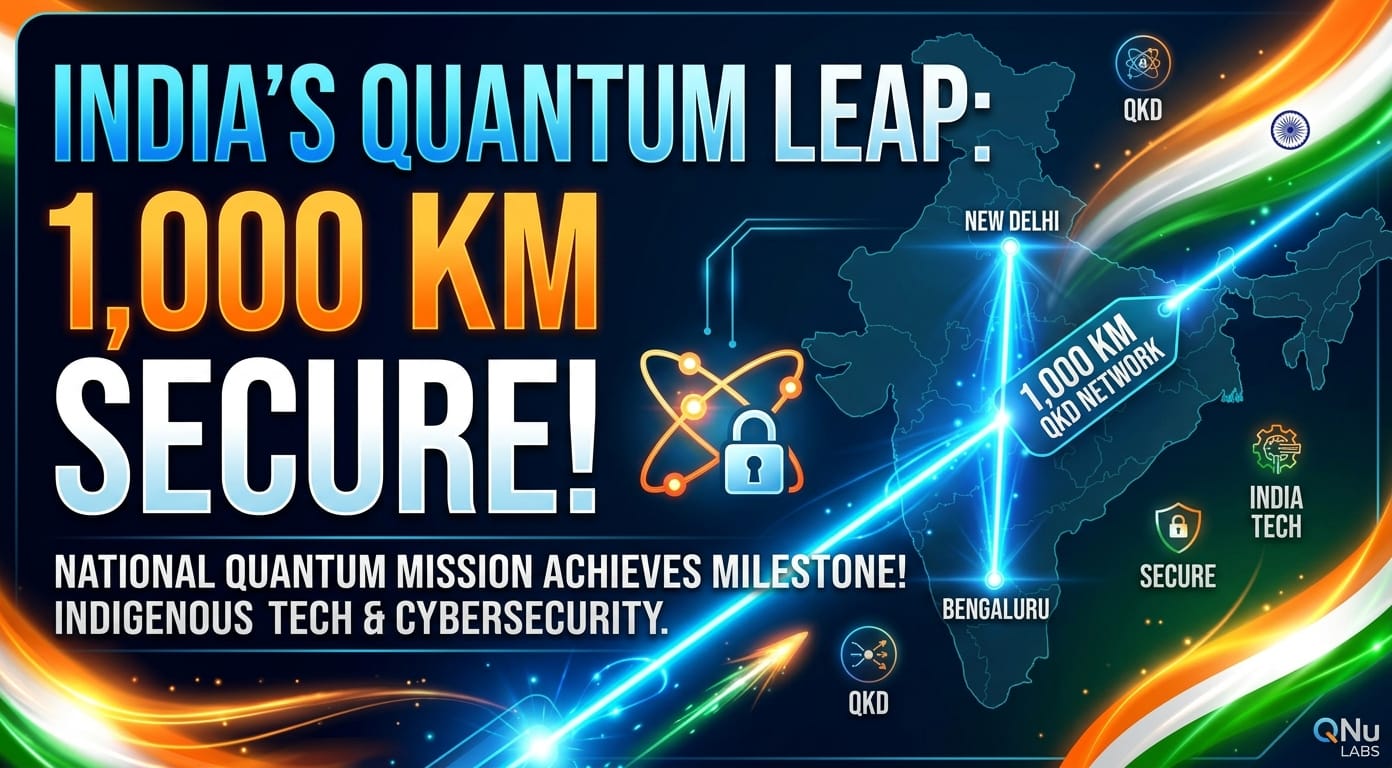
This successful demonstration of a 1,000-km quantum communication network under the National Quantum Mission in less than two years since its launch in October 2024 has marked another historic stride in the government’s technological journey.
The announcement, which came during a review meeting chaired by Union Minister for Science and Technology Dr Jitendra Singh, shows that India’s science and innovation ecosystem is moving forward at a fast pace. This network, which is based on indigenous technology and created by the Bengaluru startup QNu Labs, is one of the longest secure quantum key distribution (QKD) networks in the world, demonstrating that India’s investments in trying to develop future-proof communication technologies are paying off earlier than predicted.
Dr. Abhay Karandikar, Secretary of the Department of Science and Technology (DST), labelled it as a landmark achievement in secure quantum communication. Information is transmitted through quantum bits (qubits) rather than binary code.
This makes obstruction or hacking of data impossible without detection, a breakthrough in cyber resilience across sectors such as defence and banking, critical infrastructure. For example, the quantum communication network has been designed to function across geographically complex networks such as underwater and underground, which will open further civilian and strategic use cases (ibid).
Beyond this monumental scientific achievement, the government is capitalizing on the momentum to establish a wider deep-tech ecosystem. The National Quantum Mission now supports 17 startups, with nine new startups in quantum computing, quantum sensing, new materials, and quantum communications.
From Quantum Biosciences and Sense-XT working on disease detection using quantum biosensors, to bloq and Quantum AI Global creating advanced photon sensing technology – India’s innovation landscape is now brimming with homegrown solutions at the very frontier of science. The steady rise of such deep-tech ventures highlights this shift towards self-reliance and global competitiveness in transformative technologies.
At same review, progress was noted under the Research, Development and Innovation (RDI) funding framework. Just within weeks of government calls for proposal, the Technology Development Board and Biotechnology Industry Research Assistance Council were overwhelmed with more than 100 and nearly 200 applications, respectively.
These submissions are for advanced sectors including biotechnology, space technologies, and manufacturing. For this, new instruments, such as optionally convertible debt (OCD), are used to allow companies to tap into public funding without compromising equity at an early stage. It is supposed to work in conjunction with private investment to attract and support scalable growth.
While these milestones mark India’s ascent as a technology powerhouse, the experts and observers are also urging caution. The expansion of the country’s scientific footprint – from quantum networks to advanced nuclear capabilities, AI to space technologies – demands strong cybersecurity and protection of intellectual properties. As India has traditionally been a country of original technological innovators, the country is now creating technologies that will be desirable to global powers.
Whether through infiltration sponsored by states or through corporate spying, there are real risks of cyber espionage and intellectual property theft. India’s culture of trust and lax security measures ranging from the use of spurious foreign devices in the conference room to less supervision of corporate networks makes this an immediate concern (ibid).
As more innovations come out of ISRO, DRDO and the country’s deep-tech startups, safeguarding them has to become as high a priority as creating them.
A National Mission for Technology Security with the Government of India as its leader could ensure that the country is protected against digital and physical intrusions in a coordinated manner. Such a mission would enable startups, research institutes, and government organisations to ensure the protection of their data, networks, and proprietary technologies before it nears becoming a target at the global stage.
With proactive monitoring, transparent protocols and integrated cyber security framework, India not only leads in innovation but also will safeguard its position as a trusted global technology hub.
The 1,000-km quantum communication milestone proves India’s potential; now securing this technology ecosystem is the next step to make sure that the nation’s inventions remain India’s own.

