
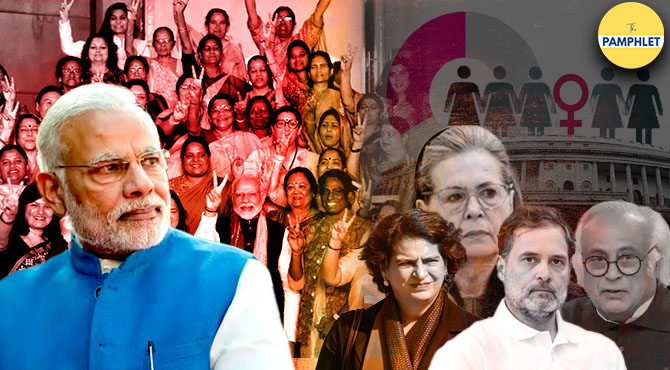
The grand illusion of political distractions is for the inattentive, devious, destructive and deranged. For Indians who are driven by creation for nation building, the essence of creation is the single most driving force shaping a resilient and prosperous India. In the Indic tradition, true knowledge is the mainspring of creation.
For thousands of years, the pursuit for true knowledge has led the men and women of Bharat into the exploration of this sacred and beautiful land. ‘How to use this knowledge’, ‘how to reach the inner–most core of knowledge that dwells within knowledge’, have been some points in the enduring quest for those who lend themselves to its illuminating mysteries. For PM Narendra Modi, the quest continues, more than two decades after he made his nascent efforts to unlock the layers of knowledge extended to him by the exploration of India. As Prime Minister, and as of now, he continues to feel the engaging textures of this quest through the tool of governance.
“अन्तःस्थमेव यज्ज्ञानं ज्ञानादपि च यत्परम्।
तदेव सर्वसंसारसारं सद्भिरुपास्यते॥”
What’s ‘knowledge’ got to do with it?
PM Modi shared the Sanskrit Subhashitam on social media, trying to highlight the vitality of “inner wisdom as the true essence of the universe.” His note explains it: “The wisdom that resides within us, which transcends ordinary or external knowledge, is the true essence of this entire universe. It is this inner wisdom that is worshipped by great men and wise men.”
There is a thin line that separates PM Modi and the commotion of the world around him, unnerving events and diabolical people he has to deal with, to create, maintain and preserve the insulated domain of safety for Bharatiyas. That thin line is of awareness, knowledge, civilisational and traditional wisdom. He does his best at harnessing its essence in work. Sometimes, he can do better. But the thin line doesn’t turn away from him, it never leaves him.
The fiendish heat of a distant war has witnessed him turning even more vigorously to deliverance, belief, building and preserving. Against the backdrop of the ongoing war in West Asia, India has seen the completion of several projects crucial to India’s continuity, or has moved closer to milestones of national importance. The Nari Shakti Vandan Adhiniyam is one such milestone. For PM Modi, it is a civilisational commitment.
The Push for ‘Nari Shakti Vandan Adhiniyam’
Prime Minister Narendra Modi recently recorded and shared a video addressing the ‘nari shakti’ of Bharat. Understanding the essence of Nari Shakti – the feminine strength and power that specifies the spiritual dimension of the divine feminine dwelling in the women, has been the most veritable differentiator separating Modi’s politics and governance from the hubris in leaders targeting him. This understanding allows Modi to build direct conversations with Nari Shakti. And such conversations have been many.
They often happen before he ploughs through massive shifts in governance or sculpts unprecedented victories or smoothly walks through the fortuitous brushing against challenges. He has these conversations in good times, not so good times, through difficult times, exigencies of gargantuan scale — like the Pandemic. He talks to Nari Shakti. Nari Shakti responds. Their reciprocal response to him has shaped India’s electoral history, shaped governance, tailored delivery in governance, and has redefined accountability, over the decades.
Where ‘Vishwas ki dor‘ comes into play
In his video message, PM Modi informs women, that on the basis of experience in governance, which extends to two and a half decades, he believes that the goal of Viksit Bharat will be achieved only when the participation and contribution is takes place in the fullest expression of their capacities and capabilities into the nation’s development. His experience in governance offers clues into why he believes that the goal of developed India by 2047 — the year that marks 100 years of Independence — would come when the full strength of “Matru Shakti” is harnessed.
Between 2014 and 2026, I have stressed on the “Vishwas ki dor” — the thread of trust that connects PM Modi with the Nari Shakti of India, in different articles. I believe that this “Vishwas ki dor” makes women positively respond to the politics of Narendra Modi. It has shaped several unprecedented victories for Modi in Gujarat and outside. In PM Modi’s video, the three words “jodnaa hee hoga” (will have to be connected) – are of great importance in my “listening” of PM Modi’s message.
It communicates that:
With PM Modi at the helm of affairs, India passed the Nari Shakti Vandan Adhiniyam with the support of all political parties. Spoken about by Modi himself, it bulldozes back the negativity that members of NDA’s opposition have tried to build against the Bill. The Bill was passed with their support. Their support has to return and sustain itself.
PM Modi indicates that the nurturing of the national goal will become possible with the maximisation of women’s participation in India’s upward surge.“Jodnaa hee hoga” — we have to connect them (to India’s development). It is not optional. It is inevitable. It is critical and indispensable. It is imperative. It is paramount.
PM Modi’s message underlines that women participation in public, social and cultural dimensions, and women participation in the democratic manifestations, is pivotal to development. When the 2029 Lok Sabha polls are held, India’s Nari Shakti must, as public representatives in Lok Sabha and Vidhan Sabhas, secure 33 per cent representation, he has said.
Not a mere legislative exercise: milestone for Bharat’s future
It gets across the message that the proposed amendments to the Women Reservation Act are not being viewed as a legislative exercise. It reflects the connection between the aspirations of India’s women and the aspirational journey of India to 2047 that Modi wants to build and exactly how he views it. As a connection. As two domains connected within a single unit of a civilisational state. Here comes into play PM Modi’s knowledge of things and vision. It’s a constant segregator.
The political past of this Bill is a prologue worth a mention in Parliament, but the past is usually the first domain Modi is seen breaking away from when it comes to moving ahead and moving on. For him, legislative milestones, when and as they occur in work, carry meaning, they bear purpose. Their purposeful and earnest propulsion moves on the gutsy combination of courage, consensus and intriguingly, consistency. Contrary to the narrative the Opposition is trying to build through Jairam Ramesh and some leaders of the Samajwadi Party, Modi has been consistent in his position on the Bill.
On his part, Modi’s position has been crystal clear on the special session of Parliament on the law dedicated to women. On April 4, during an election rally in Kerala, PM Modi announced, “We called the people of Congress for a meeting. We hope that they agree and will participate.” He urged people at the rally to tell the people in the opposition about the need to pass the Bill. Imagine a situation where MPs have to learn from the voters, particularly women voters, why a certain Adhiniyam should not be postponed. What impression will such an exercise between voters and MPs and MLAs of the opposition, create in the minds of voters in general? Modi will rise in perception, rise higher and swiftly in public perception, right?
In speeches during his rallies in Assam and Kerala, Modi has deftly designed and placed the moral onus and political responsibility with the Congress and its partners in the INDI Alliance. The audience for the special session of Parliament is not Parliament alone. The audience is wide. It is huge. It is spread across five different state-UT venues of the assembly polls, and the nation at large. The political cost of stonewalling, negating and delaying legislation that Modi believes “we owe it nari shakti to come together”, any further, would be written in the column that reads “Congress”.
Jairam Ramesh is angry, PM Modi positive
Senior Congress leader Jairam Ramesh has actively criticized Modi and the central government’s legislative moves centered on the Bill. Ramesh has chosen attack over lament. He has chosen rancour over collaboration in accusing Modi of choosing “diversions”. Ramesh seems upset with the legislative exercise, particularly in the event of Modi urging unanimous support for the women’s reservation bill. Ramesh is unrelenting. On April 10, he said that PM Modi owes apology to the women of India.
Ramesh’s grouse is that his party had demanded the implementation of the Nari Shakti Vandan Adhiniyam — unanimously passed by Parliament in 2023, in 2024. Ramesh views Modi’s latest stance on the Women’s Reservation Act as an election issue (in the context of assembly polls being held in 2026). But what Ramesh is singularly angry about is that the census and delimitation — the previous requisites for the reservation coming into effect — are now being done away with.
Ramesh finds himself in the prime striking position when it comes to countering Modi in the forthcoming special Parliament session. Modi has urged Congress to “not do politics”. Sonia Gandhi and Rahul Gandhi have maintained their silence on Modi’s latest stance. In 2023, during one of her speeches, Sonia Gandhi questioned the possible delay in implementation. “How many years? Two? Four? Eight?” Rahul Gandhi stated the same year that the Bill should be immediately implemented and that there was no connection between women’s reservation, and the census and delimitation.
PM Modi has been the target of Ramesh’s ire on the issue. Ramesh has given Modi the title of “U-Turn Ustad” – meaning – the master of U turns. Modi usually stores such titles thrown at him for counter usage and employs them at the right moment. As of now, he seems undeterred by the consistent negativity from a section of the opposition. He has stated in his video-message that he is engaged in a dialogue with other political parties. He confidently states that there is visible positivity on the matter.
Timing symbolic and harvest timely
On April 9, PM Modi broadened his dialogue on the issue in an op-ed – maintaining a flow between the said word in the short video and the word. It was published on mainstream media websites and newspapers, and on social media platforms. In it, PM Modi urges people (including ‘nari shakti’ he is addressing) to read the article. He urges women to “motivate all political parties, inspire and encourage them, to work on passing it in Parliament on April 16-18, and to celebrate it together. The video is short, but it covers a long-term vision. It captures the need for an important task – that is meant to empower the women of India — for India’s empowerment.
The mention of Assam’s Rongali Bihu, Odisha’s Maha Bishuba Pana Sankranti, West Bengal’s Poila Boishakh, Vishu in Keralam, Puthandu in Tamil Nadu, and Baisakhi in several parts of north of India, in the beginning of the PM Modi’s op-ed, signify the exclusivity that political stability and peace bring to India during these volatile times. The feminine is central to Bharat’s festivals of harvest that delineate abundance. The bearer of the soil, on which the harvest breathes, is feminine. The bearer of the bounty of grains is feminine. The deity who is offered the harvest, in many parts of India, is feminine. The creator that marks the season of renewal is feminine. She dances to the colours of nature, joy and folk music, her hands swaying to the rhythm of life.
It is at this juncture of the festive season in the Indic calendar that India’s parliament will discuss a bill pending for 40 years. Meanwhile, a big part of the world is grappling with survival. Threats and counter threats between Iran and the United States of America have been flying faster than munitions between neighbours in the war-torn region. India at this grim moment in world-history is preparing for a difficult but important exchange of words on equality, inclusion and women’s aspirations. Such contrasts have defined the character of India’s work for becoming future ready during Modi’s times over a series of crises unfolding in the world.
If the politics of the Indian National Congress doesn’t allow it to quietly congratulate Modi on this lone aspect, in firmness and deliberation required to ignite the discussion on the women’s bill, nothing will. Nothing else can.
Here is why: a matter of national importance that directly addresses the strengthening of Constitutional values and corresponds to the inclusion of women for national progress, is the simple yet accurate test of who is ready for correction overdue and who is not. Who is ready to clasp and unlock that one outcome on legitimate representation of women – without ifs and buts being thrusted on Modi, without bringing disruptions, will be seen as a contributor to women-empowerment.
‘Broadest possible consensus’ for national interest
Contrary to the comfort of the Modi-crafted seclusion India has secured (till the point of writing this article) amidst the devastation inflicted by short-lived and broken ceasefires in West Asia, is the persistent disconnection with political benevolence that marks NDA’s opposition. Known for his women-centered beneficiary intervention in governance that touches a range of aspects in the ordinary woman’s life, PM Modi is seeking to create a sustained movement for women empowerment through the passage of the bill for reservation dedicated to them. In his op-ed, he has called for “broadest possible consensus”.
His mention of “larger national interest” and “for future generations” is evidence of his awareness of how the politics of self interests practised by some can hinder inclusiveness in democracy. Keeping women reservation in place for Lok Sabha 2029 polls and assembly elections “in the coming times” seems his mission, and sustaining the consensus on the Adhiniyam witnessed in Parliament in 2023, his subtle reminder to fellow MPs.
Another point of importance in his note upholding the rightful democratic space for those who represent half of India’s population is its resonating with the “spirit of the Constitution.” This indicates that the act of or efforts towards deferring, hindering, stonewalling or delaying the “greater participation of women” will be seen as contrary to the practice of respecting and upholding the Constitution.
Postponing through lack of consensus PM Modi’s call for “collective action for women” is a choice MPs opposed to Modi do not have. They should not (have it), ideally. It is because Modi’s style of politics ties women empowerment and increased participation and inclusion, be they cultural, electoral, financial or democratic, to Bharat’s future and future readiness. He ties them together, carefully, assuredly, using the unseen “Vishwas ki Dor”.
A walk away from collective consensus on the Nari Shakti Vandan Adhiniyam will be seen as a dent of the trust that Modi has built for “government” and “governance” — through his own efforts in governance. His “Vishwas ki Dor” doubles as the trust based connection between members of half the population of India, democracy and government as institutional wholes. PM Modi has stated that “we are” in talks with different parties over the consensus. PM Modi has spoken loud and clear about trust being the traditional value. This alone will transcend ordinary and external knowledge the day democratic India surpasses the temptation for self interest in politics. April 16-18 could offer ‘the’ day and opportunity to politicians who move around carrying the red slim “coat pocket” edition of the Indian Constitution before and after elections – for symbolism, to surpass the temptation for self interest in politics. It is time for practice. Women of India are watching. So are the future generations.

