
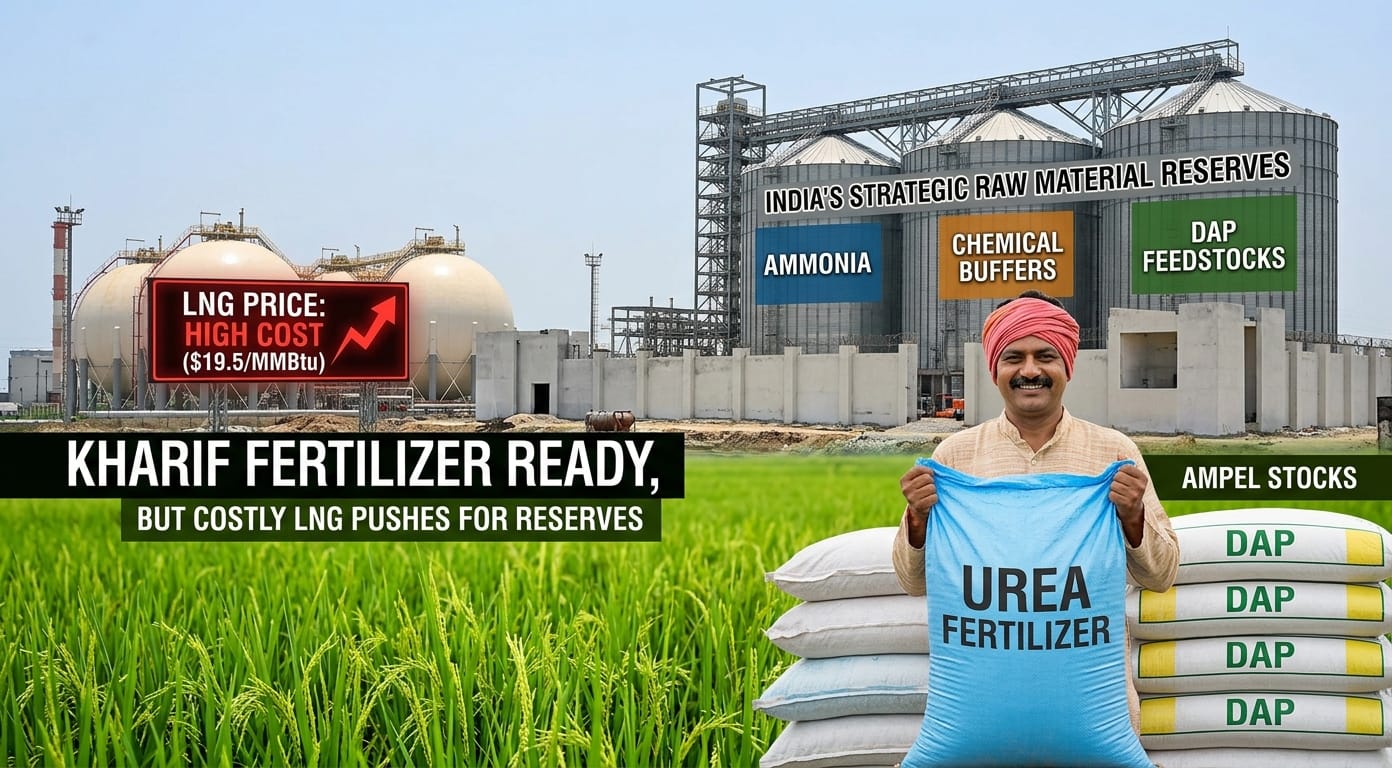
At a time when the world is reeling from energy market shocks triggered by the West Asia war, the government seems prepared for the upcoming Kharif season—at least on the fertilizer front. The government has announced that there are “adequate fertilizer stocks” across the country, easing fears among farmers and agri-economists who were worried about disruptions in supply. Behind this assurance, however, lies a complex and evolving story of rising input costs, shifting global supply chains, and a growing realization that India’s import security must go beyond oil and gas.
According to officials in the Department of Fertilizers, India currently holds about 180 lakh tonnes of fertilizer stock—significantly higher than the 147 lakh tonnes available at this time last year. The total requirement for the upcoming Kharif season is estimated at around 390 lakh tonnes, giving the government a comfortable head start to meet demand during the crucial sowing period beginning June. To maintain supply, 27 urea plants are receiving natural gas, while others that were under annual maintenance are restarting operations. This steady production base is crucial since urea and DAP (di-ammonium phosphate) are sold in India at regulated prices, shielding farmers from international price swings.
However, the government’s reassurance comes with a financial caveat. Because local production relies heavily on natural gas—a feedstock that has seen global prices jump nearly 70% since the war began—the fertilizer subsidy bill is likely to rise considerably. Spot purchases of liquefied natural gas (LNG) have touched around $19.5 per million British thermal units, compared to $11–12 before the conflict. This higher input cost means that, while farmers will continue to buy urea and DAP at controlled prices (Rs 266 for a 45-kg bag of urea and Rs 1,350 for a 50-kg DAP bag), the government will absorb the burden through subsidies. The revised fertilizer subsidy for 2025–26 already stands at Rs 1.86 lakh crore—up from Rs 1.68 lakh crore in the initial budget estimate—and analysts say the final outgo could rise even further if the geopolitical crisis persists.
Interestingly, the fertilizer issue is now being seen not merely as an agricultural or fiscal challenge, but as part of India’s larger energy and raw material security debate. Chief Economic Advisor V. Anantha Nageswaran recently argued that India must start building “strategic reserves” not just of petroleum and LNG, but also of critical raw materials such as fertilizers, ammonia, and chemicals—inputs that are vital for food and industrial production. His observation cuts to the core of what the ongoing geopolitical turmoil has exposed: supply shocks are no longer confined to energy; they now extend to feedstocks that power entire value chains.
This shift in perspective is significant. For long, India’s strategic thinking around reserves was dominated by crude oil storage. But disruptions in fertilizer and chemical supply during the West Asia conflict have made it clear that the country’s economic stability depends equally on securing industrial and agricultural raw materials. When LNG prices spike or ammonia supplies tighten, not only do fertilizer subsidies balloon, but crops, food prices, and farmer incomes are all indirectly affected. In short, energy and fertilizer security are now two sides of the same coin.
While the current government has diversified sourcing to mitigate immediate risks—floating a global tender for over 13 lakh tonnes of urea and sealing long-term supply deals with producers in Saudi Arabia and Oman—it also aims to expand partnerships with countries such as Russia, Morocco, Indonesia, and Canada. This diversification, though promising, cannot fully substitute for physical reserves. As Nageswaran noted, India may need a strategic shift that includes setting up buffer stocks of key raw materials much like the strategic petroleum reserves that currently shield the country from oil shocks.
For now, farmers can be assured that fertilizers will be available as the Kharif season nears. But the broader message from policymakers and economists is clear: the world is entering an era of supply dependencies far more intricate than fuel alone. In this new reality, securing fertilizer and chemical feedstocks may prove as critical to national resilience as maintaining an oil reserve. The Kharif season, therefore, is not just a test of fertilizer logistics—it is a reminder that India’s next frontier in energy strategy lies in the soil itself.

