
The global shipping ecosystem has been under serious pressure due to rising geopolitical tensions, especially around critical routes like the Red Sea and Strait of Hormuz. If you haven’t watched our video on that yet, you can check the link in the description, and here’s another reference for context:
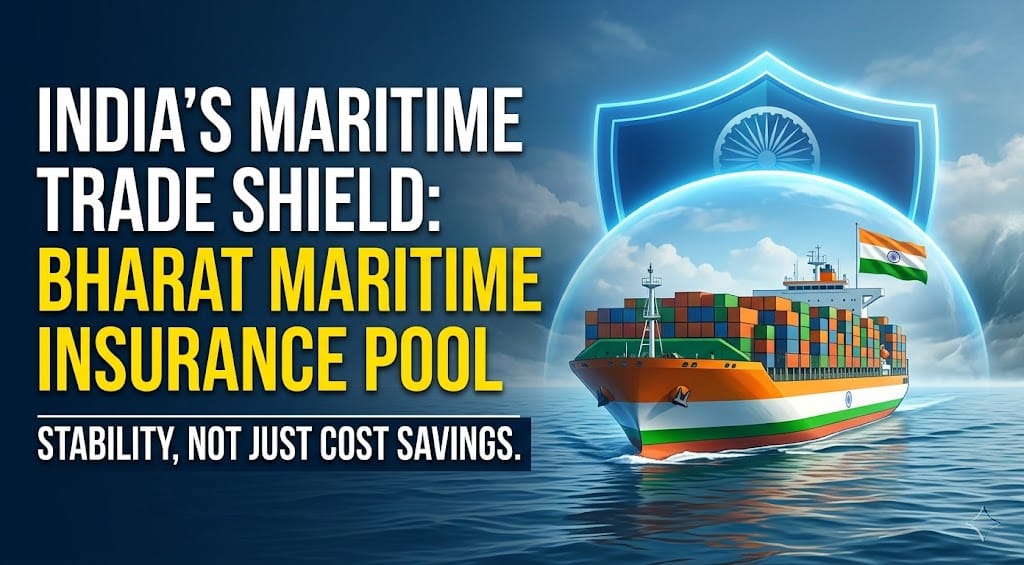
Now, in a major move, India has launched the Bharat Maritime Insurance Pool (BMI Pool), a $1.5 billion sovereign-backed initiative aimed at protecting ocean trade and reducing insurance costs. At first glance, the headline number grabbing attention is a possible 25% reduction in premiums. But the real story goes deeper than just cost savings.
The pool is being administered by GIC Re, with an underwriting capacity of ₹935 crore, and importantly, it is backed by a sovereign guarantee. This changes the entire economics of marine insurance. Earlier, insurers had to rely heavily on global reinsurance markets, particularly in London and Europe, to cover high-risk zones. These markets often increase premiums sharply or withdraw coverage altogether during conflicts.
With the sovereign backing now in place, insurers don’t need to buy expensive reinsurance for war-risk coverage. That cost saving is expected to be passed on to companies. According to GIC Re, this could translate into roughly 25% lower premiums, especially for routes affected by geopolitical tensions.
But here’s the important nuance. The actual savings will vary depending on factors like cargo type, shipping routes, and the evolving risk environment. For example, Vedanta Sterlite Copper, one of the early users of this pool, expects savings of around $10 per metric tonne for shipments to West Asia. That may sound small, but at scale, it adds up to nearly $50,000 in savings during a conflict period.
However, if we look closely, industry experts are saying the bigger benefit is not just cost reduction but predictability. In recent months, shipping companies have faced a situation where insurance cover was suddenly withdrawn mid-contract. Routes were reclassified as high-risk overnight, and premiums were revised unpredictably. This created chaos for shipping contracts, freight pricing, and delivery timelines.
With the Bharat Maritime Insurance Pool, India now has a domestic fallback mechanism. This means even if global insurers pull back due to sanctions or geopolitical shifts, Indian shippers still have access to coverage. That continuity ensures that trade flows don’t get disrupted suddenly.
This is crucial because shipping is not just about moving goods, it is about honoring contracts signed months in advance. If insurance disappears, ships cannot sail, contracts get renegotiated, and companies face heavy financial penalties. In that sense, stability itself becomes an economic advantage.
Another important factor is how much risk GIC Re decides to retain versus how much it still passes on to global markets. If the sovereign guarantee truly replaces the need for external reinsurance, then savings in the range of 15–25% on war-risk premiums, especially for sensitive routes, are very realistic.
At the same time, experts caution that insurance availability alone will not drive shipping decisions. Shipowners will still evaluate ground risks independently. If a route is too dangerous, lower premiums won’t necessarily make it viable.
From a broader perspective, this move also signals India’s intent to reduce dependence on global financial and insurance ecosystems. Just like we’ve seen in energy, defense, and payments, India is now building resilience in maritime trade as well.
So yes, the 25% cost reduction makes headlines, but the real impact lies in giving Indian trade a safety net during uncertain times. In a world where geopolitical shocks can disrupt supply chains overnight, having that kind of insurance backbone could be far more valuable than the savings themselves.

