
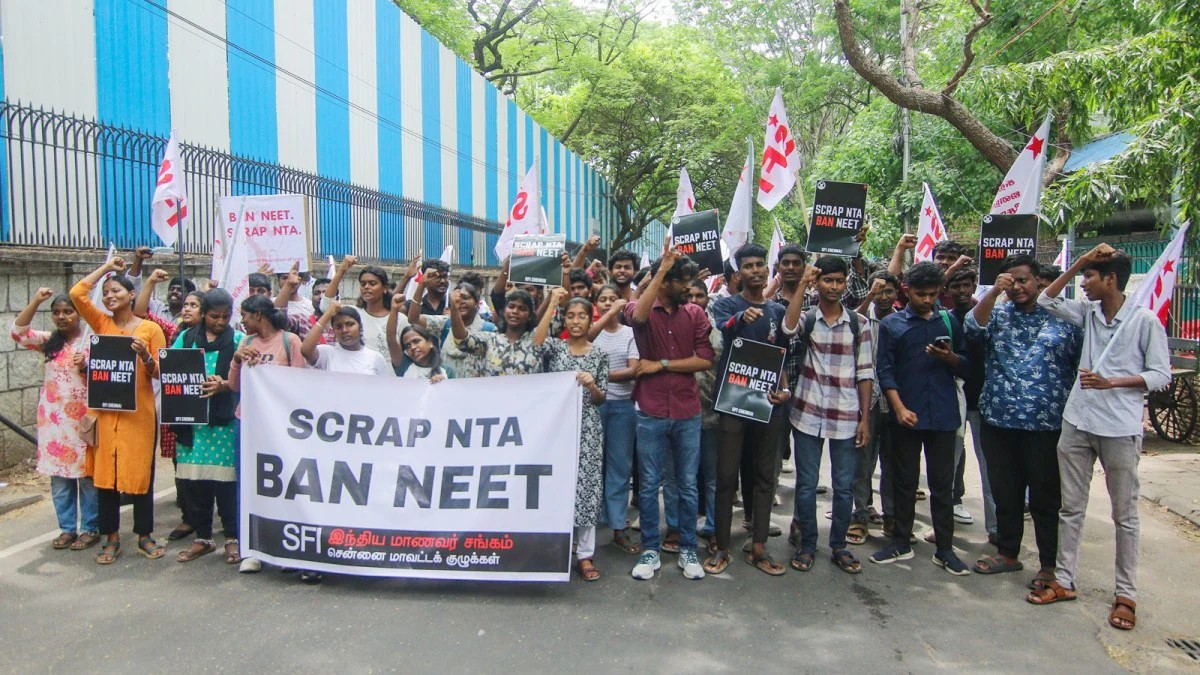
The nationwide outrage over the NEET 2026 paper leak has triggered massive protests across India, with lakhs of medical aspirants demanding accountability and justice. Students and parents alike are worried about the future of an entire generation that spent years preparing for one of the country’s toughest entrance examinations.
But while ordinary students are demanding stronger safeguards against paper leaks and corruption in the examination system, certain opposition-backed student groups are attempting to turn the protests into a platform for ideological and political messaging rather than focusing on the core issue.
At the centre of this controversy is the student wing of the Communist Party of India, AISA, whose leaders have been accused of diverting attention away from the NEET crisis toward broader political narratives.
From paper leak protest to ideological and political platform
One of the most talked-about moments from the protests came during a speech by Aditi Mishra, the president of the Jawaharlal Nehru University Students’ Union and a prominent AISA leader.
While beginning her speech by calling the NEET paper leak a “systematic failure,” critics say the speech soon shifted away from the immediate concerns of students. Instead of focusing solely on examination reforms, security failures, or accountability from authorities, the speech reportedly moved toward issues such as transgender rights, Muslims, Dalits, and allegations that citizenship rights in the country were being undermined.
This has led many to question whether lakhs of NEET aspirants protesting on the streets had gathered for ideological debates or simply to demand a fair examination process.
Parents whose children spent years preparing for NEET are asking whether this genuine student crisis is now being used to push pre-decided political narratives.
Criticism of “Manufactured Narratives”
Critics of the Left student organisations argue that the protests should have remained centred on practical reforms such as:
- Stronger exam security systems
- Accountability within the National Testing Agency (NTA)
- Transparent investigation procedures
- Strict punishment for those involved in the leak
Instead, they claim the protests were increasingly dominated by broader ideological discussions around “capitalism,” “Brahmanism,” “corporate rule,” and identity politics.
Opponents argue that such messaging alienates ordinary students who simply want justice and fair opportunities.
Many also took issue with comments made during the protest about examination systems favouring the wealthy because answer sheets are evaluated through machines. Critics mocked such claims, arguing that automated evaluation systems actually reduce human bias and corruption compared to older manual systems where influence and political recommendations often played a larger role.
According to these critics, organisations like AISA are less interested in helping students and more interested in expanding their ideological influence through mass protests.
Government response and Re-NEET announcement
Amid mounting public anger, the National Testing Agency moved to cancel the compromised examination, stating that the decision was necessary to protect students’ interests and maintain trust in the national examination system.
The government also referred the matter to the Central Bureau of Investigation for a comprehensive inquiry into the paper leak network.
NTA Director General Abhishek Singh later announced that the re-examination schedule would be declared within a week. The promise was subsequently fulfilled when the agency officially announced that Re-NEET 2026 would be conducted on June 21, 2026.
Importantly, students will not have to register again, and no additional fee will be charged for the re-exam.
Students wanted justice, not political sermons from the Left
For many ordinary students, the issue remains straightforward: the NEET paper leak was a criminal and administrative failure that required a focused institutional response.
The affected aspirants come from every section of society — poor families, middle-class households, SC, ST, OBC, General category students, rural backgrounds, and urban centres alike. Their common concern was not ideology, but fairness.
Critics argue that when every issue is interpreted exclusively through ideological frameworks, the real victims risk being sidelined.
No one denies activists the right to hold political opinions. But the backlash against some protest groups stems from the belief that the pain and anxiety of lakhs of students should not become a recruitment ground for political or ideological campaigns.
As the investigation proceeds and students prepare once again for the re-exam, many believe the focus must remain where it belongs — on restoring trust in India’s examination system and ensuring that students’ futures are protected above all else.

