
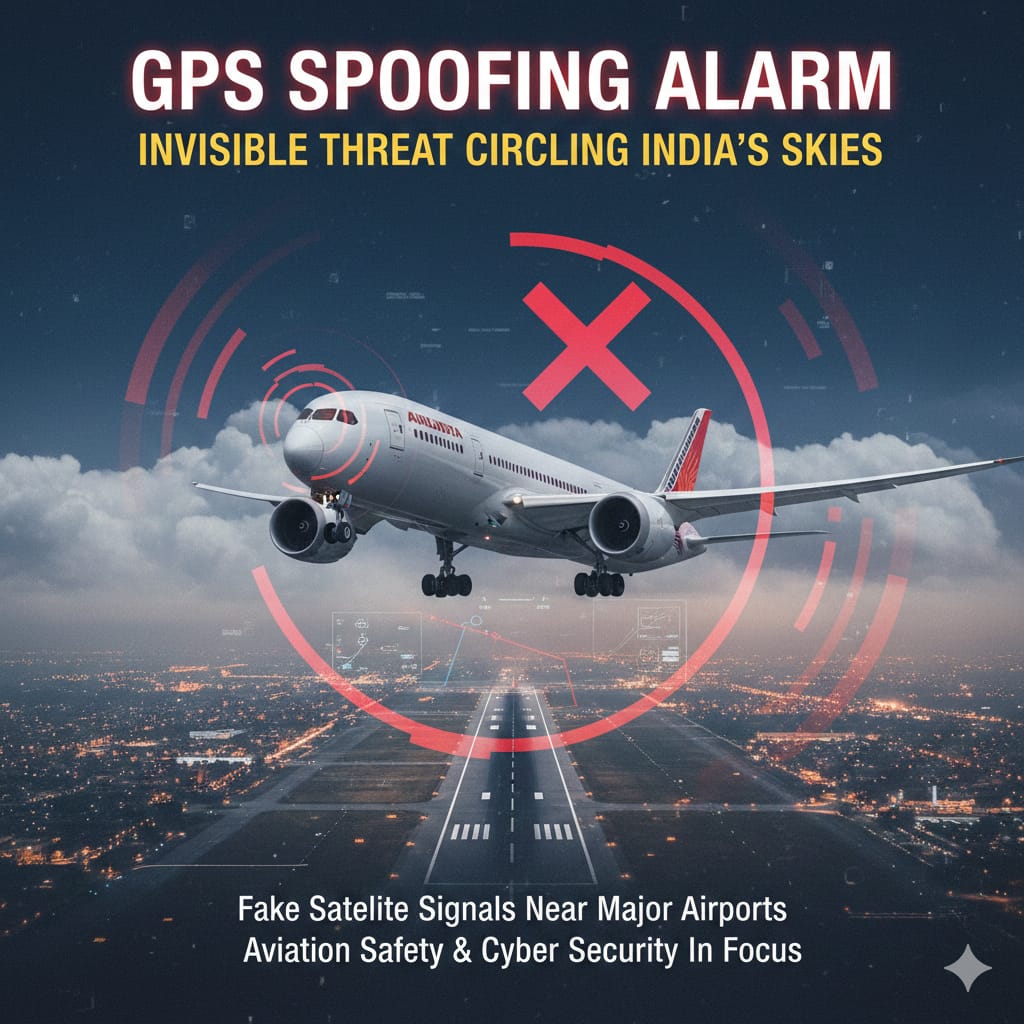
Imagine a pilot on final approach to Delhi’s Indira Gandhi International Airport, descending through clouds, trusting the aircraft’s navigation system to guide the way. Suddenly, the GPS thinks the plane is somewhere else. No alarms, no dramatic failure – just quiet, invisible manipulation of position data. That is the unsettling reality behind the recent reports of GPS spoofing and GNSS interference around Delhi and other Indian airports, now serious enough for the government to brief Parliament and rope in spectrum sleuths to hunt for the source.
GPS spoofing sounds like science fiction, but in practice it is chillingly simple: counterfeit satellite-like signals are transmitted from the ground to trick receivers into calculating a wrong position, time or navigation solution. In aviation, where every metre and every second matters during take-off and landing, such deception can have serious safety implications. Unlike jamming, which works by overpowering genuine satellite signals with noise and making them unusable, spoofing actively lies to the aircraft, feeding it false data while appearing “normal” to onboard systems until anomalies are detected.
Civil Aviation Minister K K Rammohan Naidu, in a written reply in the Rajya Sabha, confirmed that flights around Delhi airport had reported GPS spoofing while using satellite-based landing procedures, particularly on Runway 10.
Pilots had to switch to contingency procedures after detecting the problem. Fortunately, Naidu clarified that flights using other runways equipped with conventional ground-based navigation aids were not affected, and there was no disruption to overall flight movements. But the pattern of incidents and their spread has raised eyebrows within the aviation community.
This is not a Delhi-only issue. Since the Directorate General of Civil Aviation (DGCA) made reporting of such incidents mandatory in 2023, regular inputs have started coming in from several major airports.
According to the minister, GNSS interference reports are being received from Kolkata, Amritsar, Mumbai, Hyderabad, Bengaluru and Chennai as well. November, insiders say, saw a spike in such cases around Delhi. With India steadily shifting to satellite-based navigation for more efficient airspace use and precision approaches, the timing and concentration of these disruptions are particularly worrying.
To respond, the Airports Authority of India (AAI), which manages civil air navigation services, has turned to a specialist agency: the Wireless Monitoring Organization (WMO) under the Wireless Planning & Coordination (WPC) Wing of the Telecom Ministry. WMO is essentially the country’s spectrum watchdog, tasked with ensuring interference-free use of the radio spectrum.
In a high-level meeting, it was directed to mobilise more resources and use approximate spoofing location data shared by DGCA and AAI to possibly identify where these hostile or malfunctioning signals are coming from.
Regulators are also tightening procedures on the operational side. On November 10, the DGCA instructed airlines, pilots and air traffic controllers to report any GPS spoofing or GNSS interference within 10 minutes of detection. Faster reporting improves the chances of triangulating sources, identifying patterns and issuing timely advisories to other aircraft in the vicinity.
At the same time, India is consciously retaining a “Minimum Operating Network” of conventional, ground-based navigation and surveillance aids, in line with global best practices, so that the system does not become dangerously dependent on satellites alone.
There is a bigger cyber story behind this technical issue. Naidu flagged ransomware, malware and broader cyber threats as growing risks for aviation infrastructure. AAI, he said, has been rolling out advanced cyber security solutions for its IT networks and systems, following guidelines from the National Critical Information Infrastructure Protection Centre (NCIIPC) and CERT-In.
The underlying philosophy is clear: both the digital backbone and the radio-frequency environment of aviation are now critical infrastructure, and both are under potential attack.
Globally, GPS spoofing has already been observed around conflict zones and strategic regions, from Eastern Europe to West Asia, often as a byproduct of military operations or deliberate signalling. India’s recent experience, especially around its busiest airport with four runways and heavy international traffic, is a reminder that this invisible battleground has arrived at home.
As air traffic grows and satellite-based navigation becomes the norm, the challenge will be to stay one step ahead of those who can quietly bend radio waves – and with them, the map in a pilot’s cockpit.

