
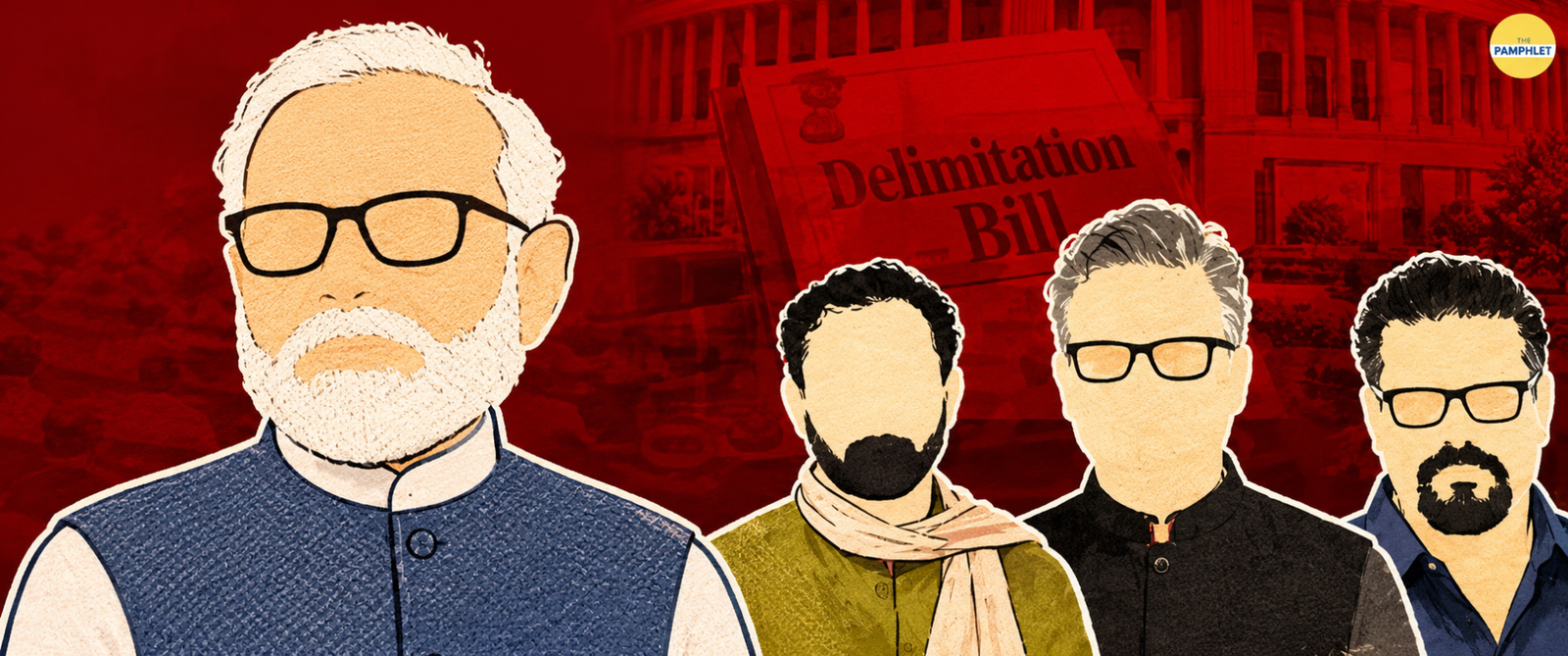
A map of India spreads on the screen with the southern states coloured. The word rotating like a fidget spinner in the video-explainer is “gerrymandering.” The expert is a seasoned editor of the UPA-era. He is heard during the Modi era. And that nearly shapes most of his views. He is one of the media personalities who delivered reactions on the delimitation bill even before the opposition declared its three major demands on it. His election analysis on Indian television becomes like a coveted scoop of Turkish ice-cream. The tip of the cone is shoved to your face everytime the BJP seems to be doing well or storming the scene. The top of the cone is poked up and down, swirl-and-swap, when the opposition bites Modi. During the last 12 years, the former has happened often. But at this point, the last month of 2026, months before Uttar Pradesh goes to vote, the anchor seems slightly exhausted. In his universe: “Modi has found his mojo back.” He criticises the linking of the women’s reservation quota to the delimitation process – like his peers. He hints that Tamil Nadu and other states in the south of India are set to lose around the delimitation bill. And then, a few days later, the DMK declares support for the delimitation bill. Modi doesn’t find his mojo back, sir. Mojo finds Modi. Modi forms new connections backed on the constant presence of “mojo”.
‘EYE ON THE BALL’, CAMPAIGN OF DOUBT BEGINS
For some of them, that the two are linked, is a “matter of shame”. They all agree – states in the south of India are the perceived victims of the proposed delimitation bill. They are the “ball” watchers for the opposition, when the opposition, perceivedly, “loses the sight of the ball”. They have the byline. They have the bounce of the speech.
They are not quite pleased with the opposition. According to one editor, the opposition “lost sight of the ball” and “Modi has found his ‘mojo’ back. He looks upset, but the tradition of seeming neutral keeps his face without lines of expression. And there he differs from many of his peers, who prematurely indulged in the exercise of sprinkling the national conversation on the delimitation bill with words “gerrymandering”, “big brother”, “suddenly”, “delimitation bill linked to the women’s quota”. And he is not alone. There is an entire ecosystem of commentators out to discredit the delimitation process and the bill. The verdict was out even before the bill reached Parliament.
Ahead of the special sitting of Parliament the coming week, three events have taken place. They have happened simultaneously. A correction: one took place slightly before the other. The anchor and his peers became active with commentary on the delimitation bill soon after the statement of minister Kiren Rijiju. The mention of “very significant” business during the “upcoming session of Parliament” in reports on Rijiju’s statements, triggered speculations on the proposed delimitation bill. The doubt-spreading machinery ignited engines and sparks flew.
Statement. Doubt. Doubt. Statement. Conclusion. Doubt. Statement. Doubt. The old pattern is here – once again. “The bill has suddenly come up.” And. “It is a sudden session on Tuesday.” And. “By the time the government has taken decisions on the bill, it will be too late.” And. “People get just Monday to look at the bill.” And. “Tamil Nadu will not lose seats, Amit Shah said, but the southern states are set to lose.” And. “BJP is shifting the balance of power in its favour.” More. “It is because the BJP is stronger in the North of India.” And. “Hindutva belt” and all that. And. “Yes, the government will increase the seats, but will there be a change in the proportion?” And. “If the government manages to pass the bill that it has suggested it will, it will make people happy.” And a big one. “If they are passing the bill, why the skullduggery, the subterfuge, why do it suddenly, it is not clear.”
OPPOSITION’S EXPECTED POLITICAL MANOEUVRES: MEDIA’S TALKING POINT
There is some lashing at Modi and BJP because the party “worked on other parties” in the absence of a simple majority “while the Congress was celebrating.” To such you might ask: ‘What exactly was Congress celebrating’. Never mind. Some of them are not exactly excited to see that Modi managed to reinstall the BJP-SAD alliance.
Others are ranting because the government might “get the support of the 20 odd defectors from the TMC.” Yet others are trying to remind the DMK that the last bill was destroyed by them and this time they might support the bill if Tamil Nadu does not lose seats. Supriya Sule, the popular leader of the Sharad Pawar faction of the NCP is the target of direct and indirect taunts from the assorted anchors and editors. The simple imagery it reminds one of is of the teacher telling the first bencher in the classroom that her fresh liking for basketball is affecting her grades. There is also a wide room for moral science lessons in “conscience” and “ethics” for Sule, Modi, the DMK-collectively, speaker of the Lok Sabha, Gyanesh Kumar, the Hindi belt, the “North”. There is none for the Congress.
Another event to have taken place before the special sitting of Parliament the coming week is that the Union Cabinet cleared a Constitution amendment Bill. Reports say that the bill is tagged with constituency delimitation and the implementation of 33 per cent reservation for women in Parliament and state legislatures. The Indian Express has reported “that the proposal hikes Lok Sabha seats by 50% across states, freezes inter-state ratio until 2051, demarcation basis to be 2011 Census.” The Union Cabinet has cleared the Constitution (One Hundred and Thirty-Second Amendment) Bill, 2026. The meeting was chaired by PM Modi. And reports say that it “provides for increasing the maximum strength of Lok Sabha to 850 and of Assemblies to 650.” The increase of seats in the Lok Sabha will not be acceptable to Congress. It has made the point clear. Union Cabinet cleared the Constitution amendment Bill on Friday. Reports say that the bill is tagged with constituency delimitation and the implementation of 33 per cent reservation for women in Parliament and state legislatures. The Indian Express has reported “that the proposal hikes Lok Sabha seats by 50% across states, freezes inter-state ratio until 2051, demarcation basis to be 2011 Census.” The three demands for Congress as stated in reports give an indication of its stand in Parliament.
“GERRYMANDERING”: WORD LOADED BEFORE FACTS ARE EXAMINED
People in the media opposed to the delimitation bill promptly decided that the word “gerrymandering” was the flavour of the season. Whether the government calls it “essential constitutional practice”, they would call it a political exercise from Modi who has “found his mojo back”. To be fair, the use of “gerrymandering” falls short of originality. It has foreign context and then it was used by Rahul Gandhi who alleged that BJP will gerrymander seats. It does not matter to the sections of the media endorsing the word “gerrymandering” in the delimitation-context that the exercise will not be done by the government but by a judge-led commission.
They have cast the shadow of doubt on the government, as expected, by stating, already, that the commission and the judge will be “chosen by them”. Who is “them” here – you ask? “Them” is the government. They have declared that the Supreme Court judge – sitting or retired, heading the delimitation commission, along with the officials, will be “chosen by them”.
This section of people in the media will not hear that the rule book is fixed. They will still scream “government influence”. The fact that every draft will head to the public and the public-eye first will not matter to them.
Do you have more facts to roll? Bring them on. Say that 130 public hearings in 24 states were held by the Commission in 2008 with the draft going to the public first. They will swipe left. The “gerrymandering” fanclub will “unhear” the public opinion even. They might even cancel the Delimitation Commission, in a row, after the election commission.
To the prejudiced, facts do not matter. Their verdict on Modi – he is going for the delimitation bill to “increase elections because only the BJP has the machinery and money to fight them”, “the BJP will take seats that are meant for the minorities”, the “South is set to lose with an increase in seats.” and so on. Allegations of “gerrymandering”, “favoritism”, “influencing”, and “shifting the balance of power in BJP’s favour” – despite facts that delimitation brought favourable results for the National Conference- Congress alliance, saw Gaurav Gogoi winning Jorhat in 2024, kept Congress and BJP on the equilibrium in the 2024 Lok Sabha poll, and gave Sachin Pilot victory in Ajmer after he shifted from Dausa – which became a reserved seat after delimitation–in the party’s traditional bastion. Remind them – the Supreme Court said in 2024 that courts can strike down any map that is manifestly arbitrary, and the Modi-mojo watchers will crumple the paper and pop it in the grudge-bin. They have the sight on the ball when the opposition perceivedly loses sight on the ball.
In places, they appear miffed with the public for not sustaining the anti-SIR protests. Commentators like these love to imagine politics as an exotic mushroom reserved for the elite. They are bound to be disappointed. Politics thrives on intention. It draws from the purposes of those invested in it. In a Modi-dominated scenario, it has ceased to be the static mass of mould fixed on a dynastic chair, rather, it moves, shifts, draws and bleeds through the temporal battles being fought by those in his opposition. It draws the fragrance of people’s mood, sweat and exuberance, and gets smeared by it.
THE “COMEBACK” STORY IS THE WRONG STORY
It stands brave but affected, through the tint of perceptions that the opposition and sections of the media aligned with it, inject into the public discourse. Even as internal strife, changes and defeats in the opposition camps kept its leaders busy, Modi seemed to be patient with them while undertaking his own victory laps. Modi’s persistence against efforts to destabilise him does not invalidate his opponent’s continuous prejudice against his being in power.
Let’s take a look back. In May, when the Cockroach Janata Party threw itself into the opposition’s political tent, Modi’s government was engrossed in making the re-NEET examination water tight and the glitch free, eventually conducting it successfully. This would not take place without Dharmendra Pradhan – his subordinate himself resigning after bringing all corrective measures in place. Pradhan’s resignation was a matter of debate within Modi’s support base and many thought that Pradhan should have been retained.
While the protests were on, in July, the Rajya Sabha today passed the Public Examinations (Prevention of Unfair Means) Amendment Bill, 2026, after the Lok Sabha passed it. Strengthening the integrity of public examinations had been on the agenda of the Modi government – evident in how the Amendment Bill in 2026 sought to further strengthen provisions the “Public Examinations (Prevention of Unfair Means) Act, 2024 by providing for fast-tracked investigation, speedy trial through Special Fast Track Courts, appointment of Special Public Prosecutors, time-bound disposal of appeals and more stringent penal provisions to effectively deter unfair means and organised malpractices in public examinations.”
Simultaneously on Modi’s work-spectrum was launching projects worth crores and undertaking his tour of diplomatic engagements in UAE, Netherlands, Sweden, Norway and Italy. Between May and October, the time period during which the CJP jumped issues and was seen directly getting support from Congress and other opposition parties, Modi participated in the G7 and SCO forums, India successfully hosted the 18th BRICS Summit under its chairmanship. In those three months, Modi announced and dedicated to the public major infrastructure, railway, industrial, transport projects across India and has asserted his agenda on India’s advance semiconductor, telecom, AI and nuclear-energy ambitions.
With a hawk’s-eye focus on institutional, security, technology and development-related projects and outcomes, he remained unperturbed by the curation of the quick political sequences arranged by those who levelled the allegations of “vote chori”. These were, besides being the signs of Modi’s “teflon-like” perusal of his nation’s development goals. He is long past the shopping spree for popularity. The perceived scenario of a “comeback” hence is best a figment of wishful imagination. Particularly, because Modi’s stance during CJP’s borrowed-bounciness was of a political figure watching his opposition clutch to another straw for revival in the world’s largest democracy. He let it be, he had work to do, he always has work to do.
In public discourse he was comfortably mentioning the difference in opinion as one of the indications of a healthy democracy, just as he has in and during Parliamentary debates. In August: Modi dedicated to the nation multiple development projects worth over ₹17,900 crore in Bhogapuram in Vizianagaram, Andhra Pradesh. Inaugurated the Alluri Sitarama Raju International Airport at Bhogapuram, set the foundation for Andhra Pradesh’s First Semiconductor Manufacturing Facility. September brought the visit to Uzbekistan and Kyrgyzstan, including participation in the SCO Summit in Bishkek. In Gujarat and Maharashtra, the nation got three sections of the Western Dedicated Freight Corridor — covering 326 route kilometres, and the launching of more projects worth over ₹35,000 crore. The momentum of similar tasks and events in his regular work calendar continued. What Modi and a huge section of Indians understand is that the scale of protests to oppose Modi is always backed by prominent politicians in the opposition known for hurling abuses at him and his family members. And that has been the least of the concerns for Modi. For him, the bigger picture takes the bigger picture. And the bigger picture is that he did not need to communicate directly with the larger mass. The protests did. The opposition itself did – by trapezing from one flashpoint to another. Without explanations, with convenience, with smooth transition, with comfort, with slogans that have been familiar in the political memory. Facts and numbers from the Election Commission did. Rebuttals did.
The truth is simpler to understand than going for the delusion of Modi’s “mojo” disappearing and reappearing. Darbari columnists are as confused as convinced they are pretending to be. CJP’s temporal buoyancy made them believe that a section of young people “treating him as a figure of fun” in the wake of the NEET protests translates to larger political validation of the “fear he had instilled in Indians began to evaporate”. Which fear? Is the perceived “fear he had instilled in Indians began to evaporate” making them elect him for three terms in a row after electing him rows together in Gujarat? The BJP has a government in 17 states and union territories under Modi’s leadership with NDA as a unit holding 22. That the BJP and NDA have secured victory in the Haryana civic polls, won 3 out of 4 municipal corporations in the Himachal civic polls (HP is a Congress ruled state), came up as the largest party in the Rajasthan urban local bodies and won majorities in 4 corporations, won Bengal Assembly by-elections, won 38 out of 44 seats in the Gandhinagar civic polls. In the Andhra municipal polls, the NDA alliance emerged winner, and repeated the feat in Andhra rural local polls.
THE PUBLIC IS NOT OBLIGED TO BUY EVERY PROTEST NARRATIVE
Celebrities in the durbari media have forgotten to make peace with the fact that democracy does involve people, that people align with the nation’s progress, and in preserving the momentum of the nation’s progress under Modi, the public has been exercising its own democratic powers. Not everyone is wooed easily or constantly by rabble rousers who are popularly identified with showing a soft corner for terrorists, the global Left, anti-Hindu forces, those who issue threats to the sovereignty of India, are anti-development. People celebrate good news when it involves India or Indians. It is no secret that in the age of social media and instant Instagram gratification, gathering protests based on negative sensationalism and verbal “hooks” is not difficult. Noting that the public was irked by the inconvenience caused by the prolonged protests and the profound loss to business caused by these protests during the festive season will not hurt journalism. The opposition did not lose the eye on the ball. The ball lost momentum on the thick pitch of facts and meaning. Modi has not recovered because there is no case for recovery. Instead, his firm-footedness is helping opponents look and appear strong. Sweet are the uses of creating adversity for Modi.
THE SELECTIVE SILENCE: WHEN GOOD NEWS DOES NOT FIT THE STORY
In Sanghvi’’s piece, the recurring notion that the Supreme Court is being “so supportive” of the government almost clashes with his deduction that Gyanesh Kumar is sticking around to keep Modi in power and for making him win the UP assembly election. Sticking out is the author’s potent displeasure that there is no bad news and there is ample good news and there is a constituency for it. For example the good news of the recovery of the stock market and the good news of nearly 50 crore Indians coming out of poverty — news not worthy or important enough to find a mention. Add to the weaknesses in the arrangement of his notions, the correlation between the decline in protests and an impression of “Modi’s recovery”.
The only point where the perception of Modi’s “recovery” does find room was during the roll back of farm laws, when his supporters thought that he was bending to political pressure, while standing by him, realising that he was doing it for India’s sovereignty and security. This was followed by pictures of PM Modi’s motorcade paused, motionless atop a flyover on the Bathinda-Ferozepur highway in January 2022, highlighting the extreme vulnerability of the occupant for around 20 minutes in a security breach. The picture presented evidence of Modi’s exposure to risk and possible adversities. When Modi recovers, his recovery is about his own supporters compounding their loyalty, about the dangers they see him defeating or surpassing, and what they do next to express it. It has not been so much about his critics invalidating his efforts. Years later, Modi and his party would manage to re-establish their alliance with the Akalis in Punjab with a warm exchange of statements dedicated to the people of Punjab and the state. This aspect, too, is skipped in the piece.
THE REAL POLITICS OF DOUBT: FROM SIR TO DELIMITATION
In such quarters of media-polity, the quest for disrupting Modi’s stability carries more attraction and serious heft than giving Modi healthy criticism in his work for India’s development, stability, sovereignty, security, and governance. In the sphere of SIR protests, the public was expected to believe the narrative that 13 crore votes have been deleted by Gyanesh Kumar. As soon as the election commission gave a pointed explanation, addressing each allegation with facts pertaining to the figure, the claims crumbled. The long phrase of “as deceased, permanently shifted, absent or untraceable, and duplicate entries” replaced the coveted jewel of a figure of 13 crore in headlines. Resultantly, the protests became hard to sustain. Attacking institutions and calling bills unconstitutional can deliver a style of politics. It cannot, however, convince the general public that the argument they are expected to stand up for, would sail its course without credibility and consistency. Even before MPs meet again in the special session, durbari media is smearing Modi’s positive intentions with their agenda in the national conversation against the delimitation bill. This genuflecting at the alter of the politics of doubt is editorial gerrymandering. It should stop. At least before others join the DMK in support of the delimitation bill.

