
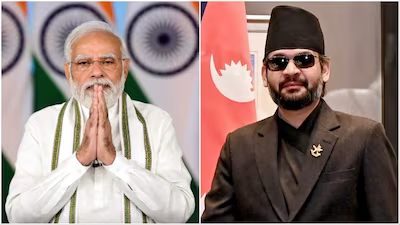
Remember the endless lectures about how India is supposedly losing friends, becoming isolated in its neighbourhood and watching its influence disappear? Well, somebody might want to update the script.
Prime Minister Narendra Modi has just had a rather productive meeting with Nepal’s new Prime Minister, Balendra ‘Balen’ Shah, delivering an approximately ₹15,000-crore development package, eight agreements and a series of major infrastructure initiatives.
Apparently, India’s diplomacy is not quite as dead as some people desperately want us to believe.
The biggest announcement was India’s development assistance package worth 24,000 crore Nepali rupees, approximately ₹15,000 crore. The assistance will support Nepal’s reconstruction following devastating floods and contribute to its long-term development.
But why stop at writing a cheque when you can actually get things moving?
India and Nepal signed eight agreements covering satellite communications, policing, forensic sciences, civil service training, healthcare, Ayurveda, sustainable urban development, and livestock and fisheries.
Imagine that! Diplomacy involving cooperation, institutional development and concrete deliverables. No need to manufacture a diplomatic crisis every other week to convince people that something is happening.
Ayodhya meets Janakpur: Connecting civilisational dots
One of the most interesting announcements was the Saryu-Kamala Express connecting Ayodhya with Janakpur Dham. The approximately 604-km journey will take around 19 hours, with regular weekly services scheduled to begin on November 28.
For those unfamiliar, Janakpur is revered as the birthplace of Goddess Sita, while Ayodhya is associated with Lord Ram. Connecting these two important religious destinations is a wonderful example of shared heritage being translated into modern connectivity.
Who needs to manufacture artificial cultural connections when centuries of shared history already exist?
The leaders also inaugurated the Dharchula-Darchula motorable bridge, dedicated the second phase of the Motihari-Amlekhgunj petroleum pipeline and advanced several infrastructure projects.
These include an integrated check post at Banbasa, an oil storage terminal in Jhapa and the 669-MW Lower Arun hydropower project.
Bridges, pipelines, energy security and connectivity. Not particularly glamorous compared with shouting about foreign policy on television, but considerably more useful to ordinary citizens.
India has also reiterated its commitment to supplying Nepal with essential commodities, including petroleum products and fertilisers.
And this is where India’s neighbourhood diplomacy deserves attention. Being a major power does not mean treating smaller neighbours as insignificant. It means having the economic capacity, political will and strategic vision to help them grow alongside you.
Of course, the usual foreign-policy experts will probably find a way to explain why this is somehow a failure. Perhaps the ₹15,000-crore package wasn’t accompanied by enough dramatic press conferences?
But the facts remain: eight agreements, a substantial development package, railway connectivity, energy cooperation and infrastructure projects.
While some are busy writing India’s diplomatic obituary, New Delhi is busy building bridges with its neighbours.
Literally.
Turns out, India’s Neighbourhood First policy is not just a catchy slogan. It involves putting money where the mouth is. What an inconvenient development for the doomsday brigade!
Improve accuracy for writing and career work

