
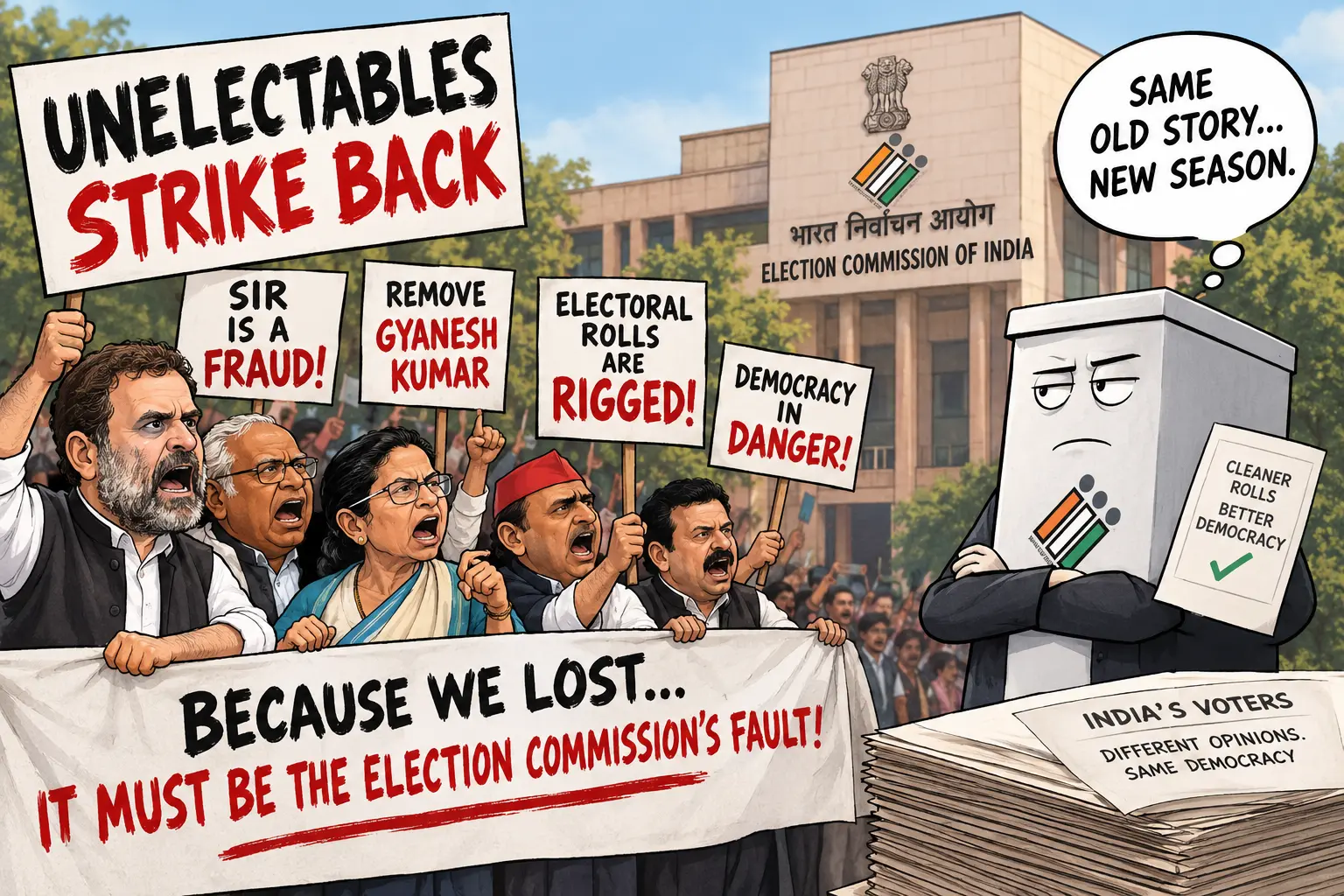
There is a peculiar problem facing some Indians. They want to govern India without having a ballot cast for them, but India keeps insisting that only those they vote for should govern India. And now, apparently, the Election Commission must answer for this terrible inconvenience.
On Friday, October 23, protesters are planning a march in Delhi against the Election Commission, with demands centred on Chief Election Commissioner Gyanesh Kumar and allegations of irregularities in electoral rolls. These unelectable, self-styled civil society members have repeatedly questioned the Special Intensive Revision (SIR), claiming that eligible voters risk being excluded. The Election Commission, meanwhile, has repeatedly clarified that the exercise is intended to clean up electoral rolls.
Welcome to the politics of the unelectables- If voters refuse to deliver the desired verdict, perhaps the institution conducting the election must be put on trial. The ones who are going to be part of the October 23 protest are Cockroach Janta Party (CJP) founder Abhijeet Dipke, Neha Bora and Aishe Ghosh, and senior advocate Prashant Bhushan. Parakala Prabhakar, actor-activist Prakash Raj, farmer leader Rakesh Tikait and Gandhi’s grandson Tushar Gandhi have also been invited to the protest.
For years, the Opposition has promised to defeat the BJP. When it wins, the result is celebrated as proof that democracy is alive. When it loses, democracy suddenly needs intensive care, emergency surgery and, preferably, a new Election Commissioner.
One can almost imagine the proposed protest’s ideal outcome – The Election Commission resigns, the electoral system apologises, and the next election is conducted under rules that guarantee the Opposition a more emotionally satisfying result. Throw in some looting of ballot papers as well as EVMs being evil aliens.
Of course, allegations of electoral irregularities deserve investigation. If eligible citizens have been wrongly removed from voter lists, they must have an effective way to get their names restored. An independent Election Commission must also answer legitimate questions about transparency and procedure. These are serious democratic concerns, not matters to be dismissed merely because opposition parties raise them.
But there is a difference between demanding accountability and treating every institution as illegitimate whenever its decisions become politically inconvenient. Evidence must establish wrongdoing – a microphone, a slogan and a gathering of angry politicians cannot substitute for it.
The irony is that India’s electoral system has repeatedly delivered victories and defeats to different parties, at the national and state levels. The same electorate that rejects one party in one election can reward it in another. That is democracy’s inconvenient beauty that nobody owns the voter.
Yet some people appear determined to turn every defeat into a constitutional thriller, complete with villains, conspiracies and dramatic announcements about the death of democracy.
Perhaps the Opposition should consider an alternative strategy. Instead of assuming that the referee must be corrupt whenever the match is lost, it could persuade more voters to support its team.
The ultimate protest against an electoral defeat is not a march against the ballot. It is building a better case before the next ballot is cast.

