
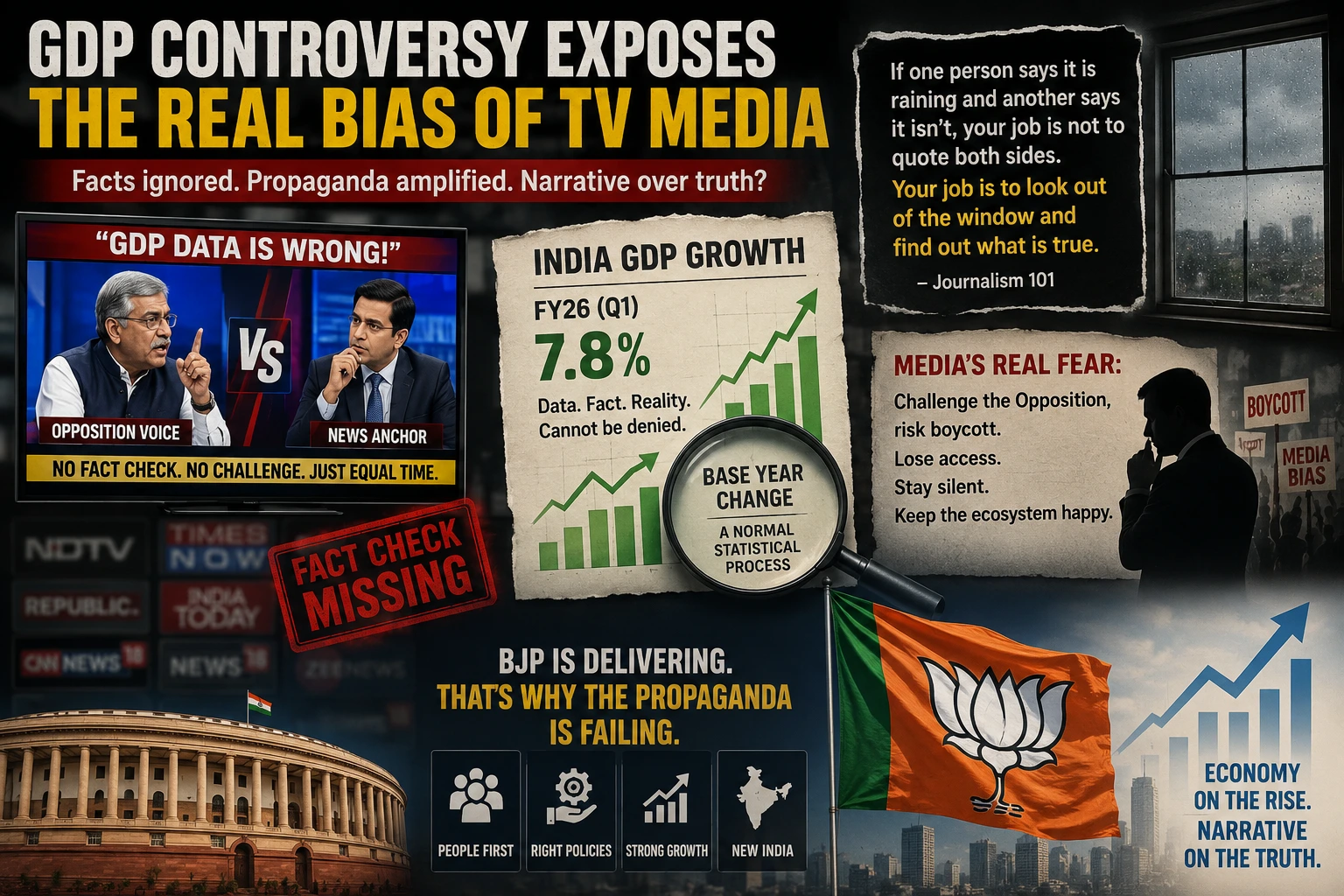
The recent controversy over India’s GDP growth rate has made one thing abundantly clear, the Opposition’s constant allegation that television news media is “Godi Media” is far from the truth. If anything, television media continues to lean heavily towards the Congress and the broader Opposition ecosystem. The 7.8% growth rate has really hurt the opposition ecosystem willing for Modi government to fail, and now they are disputing this figure and media is helping them push this propaganda.
The only reason the BJP appears immune to much of this criticism is that it is, quite simply, on the right track and delivering tangible results for the people. The media may try to challenge the BJP, but it is increasingly finding it difficult to make a dent in the government’s credibility because the facts on the ground do not support the narrative.
Imagine, for a moment, if the BJP were in Opposition and employed the same kind of propaganda that the Congress and its ecosystem routinely engage in. The very same television channels would have torn the BJP apart.
Now consider the GDP growth rate controversy. GDP growth is not an opinion. It is data. It is a measurable economic indicator. It is a fact. Changing the base year is also a standard statistical exercise undertaken to ensure that economic data better reflects structural changes in the economy.
Yet, despite this, a person appears on television, dismisses the officially reported data and presents his own alternative figures without establishing any credible basis for them. And what does the media do? It simply reports the claim.
There is little meaningful fact-checking. Even television channels that specialise in business and financial reporting failed to adequately scrutinise the claim. This is particularly surprising because these channels have access to economists, statisticians and financial experts who could have immediately examined the argument and explained whether it had any merit.
The irony becomes even greater when you recall the favourite analogy often used by critics of television media, “If one person says it is raining and another says it isn’t, your job is not to keep quoting both sides. Your job is to look out of the window and find out whether it is actually raining.”
That is precisely what the media should have done here.
It should have immediately examined and challenged Subhash Garg’s allegations instead of presenting them as just another side of the story. Journalism is not merely about providing a platform to competing claims. It is also about establishing what is true.
Why, then, did the media hesitate?
The answer may lie in the fear of the Opposition ecosystem. If a channel directly challenges a prominent Opposition figure, it risks being labelled biased, boycotted by Opposition leaders, and potentially losing access to Opposition sources and coverage. In an intensely competitive television news environment, access matters.
So, even when journalists and editors may know that a claim deserves scrutiny, there can be an institutional reluctance to confront it.
To its credit, the BJP’s aggressive response and political messaging appear to have neutralised much of the Opposition’s narrative. But the episode should still serve as a warning.
When facts themselves become negotiable on television as the media companies chase views, everything else becomes a matter of narrative.

