
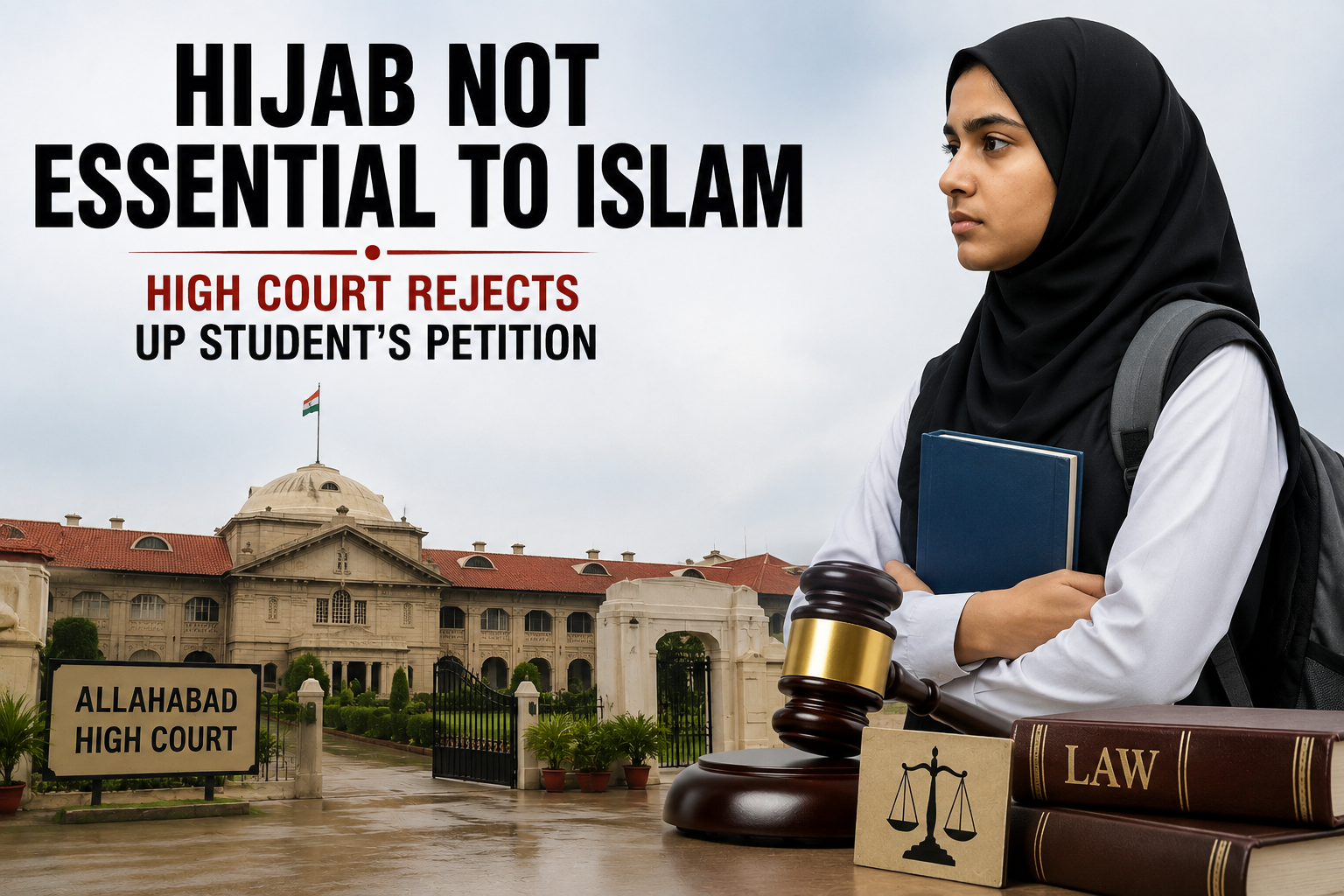
The Allahabad High Court has dismissed a petition filed by a Muslim student seeking permission to wear a hijab along with her prescribed school uniform, ruling that the petitioner failed to establish that wearing a headscarf is an essential religious practice protected under Article 25 of the Constitution.
The case involved a minor student from a private school in Prayagraj who had completed Class X and was seeking admission to Class XI at the same institution. Through her mother, she approached the court seeking permission to continue wearing the headscarf, which she claimed to have worn since Class VI. The school administration, Uttar Pradesh government, and even the CBSE opposed the plea.
A Division Bench of Justices J.J. Munir and Indrajeet Shukla held that the student had not placed sufficient material before the court to demonstrate that wearing the hijab was an essential and obligatory practice of Islam. The court relied on existing legal precedents and concluded that the argument could not override the institution’s uniform policy.
Importantly, the ruling also dealt with the broader issue of school discipline and uniformity. The court held that a private unaided school can enforce a uniform policy when the dress code is bona fide, uniform and non-discriminatory. Allowing individual students to add religious clothing to a prescribed uniform, the court observed, could undermine the very concept of a common uniform.
The judgment does not mean that Muslim students are prohibited from wearing hijab everywhere. Rather, the immediate issue before the court was whether a student could claim a constitutional right to wear the headscarf despite a school’s prescribed uniform.
The Allahabad High Court’s ruling reinforces a key principle- religious freedom and institutional rules can sometimes intersect, and courts may uphold reasonable, non-discriminatory dress codes even when students seek exemptions on religious grounds.

