
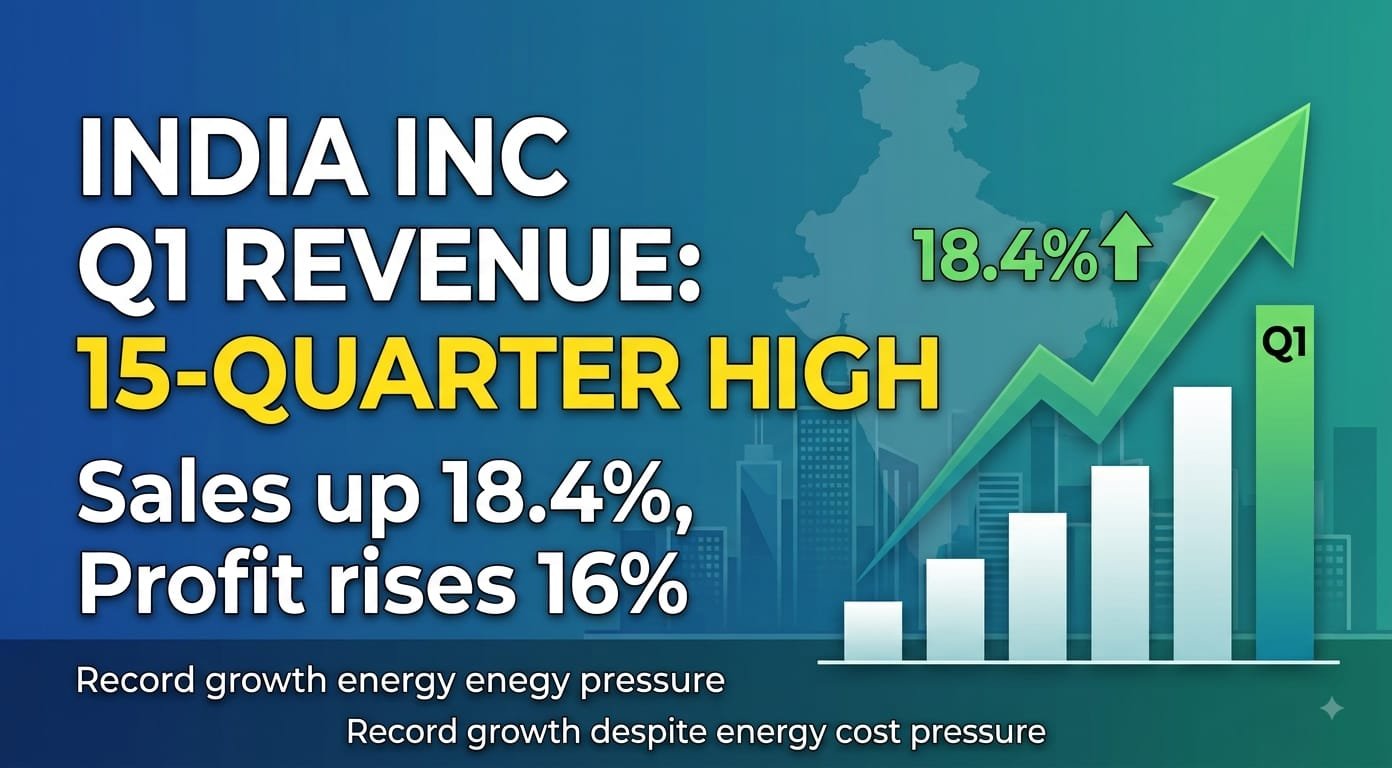
India’s corporate sector began the financial year 2026-27 with strong growth in sales and profits. Listed companies recorded their fastest revenue growth in 15 quarters during the April-June quarter, commonly known as the first quarter or Q1. The performance indicates that business activity remained firm despite higher energy prices and increased operating costs.
The combined net sales of 3,458 companies increased 18.4 percent year-on-year to nearly ₹47.27 trillion in Q1FY27. In the same quarter a year earlier, sales had grown by around 6 percent . The latest growth was also higher than the 11.8 percent increase recorded in the March quarter of FY26. This sharp improvement suggests that demand, pricing power and sector-level activity supported corporate revenues during the quarter.
Profit growth also remained healthy, although it was not as strong as the rise in sales. Adjusted net profit increased 16 percent year-on-year to about ₹4.58 trillion, compared with nearly ₹3.95 trillion in Q1FY26. Profit growth had stood at 8.9 percent in the first quarter of the previous financial year and 16 percent in the March quarter. The figures show that companies continued to earn more, but the pressure on costs remained an important concern.
The main challenge came from energy prices. Higher fuel and power costs increased the expense of running factories, transporting goods and providing services. This reduced operating margins even when sales improved. In simple terms, companies earned more from customers, but a larger share of that income was spent on energy and other operating needs.
Mining and metals companies emerged as the strongest performers during the quarter. Their combined net profit rose 45 percent from a year earlier. The improvement was supported by stronger realisations and better business conditions in the sector. Finance companies followed with 28 percent profit growth, while banks recorded a 20.3 percent increase.
Banks, non-bank lenders, and mining and metal companies together contributed around 66 percent of the total year-on-year growth in corporate profits. Their combined sales or gross interest income rose 12.3 percent to nearly ₹12.1 trillion from around ₹10.8 trillion in Q1FY26. This shows that financial services and commodity-linked businesses played a major role in lifting the overall corporate performance.
Banking and finance companies benefited from steady credit demand and continued financial activity. Banks earn interest income from loans, while non-bank lenders support consumers, small businesses and larger companies through different forms of credit. When borrowing and repayment activity remain stable, the financial sector can contribute strongly to both revenue and profit growth.
The performance outside the top-performing sectors was more moderate but still positive. The combined net profit of the remaining companies increased 9 percent to approximately ₹2.6 trillion from nearly ₹2.38 trillion in the same quarter last year. This indicates that growth was not limited entirely to metals and financial services, although these sectors provided the biggest support.
Another industry assessment also showed strong revenue growth in the June quarter. Icra reported that revenue in its sample of 838 listed companies grew 22 percent year-on-year, compared with 13 percent in the preceding quarter. However, the rating agency noted that higher crude prices and pressure in the oil-refining sector affected profitability. Excluding oil and gas companies, operating margins remained stable at around 19 percent and net profit growth crossed 20 percent .
The wider message from the results is encouraging but balanced. Strong revenue growth suggests that Indian businesses are finding ways to increase sales through demand improvement, higher prices or better business volumes. At the same time, rising energy, freight and raw material costs could limit the pace at which sales growth turns into profit.
For households and investors, the results offer two different signals. The first is that business activity remains strong across important parts of the economy. The second is that future earnings will depend not only on sales but also on how effectively companies control costs. If energy prices remain elevated, companies may face continued pressure on margins in the coming quarters.
The Q1FY27 results therefore present a picture of resilience. India Inc has started the financial year with its fastest sales growth in 15 quarters and a healthy 16 percent rise in adjusted profit. However, the sustainability of this momentum will depend on demand, commodity prices, borrowing conditions and the ability of companies to protect their margins.

