
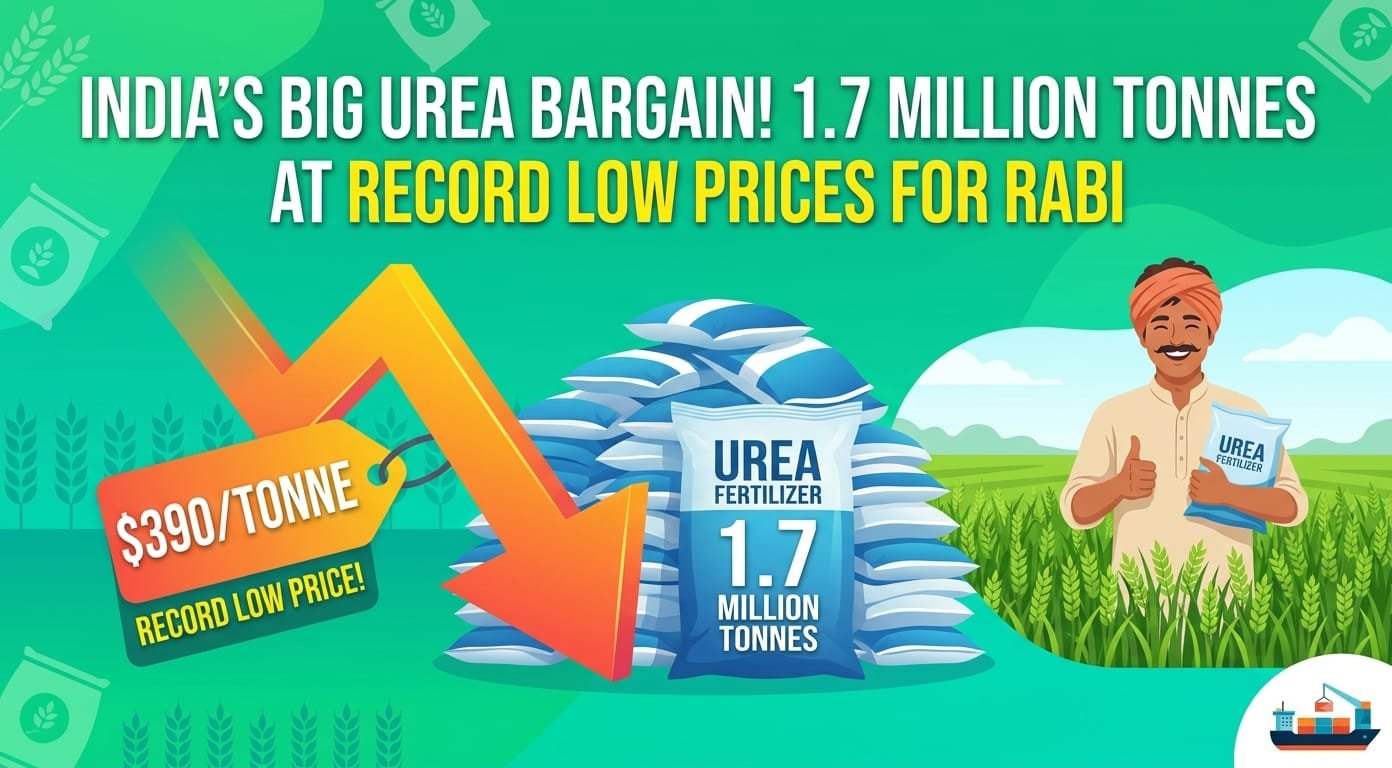
India has successfully arranged to bring in 1.7 million tonnes of urea from international markets at prices that are significantly lower than what was paid in earlier deals.
This move is expected to help farmers during the rabi cropping season, which begins after the monsoon and runs into the spring months. The new import price ranges between $390.25 and $393.65 per tonne, which includes the cost of the fertiliser plus shipping charges to Indian ports.
This is a big drop compared to previous contracts, where India had to pay between $444.9 and $449.3 per tonne in June, and even as high as $935 to $959 per tonne in April when global markets were tight due to geopolitical tensions.
The latest deal was finalised through an international tender floated by Rashtriya Chemicals and Fertilizers (RCF), a public sector company that handles urea imports on behalf of the government. The lowest bids came from Ameropa Group, a trading firm based in Switzerland, which offered competitive rates for deliveries to both the east and west coasts of India.
Such a sharp fall in prices has been possible because global supply conditions have improved, especially after China eased its export restrictions on urea earlier in the year.
When China had put a hold on urea shipments in March, it created a shortage in the world market, pushing prices up dramatically. But as exports resumed, the pressure on prices began to ease, giving importing countries like India a chance to negotiate better deals.
This development comes at a time when there were concerns about whether enough fertilizer would be available for the rabi season. However, officials have confirmed that there is no shortage of urea for either the ongoing kharif season or the upcoming rabi season.
In fact, India’s urea imports between April and June 2026 rose to 25.1 lakh tonnes, much higher than the 8.4 lakh tonnes imported during the same period last year. This shows that the government has been proactive in building up stocks to meet domestic demand, even when global prices were volatile.
The drop in urea prices is also good news for the government’s budget. Fertiliser subsidies make up a large part of agricultural spending, and when import prices go up, the subsidy burden increases. With the new lower rates, the overall cost of supplying urea to farmers at subsidised prices will come down.
This could allow the government to reassess its subsidy estimates for the current financial year and possibly redirect savings to other areas of rural development. Industry experts believe that if suppliers continue to offer low prices, India may even consider importing more than the originally planned 1.7 million tonnes to further strengthen domestic availability.
For farmers, the steady supply of urea at stable prices means that crop planning for the rabi season can go ahead without disruption. Urea is one of the most widely used nitrogenous fertilisers in India, especially for crops like wheat, mustard, and pulses that are grown in winter.
Any shortage or sudden price rise could have affected sowing decisions and ultimately farm incomes. But with the current situation, the outlook appears comfortable. The government has also been working to ensure that distribution networks function smoothly, so that fertilizer reaches even remote areas on time.
The urea market has seen a lot of movement over the past few months. In April, when tensions in the Middle East disrupted shipping routes, India had to import 2.5 million tonnes at nearly double the price it paid just two months earlier.
That deal was necessary to avoid a shortage during the kharif season, but it came at a high cost. Since then, the situation has changed. With the Strait of Hormuz reopening and China resuming exports, global prices have cooled down.
India has used this opportunity to lock in better rates, showing how timely decisions in import policy can protect both farmers and the national budget.
Looking ahead, India’s dependence on urea imports is expected to grow. Domestic production capacity has not kept pace with rising demand, and by 2030, imports could account for nearly 30 per cent of total consumption.
This makes it even more important for the country to stay alert to global price trends and secure favourable deals whenever possible. The recent tender is a good example of how strategic procurement can turn a challenging situation into an advantage.
In simple terms, what has happened is that India needed urea for its farmers, went into the global market, and found that prices had come down. Instead of waiting or buying small quantities at higher rates, the government moved quickly to secure a large amount at a low price.
This ensures that when farmers begin preparing their fields for the rabi season, they will have access to the fertiliser they need without any delay or extra cost. The entire process reflects careful planning and a focus on keeping agriculture stable, even when world markets are uncertain.
The story of urea imports is not just about numbers and contracts. It is about making sure that the people who grow the country’s food have the support they need.
When fertilizer is available and affordable, it leads to better harvests, higher incomes for farming families, and more food for everyone. The recent deal shows that with the right approach, challenges in the global market can be managed in a way that benefits both the economy and the common citizen.

