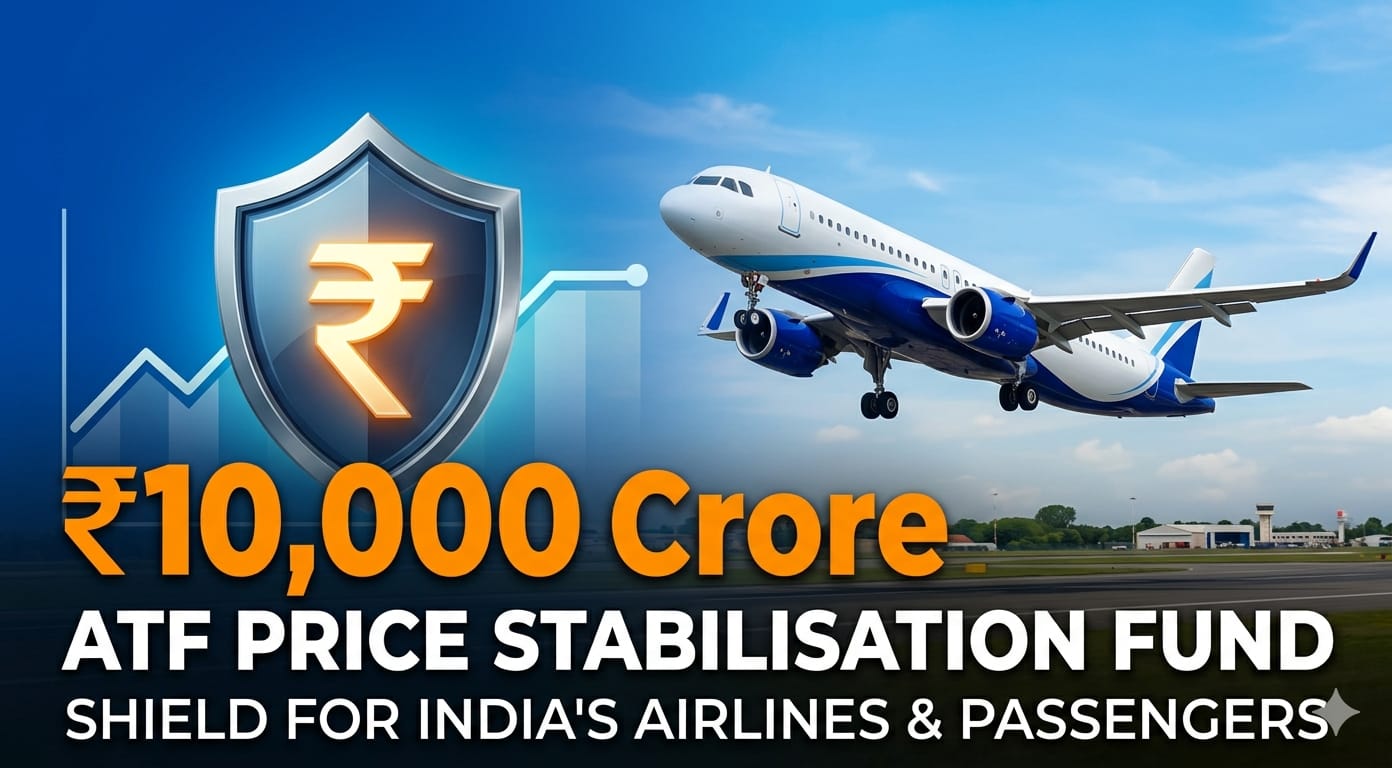
The Union Cabinet has given its approval for a ₹10,000 crore Aviation Turbine Fuel (ATF) Price Stabilisation Fund, a decisive move to protect India’s aviation sector from the sharp rise in jet fuel prices triggered by the ongoing crisis in West Asia.
This fund is designed as a self-sustaining revolving mechanism that will help airlines manage fuel costs without passing the full burden to passengers through steep fare hikes. The support comes at a time when international ATF prices have surged due to geopolitical tensions, putting immense financial pressure on airlines whose operational costs are dominated by fuel expenses.
The financial assistance will be provided as interest-free advances to state-owned Oil Marketing Companies (OMCs) through the Ministry of Petroleum and Natural Gas.
These companies will then supply ATF to scheduled Indian airlines at stabilised prices for both domestic and international operations. Under the scheme, OMCs will be compensated whenever international import parity prices exceed a benchmark price set under the mechanism, allowing airlines to lock in predictable fuel rates for up to 36 months.This fixed-price arrangement brings much-needed cost certainty to airlines, enabling better financial and operational planning.
The stabilisation support is available to all willing scheduled Indian carriers, covering both domestic and international flights. For domestic operations, ATF prices have already been capped at ₹75.6 per litre, but carriers purchasing fuel for international routes at import parity prices remained exposed to elevated costs until now. The new mechanism ensures that even fuel for international flights is covered under the stabilisation framework, closing a significant gap in earlier protection measures.
Once international ATF prices moderate, the differential amount will be recovered from OMCs and returned to the Consolidated Fund of India, making the arrangement self-recovering and fiscally responsible.
The fund will remain active for 36 months, subject to annual review or until the entire advance is fully recovered, whichever occurs earlier. A monitoring committee comprising representatives from the Ministries of Civil Aviation, Petroleum and Natural Gas, and the Department of Expenditure will oversee implementation, verify claims, and ensure audit compliance.
This structure ensures transparency and accountability while preventing misuse of the support. The government emphasised that the intervention is temporary and aimed specifically at navigating the current period of exceptional fuel price volatility arising from the West Asia crisis.
This move is expected to prevent disruption to airline operations and shield passengers from sharp fare spikes, while also ensuring continued air access to Tier-II and Tier-III cities, including airports operationalised under the UDAN scheme.
The aviation sector’s stability is crucial for maintaining India’s broader air connectivity goals and supporting economic activity that depends on reliable flight services. Following the announcement, IndiGo’s parent company InterGlobe Aviation saw its shares surge by up to 1.62%, reflecting market confidence in the relief measure.
Union Minister Ashwini Vaishnaw stated that ATF prices have risen sharply due to the conflict in West Asia, and the fund is aimed at cushioning the impact on both airlines and passengers.
Union Home Minister Amit Shah described the ₹10,000 crore fund as a shield against the global energy crisis, noting that it will buffer airlines from international price instability and ensure smooth operations. The initiative represents a targeted intervention during a challenging period, balancing fiscal prudence with the need to protect a strategically important sector.
For everyday travellers, the fund means greater chances of stable airfares even when global oil prices swing wildly. For airlines, it translates into reduced financial stress and the ability to plan routes and capacity without fearing sudden fuel cost shocks.
For the economy, it safeguards air connectivity that supports tourism, trade, and regional development. The self-recovering nature of the fund ensures that taxpayer money is not spent irreversibly, as the amount will flow back into government coffers once fuel prices normalise.
ATF price stabilisation fund, jet fuel price India, airlines fuel cost relief, ₹10000 crore aviation fund, West Asia crisis ATF prices