
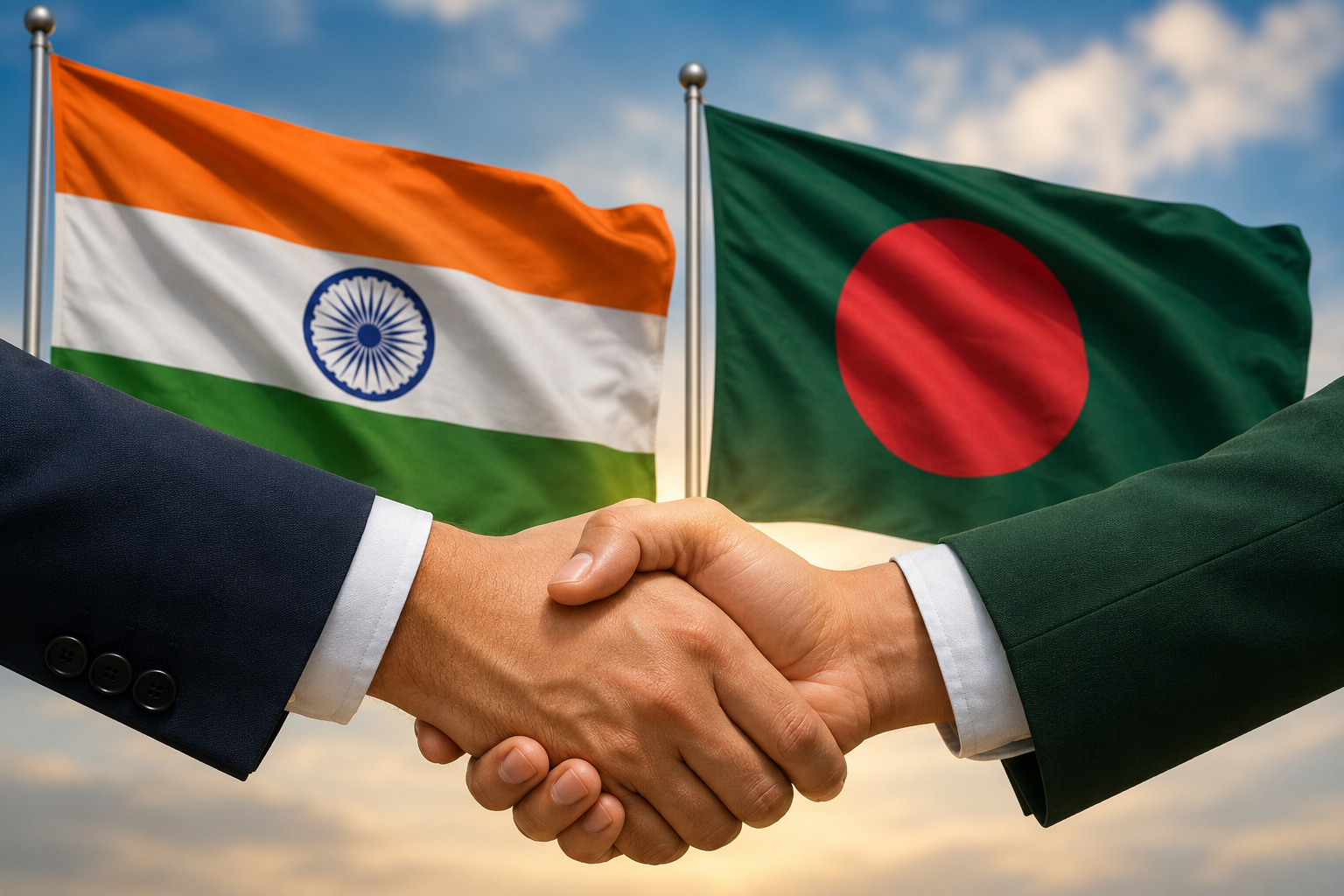
When Bangladesh’s Foreign Minister Khalilur Rahman landed in New Delhi on April 7, 2026, he carried more than a diplomatic agenda. His three days of talks with External Affairs Minister S. Jaishankar and National Security Adviser Ajit Doval signalled that one of South Asia’s most important bilateral relationships has been deliberately reset.
India has prepared the ground for this moment with characteristic patience. The appointment of senior political figure Dinesh Trivedi as High Commissioner to Dhaka, in place of the conventional career diplomat, was an early signal that New Delhi was investing political weight in the engagement. The MEA’s calibrated public messaging through the eighteen months following the August 2024 transition in Dhaka, steady, non-recriminatory, focused on shared interests, has now begun to deliver returns.
The structural logic of this partnership is what makes the patient approach correct. India shares its longest land border, 4,096 kilometres, with Bangladesh. The country flanks the Siliguri Corridor, sits across the access routes to India’s Northeast and occupies the northern littoral of the Bay of Bengal. Fifty-four rivers run between the two nations. A stable, cooperative Bangladesh is central to India’s Neighbourhood First Policy, its Act East ambitions and its maritime strategy across the Indo-Pacific.
The security foundation
What has held the relationship together through political turbulence is the security partnership. The biannual Director General-level talks between the Border Security Force and the Border Guard Bangladesh have continued uninterrupted across every phase of recent bilateral history. In February 2025, both forces established a new hotline between BSF Eastern Command in Kolkata and BGB headquarters in Dhaka, jointly identified 99 fresh patches covering approximately 70 kilometres for fencing work and strengthened night-patrolling protocols. That this institutional cooperation held at the lowest point of bilateral relations is the single most reassuring fact in the strategic picture.
The Doval-Rahman discussions in April have now elevated this further. Counter-terrorism cooperation, intelligence-sharing on trafficking syndicates and coordinated action against counterfeit currency and cattle smuggling networks were all advanced. Both capitals have endorsed a principle that matters: the shared border must function as a zone where no illegal activity is permitted. This converts what could be a source of friction into a shared strategic objective.
The fencing work, which has sometimes attracted disproportionate commentary, is best understood for what it is, barbed wire, lighting, technical sensors and cattle barriers. This civilian-grade infrastructure deters the trafficking networks that prey on border communities on both sides. In West Bengal, where land transfer issues had stalled work along 569 kilometres of border, the new state government’s commitment to complete transfer within forty-five days has cleared a long-pending bottleneck. Dhaka’s response to the broader fencing effort has been measured, with senior Bangladeshi voices acknowledging that orderly borders serve both countries’ interests.
Addressing shared threats
The threats that India and Bangladesh face are largely common. Cross-border infiltration, narcotics trafficking from the Golden Triangle through Bangladesh into India’s Northeast, transnational criminal networks and the radicalisation of weakly governed spaces affect both societies. India’s government has approached these as problems requiring cooperative solutions rather than unilateral pressure.
On radicalisation in particular, New Delhi has engaged Dhaka at the NSA level with quiet purpose. The February 2026 election in Bangladesh delivered a clear popular verdict against extremist political platforms, creating space for the kind of frank counter-terrorism cooperation that defined the earlier successful period of bilateral security work. The systematic rollback of operational space for groups, such as ULFA, along the Northeast frontier, achieved through years of sustained intelligence cooperation, demonstrates what is possible when both establishments work together. That template is now being reactivated.
The detected infiltration figure of over 1,000 attempts along the frontier in eleven months of 2025, reported to Parliament, reflects the effectiveness of India’s enhanced detection systems. The next phase of bilateral cooperation aims to deepen joint patrolling and intelligence-sharing so that detection translates more consistently into deterrence at source.
Beyond security
India’s engagement extends across every meaningful dimension of the relationship. The renewal of the 1996 Ganga Water Treaty in 2026 for a further thirty years is a substantial achievement, providing the foundation for further progress including on Teesta. The Bangladesh-India Friendship Pipeline continues to deliver, with approximately 180,000 tonnes of diesel supplied annually from the Numaligarh refinery in Assam and Dhaka’s request for additional volumes is under active consideration.
Connectivity is the structural undercurrent. Roads, railways, ports and inland waterways are quietly integrating the two economies. As Bangladesh prepares to graduate from Least Developed Country status, the Comprehensive Economic Partnership Agreement that India is working toward will anchor the next phase of economic ties.
The regional stake
A stable India-Bangladesh partnership matters well beyond its bilateral dimension. The two countries are natural anchors of stability in the Bay of Bengal region and their cooperation directly shapes the prospects of BIMSTEC and broader sub-regional integration. In a strategic neighbourhood where external powers seek influence, a robust bilateral relationship is the strongest answer New Delhi can offer.
India’s approach has been the right one, patient, institutional, consistent and grounded in demonstrated commitment across security, economic and political domains. The forthcoming official visits between the countries will consolidate what has already been built. The trajectory is set. The partnership is delivering. And the regional dividend will follow.

