
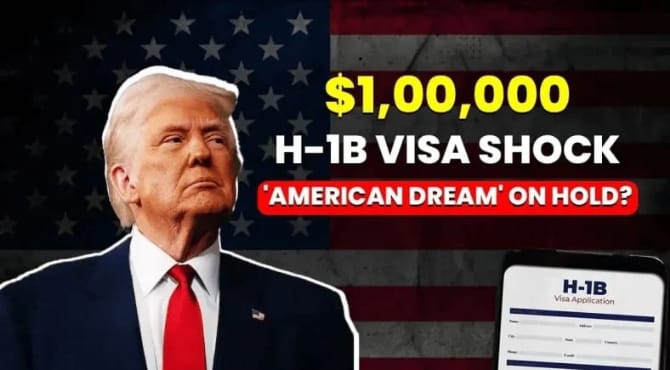
The US Chamber of Commerce, in a daring legal move that could significantly alter the scenario of skilled immigration in the US, has sued the Trump administration for the imposition of a $100,000 fee on a H-1B visa petition. This lawsuit in a federal court in Washington, DC, is the first time the Chamber has legally challenged President Donald Trump’s administration after the start of his second term in January.
The H-1B visa program, which has been instrumental in providing American companies access to worldwide talent, is now entwined in a risky legal and political battle concerning the extent of executive power and the position of the US in technology and innovation sectors.
According to the Chamber’s complaint, the newly-introduced $100,000 fee breaches the Immigration and Nationality Act (INA) since it allows such charges to be limited to the government’s processing costs only. The Chamber argues that by creating such an exorbitant fee, the Trump administration has overstepped its authority in no uncertain terms and has, in effect, prevented small and medium-sized enterprises from gaining access to the kind of human/resource development that will be instrumental in their growth.
Neil Bradley, Executive Vice President and Chief Policy Officer of the Chamber, pointed out that the newly announced measure would weaken H-1B usage, a program created by Congress to empower rather than restrict businesses. “The new visa fee will make it cost-prohibitive for US employers, especially start-ups, to utilize the H-1B program,” he said.
On the other side, the Trump administration has justified the fee as a move that will both protect American workers and stop the H-1B system abuses that it alleges. The White House points out that the measure is mainly designed to prevent big outsourcing companies from using foreign workers to replace Americans at a lower cost.
However, the overwhelming size of the fee, an almost 28-fold increase from the previous amount of $3,600 to $100,000 has stirred opposition to it by almost every industry particularly by tech behemoths like Amazon, Microsoft, and Google that are highly dependent on foreign experts to fill the specialized roles. While the administration has stated that the fee will not apply to H-1B holders, and that they have introduced a form for exemption requests, businesses are unsure about the way that enforcement will be carried out, which has led them to a state of confusion.
The Chamber’s lawsuit is not only aimed at stopping the fee’s enforcement but is also intended to obtain a court ruling confirming that the administration has gone beyond its executive authority. The White House has declined to comment on the situation till now, creating a state of uncertainty among employers and thousands of workers waiting for their applications.
The fee is only planned to last for a year but the power to renew it still rests with the administration, a fact that has generated even more apprehension about its potential adverse consequences regarding innovation, hiring, and America’s position as a leading hub of talented people worldwide.
The decision on whether Trump will waive the $100,000 H-1B visa fee is still pending as the legal battle progresses. The courts are now the ones to make a decision: whether the administration’s hardline stance on immigration reform is legal or not. The implications for American business, most notably those from tech and start-up sectors, couldn’t be more significant.
This issue extends beyond the law to reflect a deeper conflict about the US – will it remain a symbol of liberalism and progress worth of emulation or will it succumb to protectionism, diminishing its own economic growth, inevitably?

