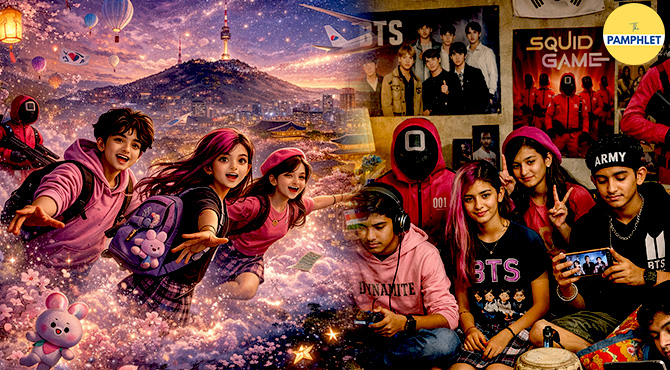
The recent tragic incident in Ghaziabad, where three sisters committed suicide, has raised questions about online gaming, phone addiction and dependence on Korean, Japanese, and Chinese entertainment among Indian children. There might be other reasons behind this tragic incident, but according to reports, police are also investigating a possible link to an online task-based game.
This report in the Economics Times says: The Police have recovered material linked to games “…named in the suicide note, including horror app titles Evil Nun and Poppy Playtime. The girls also watched Chinese and other cartoons such as Doraemon, Shinchan, PJ Masks and Pegga Pig.”
The investigation into the incident is complex, but it has once again revealed the dark and scary side of digital gaming. It becomes important to recognize the dark and scary side of online gaming, but also to recognize it as a dark aspect of another country’s soft power. Exposure to dangerous video games does not arrive alone. It is accompanied by other aspects of foreign soft power — such as cartoon films, rom coms, related accessories, and a vast ecosystem of entertainment that lures Indian children to the “culture” of a foreign nation.
Reports indicate that some online games even undermine children’s Indian identity, convincing them that they are not Indian but rather belong to the country the game originated from. This means that a completely false and unrealistic perception of identity is implanted in children’s minds.
Manipulating young minds through ‘tasks’
Until now, the practice of escaping and making people feel ashamed of their Indian identity was the work of colonial forces. But now, it seems that online games originating in Asia have taken over this responsibility. The dangerous consequences of online games have become even more serious. Unguarded and dangerous exposure to online games not only threatens the emotional, mental, and physical safety of Indian children and youth, but also contributes to loneliness and the resulting distance from their families—and thus, attacks their very identity.
You may recall that the horrific “Blue Whale Challenge” first made news in India in 2017. Such games share a common factor: strangers contact children through social media, give them confidence for gaming, lure them into a loop of gaming and challenges, target them, and incite them to perform such tasks. Sadly, these tasks often lead to a turbulent journey—and ultimately – self-harm.
Viewing India as one large family gives a whole new perspective on how the addiction for online games coming from Asian nations targets. Each family is the smallest unit of this larger family, and children and youth are the most important members and assets. Some dangerous online games are targeting this very basic unit, remotely controlled by people in another country. There should be no further delay in developing mechanisms to defeat this. This is no time to glorify a said “cultural wave”.
According to sources involved in the investigation, the controversial game currently in the news begins when an unknown person initiates a conversation with a child through social media or mobile apps. One can imagine how dangerous this first step is. Sources in these reports say that the person identifies as Korean or a foreign national. Then, the conversation turns to friendship, is taken beyond friendship and is extended beyond that. Trust is built and established through this complicated series of conversations. The communication then develops towards tasks. Imagine this same sequence or scenario – outside of online games, in real life. Would you allow children to be a part of it? No, right?
Cartoons: The early hooks in a turbulent lure
When tragic incidents linked to online games occur, there’s a shock and surprise element in everyone’s reactions. This is natural. What, however, seems missing, is a concerted strategy to fight this demonic influence. I don’t think that Indian children suddenly resort to such online games. I believe that the attraction to this kind of entertainment begins early. During the children’s early years – in the long and extended hours of cartoon shows they watch. In the fight against this dangerous tool of online game addiction, it’s important to understand that its foundation is laid in childhood, in cartoon films whose make or influence—or both—are foreign.
The flaw isn’t in a cartoon film being foreign. We’ve all seen Spider-Man, Disney cartoons, and, during our time, the animation film based on the beautiful work, Yugo Sako’s Ramayana – The Legend of Prince Ram. To this day, I watch this series and the Jungle Books, based on Rudyard Kipling’s work. This is probably because their storytelling, their intricate interaction with the arts, and simplicity, are so integral to childhood that they continue to teach us so much. Changes do happen with time and entertainment evolves. However, there is a question. Why have we allowed the definition of entertainment for children to change so drastically in just three decades? Today, some Australian, Canadian, and American series on OTT are incorporating childhood roots, family values, sports, academics, creative activities, and even the struggles of our ancestors into decent productions for children’s entertainment.
The problem lies in those aspects or products of foreign soft power that are against Indian culture and civilization, distorting and ruining children’s imagination and language, their way of thinking, their attitude towards elders and friends.
You must have heard over the past few decades how some children become so influenced by a cartoon character that they don’t want to learn or speak Hindi or their mother tongue. And in such cases, even the elders at home are happy to hear that the English learned from cartoons and films has a special accent. Such thinking is a kind of cultural deficiency.
On the other hand, we often hear about an Asian cartoon show – after watching its dubbed version, it has been revealed that children learn to taunt and criticize over trivial matters. The words, mannerisms, and habits of other cultures become like photocopies in the innocent minds of children.
Why parents show such shows to their children so much is a different matter, but the high dependence of children on such shows can also be attributed to the lack of good Indian animation films and cartoon shows. The inability to integrate Indian culture into life and entertainment is a cultural deficiency.
But the question arises: should that deficiency be made a compulsion? It has been observed that entertainment coming from other countries possesses a precise blend of creativity and imagination, which leads to its dominance throughout the world.
Entertainment to video games: The ecosystem
The influence of Korean entertainment, within South Korean soft power, is steadily increasing worldwide. Since the 1990s, the influence of Korean soft power has spread globally through Korea’s neighboring countries. Regional politics played a major role in this. South Korean films, entertainment, and soft power competed with Chinese films and Japanese creativity. I personally witnessed some of this at film festivals in the 2000s. But at that time, this soft power penetration was not as widespread as it is today, nor was it as intense.
However, in the 2000s, Korean films and entertainment captured a global audience. The Academy Award-winning Korean film “Parasite” and the viral Netflix show Squid Games contributed significantly to this. The internet reveals that there are numerous free games based on Squid Games, which provide players with a series of tasks. This template has been used for inspiration elsewhere.
It’s worth noting that this same trend of assigning tasks to gamers is applied to children. Some online games assign tasks to gamers, meaning that as you progress in the game, you have a task to complete. Experts say that this is where psychological control becomes more dangerous and complex. Reports suggest that some tasks last up to 50 days, gradually increasing in intensity.
Dr. Ashima Ranjan, a psychiatrist at Noida-based Yatharth Hospital, told a publication that such games manipulate “vulnerable minds,” especially children dealing with loneliness, academic stress, or emotional neglect. She says the danger lies not only in the tasks themselves, but also in the psychological control these games gradually establish. Dr. Ashima Ranjan also says that children are drawn to these games not for entertainment but as a coping mechanism.
She says: “Children don’t always express that they are in pain. From a mental health perspective, some children use online games to escape emotions they cannot process.” Looking at it from a mental health perspective, some children use these online games to escape from emotions they cannot process or understand.
Imagine the impact of such task-based games on children and individuals who are already feeling isolated, struggling with difficulties, lacking the understanding or ability to think through problems, and desperate for someone to listen and understand and help them through it all. This is precisely the time when they need guidance and expert help. They need a family support system. But instead, they are surrounded by dangerous online games.
Do you create restrictions or gateways to prevent any danger? For example, wear a seat belt when you get into a car, use indicators while driving, and use driving controls. Similarly, there are countless ways to keep your home safe. But those who fall into such online games have no gateways or security layers.
It is important to know how many gateways these games have to cross to reach vulnerable minds: scary and absurd instructions are followed without question. One report even suggests that children easily download many such games outside of guarded apps, where there’s no question of security or scrutiny. All activities in these games can be hidden from parents. While playing these games, gamers even come to believe that no one understands them well except the game itself. This gives an idea of psychological control.
The extent to which these games are affecting children’s sleep patterns, mental, physical, and emotional health is ignored. While playing games, a fear of consequences is ingrained in the mind. If you don’t do this, this will happen; if you don’t do that, that will happen. And if you quit, this will happen. The fear of the unknown is magnified while asserting the use of the unknown and its unknown dangers.
It’s worth noting that those who create these games have no fear of consequences. But for those who fall victim to them, the fear of consequences is great and terrifying. These clearly are workings of a psychological trap that’s given the name of “culture”.
Children and adults deepen their emotional dependence on such games, to the exclusion of family, studies, work, creativity, and outdoor sports activities. What I find absolutely outrageous is that, in the name of entertainment, allowing children and youth to become victims, knowingly or unknowingly, of something horrific is labelled “culture.” Do the media and social media people who glorify red flags in Korean entertainment expose the horrors of these games as soon as they appear?
A mission-mode fight is needed against these games’ infiltration into mobile phones and society. Things that shouldn’t even be near the realm of society are entering homes, families, and the innocent spaces of children. A mission-mode fight against this evil is needed.
Signs of alarm: The extreme response
In 2022, Battlegrounds Mobile India — an online game – was removed from the Google and Apple App Stores in India. According to reports, Google blocked access to the game in the country following a government order. This game was a new version of PUBG. PUBG was removed by the Indian government in 2020. PUBG was one of the Chinese apps banned by India amid ongoing tensions with China.
Regardless of the reasons for the removal of Battlegrounds Mobile India, its ban seemed to have brought relief to many. Addiction to this game among children may have been a cause of concern for many. Some alarming incidents related to game addiction have been reported. In June 2022, news broke that a 16-year-old boy in Lucknow allegedly shot and killed his mother because she scolded him for playing the game.
The frightening and shocking impact of online game addiction was revealed again in 2023 when news broke that a 16-year-old boy emptied his mother’s bank account due to game addiction. The woman lost approximately 3.6 million rupees due to her son’s insistence on playing online games on his mobile phone. Details were provided to the Cyber Wing of the Hyderabad Police.
Reports indicate that the game was free, but as the player advanced, the expenses increased. Game addiction causes psychological harm, as well as financial harm, and becomes part of the systematic exploitation of children and families. Some children are so young that this systematic exploitation is beyond their understanding.
The loss of life, time, and capital for some can be a testament to how difficult it will be for these children and families to recover from the long-term impacts of this exploitation.
Flight of peril to an imaginary world
Online games are part of entertainment and entertainment is part of soft power. It’s not typical of Indians to criticize any country’s culture. There are even those in our country who find merit in Pakistan’s culture, often dismissing their own rich culture. But regardless of the country, it’s important to examine whether entertainment, which is part of its soft power, is having a negative or positive impact on our country and society.
I came across some media articles praising Korean entertainment. These articles explain in detail why not only young people in India, but people across all age brackets, especially women, are becoming so enamored with Korean films, serials, OTT series, and food.
Some of the reasons are perceived shared aspects: family, complexities within families, struggles for succession within royal families, and court intrigues, handling relationships with a sense of duty while ignoring one’s own emotions in the private sphere, and so on. Naturally, you’ll quickly connect with these themes. And when these stories are set against the cultural backdrop of a developed country, with glimpses into lifestyles, food habits, social customs, and individual spaces, the appeal deepens even more.
What’s even more interesting is that most Korean characters, especially Korean men, on the big and small screens revolve around their perceived soft, understanding, emotionally available nature.
Another interesting point emerges. If these articles are to be believed, Korean entertainment is gaining popularity in India because women see in it values that are not present in either Indian entertainment or the male characters portrayed in it. It is often said that characters in entertainment and cinema are depictions of real people or real life. Therefore, it cannot be denied that the male characterization of those who come directly from one country, is done in such a way that it can be compared to the portrayal and nature of the Indian male. Such depictions can be misleading, if not always inaccurate.
It is not uncommon to be influenced by foreign entertainment and then arrive in that country. But if you fall prey to the cultural stereotyping of foreign entertainment, harboring unrealistic expectations, and then pack up your suitcase and head to any country, then salute to your courage, as well as to your education system and society, which neither taught you to accept your own cultural differences nor those of other countries.
In 2025, news reports surfaced of an American woman who traveled to Korea after watching a Korean drama. The news claimed that she had traveled to Korea seeking romantic partners from the male characters depicted in Korean dramas, but was disappointed upon arriving. The woman claimed that men in Korea are not like those portrayed in Korean dramas.
She uploaded a video from the US, saying: “On my way to Seoul to fall in love with a Korean man.” But when she didn’t see men like her K-Pop idols while traveling around Korea, she became disheartened. Now, if a foreign tourist comes to India and says that not everyone looks like Shah Rukh Khan, isn’t the problem with soft power? Isn’t it the perception the audience forms based on that?
On the other hand, this shows how intricately a country uses its soft power, making even young women from a progressive and developed country like America create an imaginary world.
This means that you should think that where you are, your own society, doesn’t deserve you and isn’t meeting your expectations. And the beautiful, alluring universe you see in entertainment from another country is where you should be, because your own society, its living conditions, its food habits, its lifestyle, are not up to par. I’m not saying that the aspiration to be part of a developed society is wrong. Many people from India migrate to other countries, starting a new life, and working hard there for education and employment.
But if that aspiration becomes an addiction, changes people’s behaviour toward their own families, deepens their loneliness, and pushes them into the idea of living an imaginary life, then it is not entertainment, but exploitation, and is no less than a danger to children.
The need for an Indic filter to soft power absorption
This is not the first time that a country’s soft power is dominating other countries around the world and India. In every era, the soft power of one country or another dominates the world and, or rather, India. For example: in the 1950s and 1960s, music and jazz from European countries influenced Indian film music. Indian film music served as a cultural pipeline. Those in the Indian film industry who had exposure to Western lifestyles incorporated many aspects of that lifestyle into Indian films and film music.
Raj Kapoor’s popularity in Russia skyrocketed. Both his films and their music became a craze in Russia. The popularity of the English band The Beatles soared in the 1950s and 1960s, and Indian soft power also took a major turn. The Beatles came to Rishikesh to meet spiritual guru Maharishi Mahesh Yogi. Staying at the ashram in Rishikesh, they worked on a new album between meditation sessions. This trip significantly influenced not only rock music but also their own life decisions. During this period, American culture also had an impact on India, thanks to rock music, alternative rock, and the success of the Woodstock Festival.
The 1970s were marked by this decade. European and American culture met and crossed paths with Indian culture. Looking at the post-independence era, whether it was Russia or India, Europe or India, America or India, both sides influenced each other in films, music, clothing, fashion, political ideas, and even spirituality. If you’re Gen Z, ask your grandparents how much they loved bell-bottoms, flowy maxi dresses, floral patterns, synthetic and chiffon sarees, tight-fitting bottoms, scarves, and bandanas. More importantly, why did they like them?
In India, Russian magazines—like “Masha” for children and “Soviet Woman”—remained popular until the 1980s! What was good or bad in all this is a separate debate. But the truth is that at that time, other countries and their cultures conquered the mind space of Indian youth. But that influence wasn’t such that it pushed the mind space of children and youth against life. It made Indians experiences different glimpses of different cultures — many times over cultural reciprocation. It made Indians witness Indic spirituality align with global arts and artistes, and people from all walks of life. It made Indians witness some positive patterns in reverse soft power.
By the 90s and after globalization, soft power from the West influenced youth in new and different ways. One key reason for this was the fusion of many Western cultures during this period. Indian spirituality, classical music, and kirtan left a deep impact on this.
One reason that might emerge is that their favorite actor sported such a fashion. One might also hear that the actor looked exactly like an American, Russian, or British. Resembling someone from another country is often viewed with pride in India. This dual stereotyping may be due to the dominance of film culture, a lack of pride in being Indian in India, and a colonized mindset. However, Indian culture seems to constantly interact with external soft power, enriching any other civilization.
Images of these are often seen on social media, both on Western campuses and from universities in Asian countries. In the 1980s, Jackie Chan and Bruce Lee, and their films and their use of martial arts, inspired video games worldwide. Here, individual talents became the reason for their fame. This was at least better than the craze for traveling abroad, or the craze for foreign cultures. And it wouldn’t be wrong to say that the popularity of martial arts in foreign films led to the popularity of foreign martial arts in India. The Korean martial art taekwondo is one of them.
In other words, India has been adopting those good cultural elements where it has been able to contribute or give something or the other to the same category – for centuries and years. In the 1990s and 2000s, Bollywood once again attracted the world to India. Today, the promotion of yoga, Indian spiritual destinations, and Indian soft power is considered one of the major achievements of the Indian government.
Prominent scholars and artists from many countries have been visiting India, making it their educational destination. It’s noteworthy that this is perhaps the first time since independence that a soft power product has had a potentially lethal, dangerous, and adverse impact on children and youth.
Any aspect of a country’s soft power that appears to be blatantly, aggressively, corroding the physical, mental, and emotional safety of India’s children and youth needs to be viewed with suspicion and should be defeated. And if it has nothing to offer other than negative influences, it should be viewed with suspicion.
If you look deeper into the news, you’ll see that in a political rival country of a country pushing aggressive soft power, children are being severely punished for watching OTT series and playing games from that other country. This is an example of responding to the fear of being negatively impacted by another country’s soft power with fear. India needs to learn on how — when safeguarding against aggressive soft power — the effort needs to be applied through an Indic filter in absorbing soft power from another nation. Control loosened is control lost.
After the success of the film ‘Dhurandhar’ on Netflix, countries promoting game addiction should remember that promising young people in India also have the talent to create games with tasks, chase you, and even beat you in soft power games through them. But our civilization teaches us to use creation for beauty, not destruction.
The country’s animation artists and promising game creators must create games based on critical thinking, creation, happiness, Indian roots, education, sports, and intelligence, providing India’s children and youth with ample opportunities and options to reject dangerous games. During this cultural crisis, there is a great opportunity to strengthen India’s soft power – within gaming itself.
The safety of children and youth is everyone’s responsibility – of policymakers, the government, society, law and order agencies, and, above all, families. We must work together to ensure that any new and stringent safeguards, deterrents, and gatekeeping measures against online game addiction are implemented and implemented. We must all work together to protect children and youth from foreign negativity. Indic shield to foreign soft power should become part of cultural policy and thinking cyber security.