
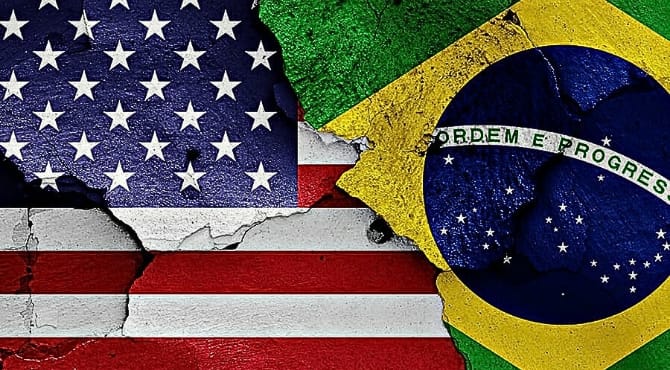
In a surprising bipartisan move, five Republican senators joined Democrats this week to vote against President Donald Trump’s sweeping 50 percent tariffs on Brazilian imports. The Senate’s 52–48 vote sends a strong message to the White House, signaling growing frustration—even within the president’s own party—over the economic impact of his aggressive trade policies.
Although the measure is expected to die in the Republican-controlled House of Representatives, the Senate’s defiance marks one of the most significant challenges yet to Trump’s use of emergency powers to impose trade restrictions.
Who broke ranks and why
The five Republicans who crossed the aisle were Rand Paul (Kentucky), Thom Tillis (North Carolina), Susan Collins (Maine), Lisa Murkowski (Alaska), and Mitch McConnell (Kentucky). Each has voiced concerns in the past that Trump’s tariffs hurt more Americans than they help.
McConnell, a longtime critic of protectionism, said after the vote, “Tariffs make both building and buying in America more expensive. The economic harms of trade wars are not the exception to history, but the rule.”
Similarly, Senator Rand Paul argued that burdening consumers with higher prices contradicts conservative principles of free markets and limited government. Their break with the president highlights a widening split among Republicans over how far Washington should go in weaponizin
The Senate resolution seeks to overturn President Trump’s national emergency declaration issued in July, which provided the legal basis for the tariffs on Brazil. Trump argued that Brazil’s government posed an “unusual and extraordinary threat” to the United States because of its prosecution of former Brazilian President Jair Bolsonaro, a close ally of the U.S. president.
Democrats dismissed this claim as political theater. “The emergency, with respect to Brazil, is that the Brazilian government decided to prosecute Donald Trump’s friend,” said Senator Tim Kaine of Virginia, who introduced the measure. “How is that an emergency for the American people?”
Economic experts point out that the U.S. currently runs a trade surplus with Brazil, undercutting the idea that American industries are suffering serious harm. Instead, they say, tariffs have driven up costs for importers and consumers, especially for coffee, beef, and ethanol.
What comes next
The resolution now moves to the House of Representatives, where Republican leaders have already signaled they will stand behind the president. Even if it somehow passes the House, Trump has promised to veto it.
Nonetheless, the vote could mark the beginning of a broader challenge to Trump’s global tariff strategy. The Senate earlier tried to reverse tariffs on Canada in April, and lawmakers are now discussing additional votes targeting the president’s “Liberation Day” tariffs, which affect dozens of countries.
Political analysts say these moves—though unlikely to change policy immediately—underscore a growing discomfort among both parties with Trump’s use of executive power to influence global trade.
Will prices fall for consumers?
If the tariffs are eventually rolled back, Americans could see lower prices on everyday goods imported from Brazil, including coffee, beef, sugar, and ethanol. However, economists warn that any price changes would take time to filter through supply chains.
For now, shoppers should not expect instant relief at the grocery store, but the Senate’s action signals that some in Washington are finally listening to consumers and small businesses struggling to absorb higher costs.
While President Trump’s tariffs on Brazil remain in place for now, the Senate’s bipartisan stand demonstrates a rare willingness to question the White House’s trade agenda. The move may not bring immediate change, but it reflects a shifting mood in Congress—and perhaps the start of a larger effort to rein in protectionist policies.
Whether or not coffee and beef prices drop soon, one thing is clear: the political cost of Trump’s trade war is beginning to rise.

