
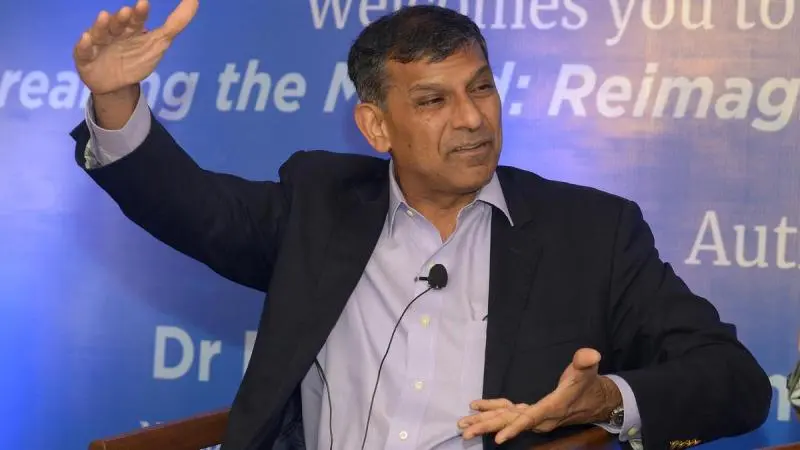
Raghuram Rajan, the economist often admired by India’s liberal establishment, is back in the spotlight with a controversial take on India’s semiconductor strategy.
In a recent interview with Frontline, Rajan questioned why India is investing so heavily in semiconductor manufacturing. He argues that Semiconductor fabrication is extremely capital-intensive, requires enormous subsidies and investments, and even after making these investments, India would remain dependent on other countries for equipment and several critical inputs.
For years, critics of the Narendra Modi government have accused India of not doing enough to manufacture and have repeatedly compared its manufacturing performance with China’s. Yet when India actually attempts to build a strategic manufacturing ecosystem, economists like Rajan question the wisdom of making such investments.
And there is another uncomfortable question- China is already a major player in semiconductor manufacturing. Since semiconductors are strategically important for multiple industries, should India really remain dependent on other countries for them?
Semiconductors are not just another manufacturing industry
The fundamental problem with Rajan’s argument is that it risks treating semiconductors as just another manufacturing industry.
They are not.
Semiconductors are the foundation of the modern technology economy. Artificial intelligence, smartphones, automobiles, telecommunications, defence systems, satellites and data centres all depend on chips.
Control over semiconductor capabilities therefore provides much more than a commercial advantage. It provides technological and strategic leverage.
The question for India, therefore, should not simply be whether the country is naturally competitive in semiconductor manufacturing today. The bigger question is – Does India want to remain dependent on other countries for critical technologies for the next 20 to 30 years?
Consider a hypothetical scenario. Suppose India becomes one of the world’s leading centres for chip design. Indian engineers design some of the world’s most sophisticated chips. But when those chips have to be manufactured, India remains dependent on fabs in Taiwan, South Korea or elsewhere.
Packaging and testing are also carried out overseas. Critical materials are imported. Semiconductor manufacturing equipment comes from other countries.
Would India then possess complete semiconductor capability? The simple answer is NO.
It would possess an important segment of the value chain, but not the complete capability. And in deep technology, that distinction matters enormously.
Can Chips simply be moved or smuggled
Another part of Rajan’s argument has also attracted attention. He suggested that chips are products that can be relatively easily moved or smuggled.
But this misses the larger point about semiconductor security. The issue is not whether an individual chip can physically be brought into India.
The real question is what happens if a geopolitical crisis disrupts supply chains, export controls are imposed, or access to a critical technology is restricted. We all saw during the COVID crisis that the supply of semiconductor chips was severely disrupted, bringing several industries to a grinding halt. That was the time when countries like India started focusing on developing their own semiconductor chips.
A modern economy needs predictable, large-scale and secure access to semiconductor manufacturing, packaging, testing, materials and other components of the ecosystem.
China provides a blueprint
India should certainly learn from China—but not merely because China manufactures and therefore India should manufacture too.
The real lesson is how China approached manufacturing.
China did not treat manufacturing simply as a source of cheap labour and exports. It built entire ecosystems around manufacturing: component suppliers, engineers, logistics networks, research institutions, materials suppliers and domestic companies.
Over time, manufacturing capability became strategic capability.
India’s historical weakness has been different. The country became globally competitive in software and services but remained dependent on foreign countries across several critical hardware value chains.
India’s semiconductor programme is an attempt to address this gap precisely.
And importantly, the programme is no longer simply about building one semiconductor fabrication plant. India is attempting to develop capabilities across chip fabrication, packaging, testing, chip design, research, materials and the wider semiconductor ecosystem.
The objective is not to replace Taiwan overnight.
The objective is to gradually increase India’s presence across the value chain and develop domestic capabilities.
That process will be expensive. Some projects may fail. Some investments may not deliver the expected returns. Mistakes will inevitably be made.
But deep-tech capabilities are not built overnight.
The larger question about Rajan’s pessimism
Rajan has raised several legitimate concerns about India’s economic trajectory over the years. Questions around employment, human capital, private investment and productivity deserve serious discussion.
But there is a difference between highlighting structural weaknesses and viewing every emerging Indian capability through a pessimistic lens.
In December 2022, Rajan suggested that India would be lucky to achieve 5 per cent economic growth in 2023. India’s subsequent growth performance turned out to be considerably stronger.
In 2018, he also warned that lending under the Pradhan Mantri Mudra Yojana could contribute to a banking crisis. More recently, the government has pointed to the scale of lending under the scheme while highlighting relatively low non-performing assets.
These examples do not mean that every criticism made by Rajan is wrong. Nor should economic policy be immune from criticism.
But predictions and warnings also need to be judged against what actually happens.
Other prominent economists, including Kaushik Basu and Arvind Subramanian, have similarly highlighted structural constraints and risks facing the Indian economy.
Prime Minister Narendra Modi has described persistent pessimists as “doomsayers.”
The semiconductor debate, however, needs to rise above personalities and political labels.

