
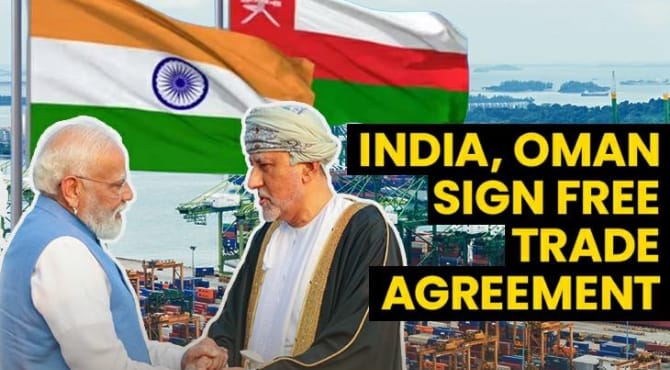
The government is preparing to activate its long-awaited free trade agreement (FTA) with Oman as early as June 1, and the timing is far from coincidental. With the Strait of Hormuz facing disruptions due to ongoing geopolitical tensions, India is looking for reliable alternatives to keep its trade flows stable. Oman, with its strategically located ports like Salalah and Duqm, offers exactly that opportunity.
Unlike many Gulf ports that depend heavily on the Strait of Hormuz, these Omani ports lie outside the choke point, making them a safer and more predictable route for Indian exports heading toward West Asia and Africa.
If you recall how India leveraged Singapore as a strategic trade hub in Southeast Asia, Oman is now being positioned in a similar role for the western corridor. The idea is not just to trade with Oman, but to use it as a transit hub.
This becomes crucial at a time when India’s trade with key Gulf partners like the UAE has already seen a sharp dip, reportedly over 35% in April alone. With only a couple of UAE ports functioning smoothly, exporters are facing rising costs and uncertainty, especially as freight rates have more than doubled.
Against this backdrop, the India-Oman FTA becomes more than just a trade agreement; it becomes a strategic tool. The deal, signed in December, promises zero-duty access on 98% of tariff lines for Indian goods.
This is a big jump from the current scenario, where only a small portion of Indian exports enter Oman duty-free. Products that earlier faced duties of up to 5% will now become more competitive in terms of pricing, giving Indian exporters an edge.
But here is an important point to understand. Oman itself is not a massive consumption market. Its annual demand is around $40 billion, which is relatively small compared to giants like the UAE or Saudi Arabia. So why is India so keen? The answer lies in connectivity and stability. Oman offers a safe corridor when traditional routes become risky. It acts as a bridge, not just a destination.
Interestingly, trade data already reflects this shift. While imports from countries like Iraq, Qatar, and the UAE declined sharply in April, imports from Oman surged by over 246%, reaching $1.48 billion. This indicates that businesses are already adapting to the changing landscape and exploring alternative supply chains.
The FTA is also expected to open new doors in sectors where India has untapped potential. For example, Oman imported electronics worth $3 billion in 2024, but India’s share was just $123 million. With tariff barriers removed and greater certainty in trade rules, Indian exporters now have a clear opportunity to expand in segments like telecom equipment, electrical components, and machinery.
Similarly, labour-intensive sectors such as food processing, textiles, and ceramics are being actively promoted by the government as part of this shift.
At the same time, Oman continues to play a critical role in regional geopolitics. It is actively coordinating with Iran on matters related to the Strait of Hormuz, which further enhances its importance as a stable intermediary in a volatile region. For India, this adds another layer of strategic value beyond just economics.
However, challenges remain. Logistics is still a concern, as not many shipping lines are currently operating on these alternative routes. Higher freight costs could reduce some of the price advantages gained through tariff cuts. Exporters will need time to fully adapt and optimize supply chains.
Even with these hurdles, the direction is clear. India is not just reacting to a crisis but reshaping its trade strategy for the long term. By fast-tracking the Oman FTA, the government is signaling a shift toward diversification and resilience in global trade routes.
In simple terms, Oman is becoming India’s backup plan that might soon turn into a primary gateway. And in today’s uncertain global environment, having such alternatives is not just smart policy, it is essential.

