
Prime Minister Narendra Modi’s short but important stopover in Abu Dhabi turned into a major diplomatic and economic moment, with India and the UAE signing six agreements designed to strengthen ties across energy, defence, shipping, and digital trade. The visit also brought fresh investment commitments worth $5 billion from UAE-linked entities, adding another layer to a relationship that has steadily grown into one of India’s most important partnerships in West Asia.
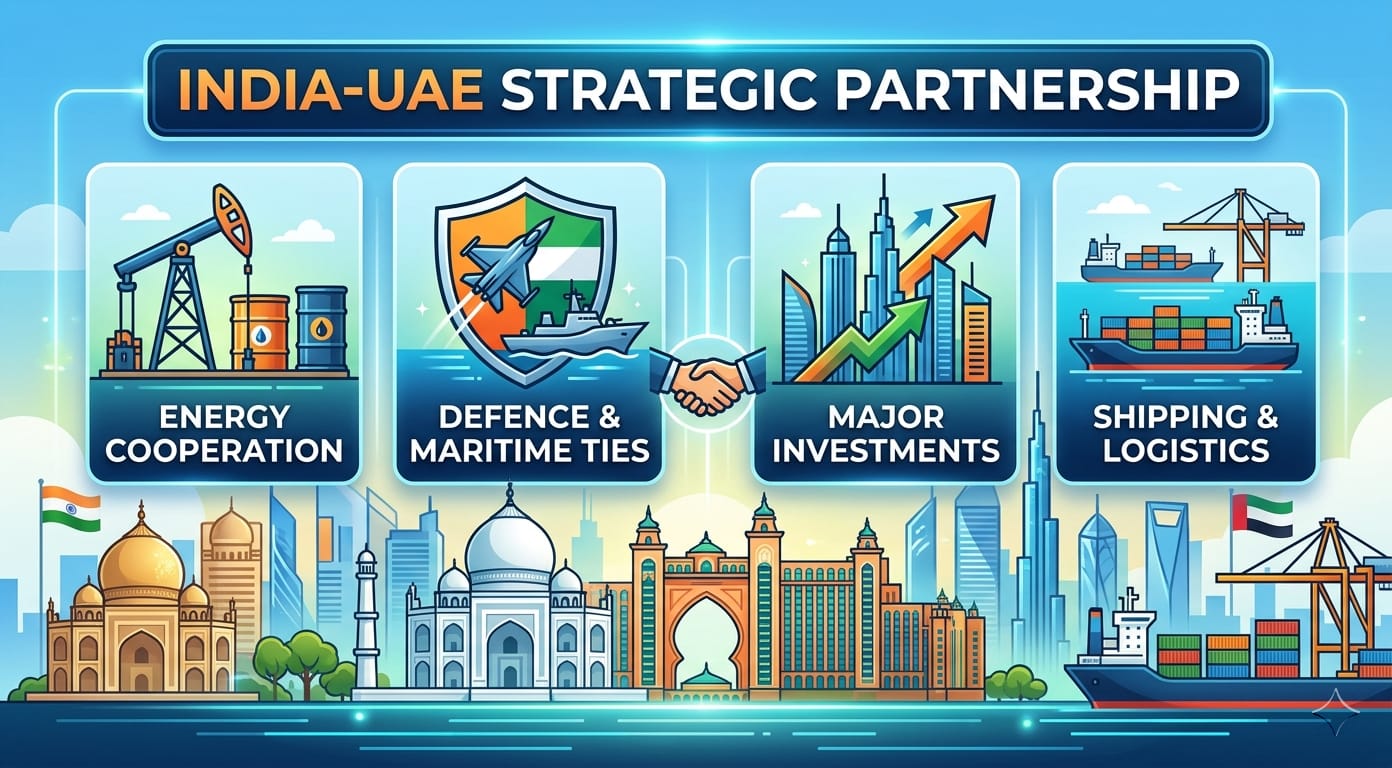
The attached graphics highlight the main outcomes clearly: strategic oil reserve cooperation, long-term LPG collaboration, a strategic defence partnership, and a ship repair cluster at Vadinar.
The biggest signal from the visit came in the energy sector, where Indian Strategic Petroleum Reserves Limited and Abu Dhabi National Oil Company agreed on a strategic collaboration that could allow ADNOC to store up to 30 million barrels of crude oil in India’s strategic petroleum reserves.
This arrangement is not just about storage; it is about energy security, mutual trust, and a deeper alignment between two countries that depend heavily on stable oil supplies. The agreement also opens the door for cooperation on LNG and LPG storage facilities in India, which matters because India remains one of the world’s largest energy consumers and imports most of its oil.
Another important outcome was the strategic collaboration on LPG supplies between Indian Oil Corporation and ADNOC, which may lead to long-term sale and purchase arrangements involving ADNOC Gas and IOCL.
For ordinary households, this kind of agreement may sound technical, but its impact can be direct: it helps improve the reliability of LPG supply, supports price stability over time, and reduces pressure from sudden disruptions in global energy markets. In a country where millions of families depend on cooking gas every day, such partnerships carry real economic meaning.
The visit also underlined how India and the UAE are thinking beyond immediate supply deals and toward long-term energy resilience. The UAE is expanding its crude export capacity by building another pipeline to Fujairah by 2027, with the aim of bypassing the Strait of Hormuz and reducing exposure to regional tensions.
That is especially relevant for India, which consumes around 5.5 million barrels of oil daily and relies on safe maritime routes for a large share of its energy imports. Modi’s emphasis on safe transit through the Strait of Hormuz reflected this larger concern, because uninterrupted movement through that waterway remains vital for global energy and food security.
Defence cooperation was the other major pillar of the visit. India and the UAE signed a framework for a strategic defence partnership that will deepen collaboration in defence industry, innovation, advanced technology, training, military exercises, and maritime security.
This kind of partnership matters because it goes beyond symbolic diplomacy and builds practical capacity in both countries. It also reflects the changing security environment in West Asia, where maritime safety, regional tensions, and technology-driven defence cooperation are becoming increasingly important.
Shipping and industrial cooperation also received a strong push. Cochin Shipyard Limited and Drydocks World agreed to establish a ship repair cluster at Vadinar in Gujarat, along with offshore fabrication facilities under India’s Maritime Development Fund Scheme.
This is an important step for India’s maritime ecosystem because it can improve ship maintenance capacity, create jobs, lower dependence on foreign repair facilities, and support the broader “Make in India” and maritime manufacturing push. The visuals shared with this request correctly capture this as a move that boosts shipping, ports, and coastal infrastructure.
Alongside these sectoral agreements, the UAE entities announced $5 billion in investments in India, including $3 billion from Emirates New Development Bank in RBL Bank, $1 billion from Abu Dhabi Investment Authority with the National Infrastructure & Investment Fund for priority infrastructure projects, and another $1 billion from International Holding Company in Sammaan Capital.
These commitments matter not only because of their size but because they cover banking, infrastructure, and finance, sectors that can have a multiplier effect on the wider economy.
The two leaders also welcomed the operationalisation of the Virtual Trade Corridor using MAITRI, which links customs and port authorities in both countries. For businesses, this can mean faster cargo movement, lower logistics costs, and less paperwork. In practical terms, that is the kind of reform that makes trade smoother, cheaper, and more predictable for exporters and importers on both sides.
Pm Modi described the visit as short but highly productive, and the outcomes support that description. The agreements show that India and the UAE are moving from a traditional buyer-seller relationship into a broader strategic partnership built on energy security, defence cooperation, investment, and digital trade.

