
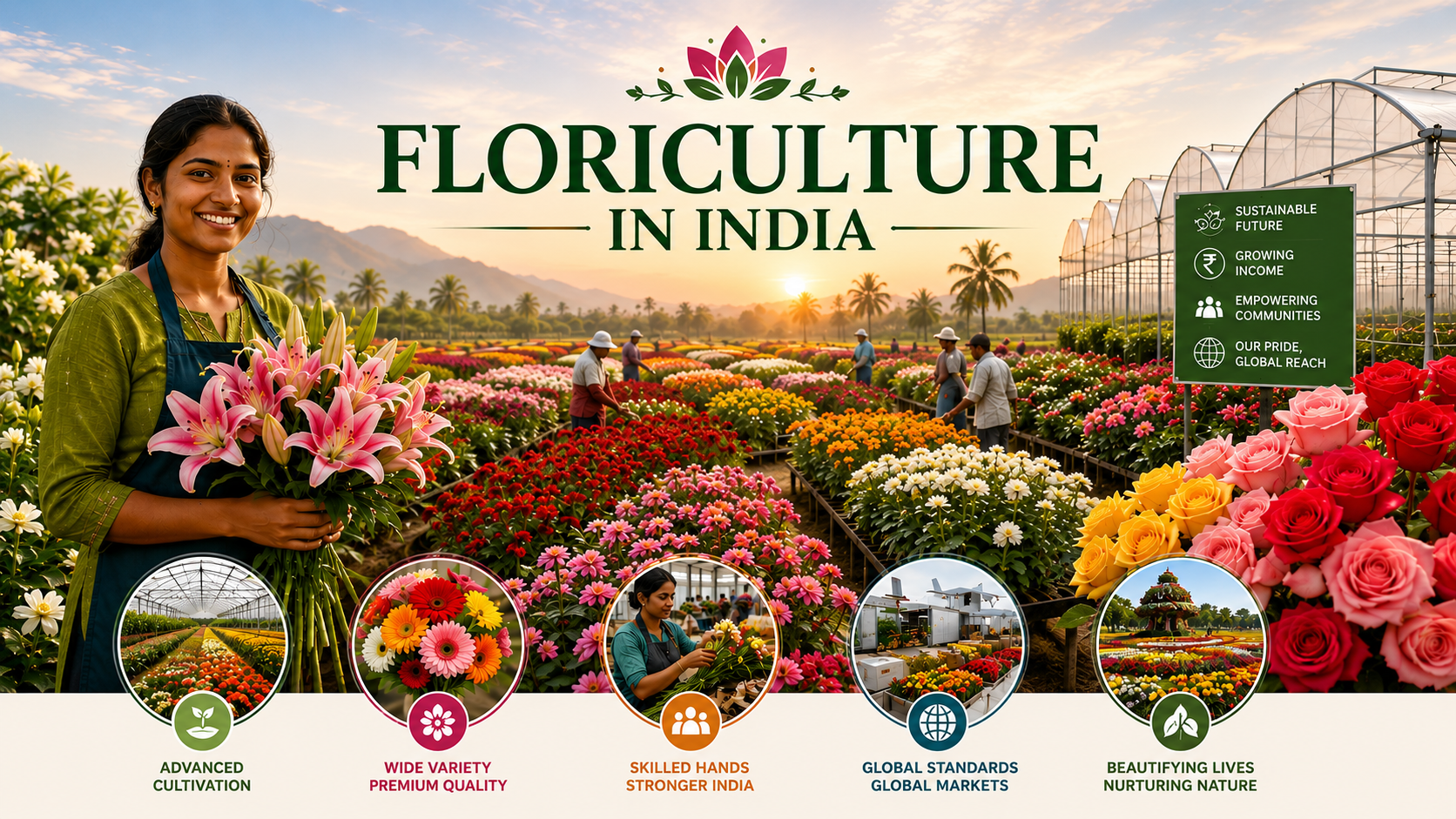
The flower industry is experiencing a remarkable transformation, with cultivation area touching 400,000 hectares in 2025-26, a sharp rise from 282,000 hectares in 2021-22. The sector’s gross value added surged to ₹51,120 crore in 2023-24, reflecting robust growth across the nation .
Floriculture’s share in overall horticulture output climbed from 0.76 percent in 2014-15 to 12 percent in 2025-26, with horticulture production reaching 377.78 million tonnes now, surpassing food grain output. This expansion isn’t just about numbers; it signals a deeper shift where farmers feel confident their sensitive flower produce will reach markets at the right time, thanks to government initiatives building cold chains, export hubs, and market linkages.
Flowers are uniquely fragile, without timely market access and proper preservation, they spoil quickly. The rise in production proves that efforts to solve this are working. The government has identified floriculture as a sunrise industry with 100 percent export-oriented status, offering subsidies, export incentives, and infrastructure support through APEDA and the Mission for Integrated Development of Horticulture (MIDH) .
Farmers now have greater surety that their produce won’t wilt in transit. Refrigerated vans, cold storages, and packaging units are being developed, while expert committees recommend turning Bengaluru, Pune, Delhi, and Hyderabad into floriculture hubs due to their climate and logistics advantages . This infrastructure reduces the risk that once made flower farming intimidating for small growers.
The national boom contrasts with challenges in the Northeast, where inadequate infrastructure and weak market connections caused some regions to decline. Arunachal Pradesh’s anthurium farmings shrunk, and Sikkim’s orchid cultivation area remained steady at 242 hectares with 16,509 tonnes production consistent with a decade ago . Yet Sikkim’s story holds a different key: its orchid exports surged 40 percent in the past year due to global demand for rare varieties like Cymbidium, Dendrobium, and Vanda .
The state’s fully organic status, added in 2016, made its flowers more appealing internationally, aligning with global preferences for pesticide-free produce . Government packages distributed 500 orchid saplings to 50 farmers in 18 clusters, with training and marketing support, while SIMFEDthe state sales network handles market linkage .
Why is production increasing? Multiple factors converge. First, India’s diverse climate allows year-round production, especially during winters when other regions face shortages . Second, cost-effective greenhouse cultivation is possible without extensive climate control, making hi-tech floriculture accessible .
Third, proximity to Europe and East Asia enhances export potential .Fourth, e-commerce and online flower marketing have boosted domestic demand . Fifth, rare orchids and native flowers once underutilized now have export potential alongside dried flowers, decorative items, and perfumes .
Sikkim’s orchid success illustrates how targeted support works. The National Research Centre for Orchids in Pakyong developed four new hybrid varieties, helping the state compete nationally . Dutch and Thai agencies signed MoUs to develop hybrids and create transportation strategies for international markets . Sikkim’s orchids sell for Rs 300–500 per bulb in Delhi but USD 15–50 per bulb in the Netherlands and Denmark, showing massive price gaps exports can bridge . Himachal Pradesh is now studying Sikkim’s model to revive its struggling floriculture, adopting orchid cultivation through World Bank-funded projects .
Tamil Nadu leads national production at 19 percent, followed by Madhya Pradesh (14 percent), Karnataka (12 percent), Andhra Pradesh (11 percent), and West Bengal (10 percent) . In 2024-25, India exported 21,024 MT of floriculture products worth ₹749.17 crore (USD 88.58 million), with USA, Netherlands, UAE, Canada, UK, Germany, and Malaysia as major destinations . Though India is the world’s second-largest flower producer, its global market share remains just 0.6 percent, indicating untapped potential .
The industry forecasts predict growth from ₹29,200 crore to ₹74,400 crore by 2033 at 11 percent CAGR . With over 300 export-oriented units more than 50 percent based in Karnataka, Andhra Pradesh, and Tamil Nadu the sector is maturing . Nagaland exemplifies rapid progress, expanding floriculture area from 70 hectares in 2015-16 to 1,300 hectares in 2023-24 .
What ties this together is farmer confidence. When produce reaches markets timely, risks drop. Government efforts in export promotion, cold chain development, and skill training create that confidence. Flowers, being sensitive, demand this surety their rise proves the system is working. The blooming paradox of national highs alongside Northeast declines shows where infrastructure gaps remain, but Sikkim’s orchid surge proves targeted interventions succeed. As online marketing grows and rare varieties gain global appeal, the future looks brighter for those who tend these fragile, beautiful crops.

