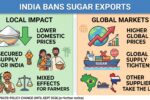
The government has taken a major policy decision by banning the export of raw, white, and refined sugar with immediate effect, marking a significant shift from its earlier “restricted” category to a complete “prohibited” status.
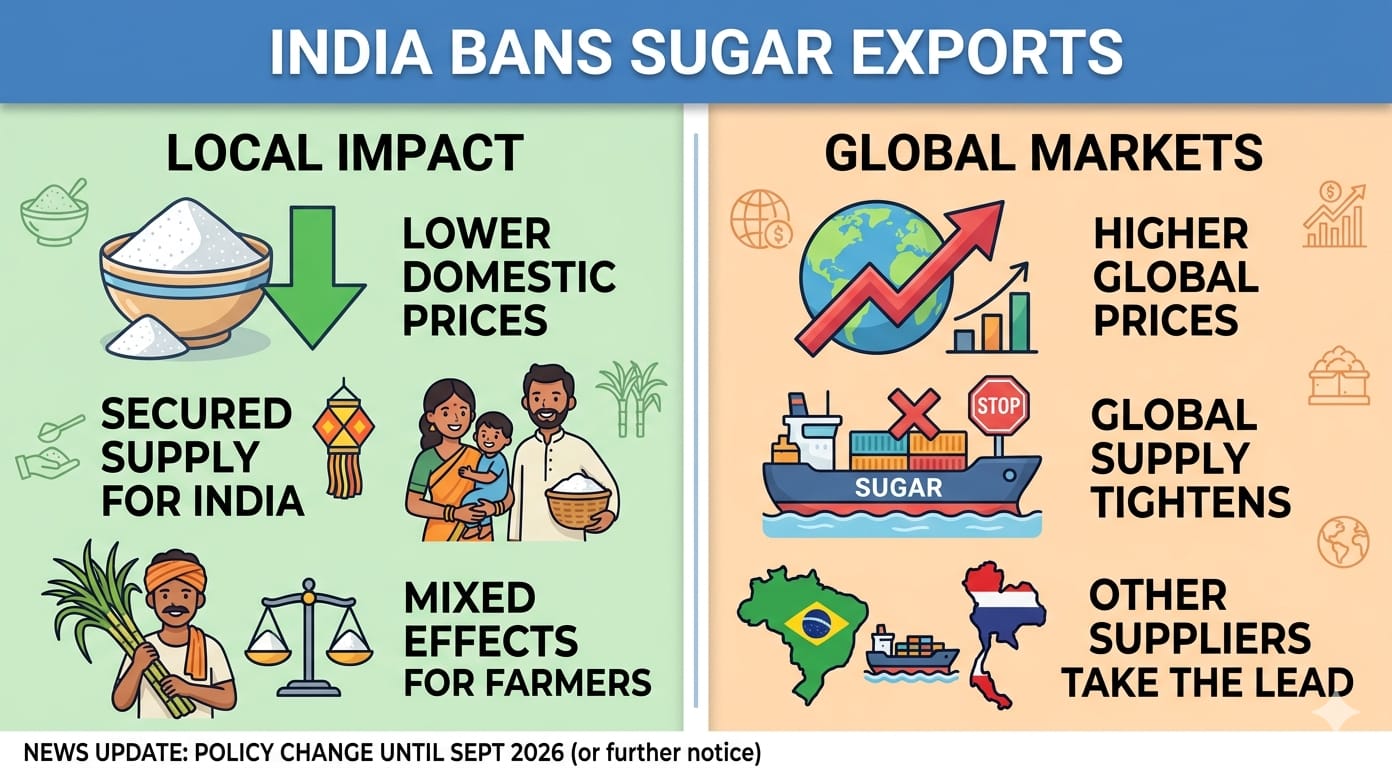
This decision, announced by the Directorate General of Foreign Trade under the Ministry of Commerce and Industry, will remain in force until September 30, 2026, or until further notice.
The move comes at a time when the government is increasingly concerned about domestic sugar availability and rising price pressures, especially as uncertainties around production and global conditions continue to grow.
The primary reason behind this ban is to ensure that there is enough sugar available within the country and to prevent any sudden spike in prices for consumers. India is one of the world’s largest producers of sugar, but domestic demand is also extremely high.
With festivals, food industries, and daily consumption depending heavily on sugar, even a small supply disruption can push prices upward. The government is trying to avoid such a situation by limiting exports and prioritizing domestic needs.
Another key factor influencing this decision is the expected decline in sugar production. While India is projected to produce around 27.5 million tonnes of sugar in the 2025–26 marketing year, earlier estimates were higher at around 32 million tonnes.
This downward revision has raised concerns about whether supply will be sufficient in the coming months. At the same time, fears of an El Niño weather pattern suggest that rainfall could be below normal in the next crop cycle, which may further reduce sugarcane output. Lower rainfall directly impacts sugar production, making this a critical risk for policymakers.
Global geopolitical developments have also played a role. Ongoing tensions in the Middle East have created uncertainty around fertiliser supplies, which are essential for agriculture. Any disruption in fertiliser availability can affect crop yields, including sugarcane. The government appears to be taking a precautionary approach by securing domestic stock before these risks fully materialize.
Despite the ban, certain exceptions have been allowed. Sugar exports to the European Union and the United States will continue under existing tariff-rate quota arrangements. Additionally, shipments that were already in progress before the notification was issued will not be affected.
This includes consignments where loading had started, ships had already arrived or anchored, or goods had been handed over to customs. The government has also kept a provision to allow exports on a case-by-case basis to meet the food security needs of other countries, but only with official approval.
The impact of this decision is not limited to India alone. As the world’s second-largest sugar producer after Brazil, India plays a crucial role in global sugar supply. Any restriction on its exports immediately tightens the international market.
Following the announcement, global sugar prices reacted sharply, with raw sugar futures rising by more than 2% in New York and white sugar prices increasing by around 3% in London. This indicates that global buyers will now have to rely more on other suppliers like Brazil and Thailand, which could reshape trade flows in the coming months.
For Indian sugar mills and exporters, however, the decision may create short-term challenges. Many exporters had already signed contracts for overseas shipments, and the sudden policy change could disrupt their business plans and revenue expectations.
At the same time, farmers may see mixed effects, as stable domestic demand supports prices but limits opportunities from higher global markets.
Overall, the government’s move reflects a balancing act between protecting domestic consumers and managing economic risks. By restricting exports, India aims to keep sugar affordable at home while preparing for possible production challenges ahead. The coming months will be crucial in determining whether these precautions help stabilize the market or lead to further adjustments in policy.