
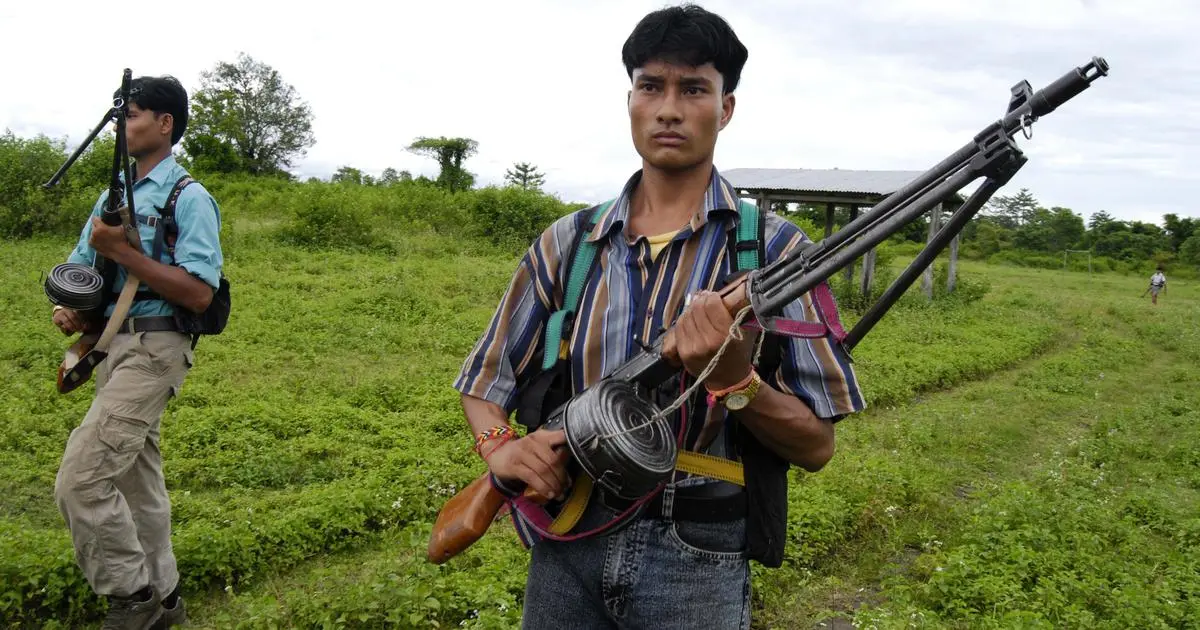
On June 26, 2026, Assam Police, assisted by central agencies, arrested two suspected United Liberation Front of Asom-Independent (ULFA-I) cadres, identified as ‘second lieutenants’ Humenjyoti Baruah alias Siyor Asom and Papu Moran alias Manoj Asom, during an intelligence-based operation at Jagun under the Lekhapani Police Station in Tinsukia District.
The duo had reportedly infiltrated into Assam from Myanmar through Arunachal Pradesh and were intercepted before they could execute a plan to carry out indiscriminate attacks on civilians in Tinsukia District. Security Forces (SFs) recovered two AK-56 rifles, 172 rounds of ammunition, two hand grenades and other war-like stores from their possession.
Police said the two were allegedly involved in the ambush on an Army camp at Kakopather on December 17, 2025, the attack on an Assam Police commando camp on March 21, 2026, and the kidnapping of an employee from a crusher unit at Jagun on October 23, 2024. The incident once again underscored the continuing efforts of ULFA-I to retain an operational footprint in Assam despite mounting military, logistical and organisational pressures.
The investigation into the June 26 arrests subsequently led to the apprehension that two suspected over-ground workers (OGWs) of the outfit from Tinsukia are involved. On June 28, 2026, Assam Police arrested Bitu Bora and Kalpa Bora for allegedly providing logistical support to the two ULFA-I cadres in Tinsukia District. Police said that Bitu Bora arranged the vehicle used to transport the cadres, while Kalpa Bora provided logistical assistance. During interrogation, the accused reportedly disclosed that the vehicle had been arranged on the instructions of senior ULFA-I leader Aiseng Asom, providing investigators with fresh leads into the outfit’s support network.
The latest arrests came amid an intensified crackdown on the outfit’s recruitment, extortion and support networks across Assam and beyond. On May 30, 2026, Assam Police arrested two suspected ULFA-I linkmen, Dulav Moran and Rongat Moran, in Tinsukia District, for allegedly maintaining communication channels between the group and its local contacts.
A day earlier, on May 29, 2026, three youths were apprehended while allegedly attempting to join ULFA-I through the Tinsukia-Arunachal Pradesh corridor leading to the outfit’s camps in Myanmar. Investigations suggested that ULFA-I’s Over Ground Workers (OGWs) were targeting economically vulnerable youths and facilitating their movement across the border.
On May 28, 2026, Assam Police uncovered a nationwide funding and extortion network linked to the outfit, arresting two operatives from Uttar Pradesh for allegedly channelling funds to ULFA-I.
Earlier, on May 25, 2026, two extortionists linked to the outfit were injured in an exchange of fire with the Police in the Sivasagar District of Assam while allegedly attempting to extract money from local businessmen. These incidents highlighted ULFA-I’s continued dependence on extortion and local support structures to sustain its insurgent activities.
Further pressure was exerted through targeted operations against the outfit’s active cadres. On May 15, 2026, the National Investigation Agency (NIA), assisted by Assam Police, carried out coordinated operations in Tinsukia District as part of an ongoing investigation into ULFA-I activities.
On May 6, 2026, an active ULFA-I cadre, Biren Chetia aka Rontu Asom, described as a Myanmar-trained militant, was arrested in Sivasagar District with a substantial cache of arms, grenades and ammunition. These operations the security agencies’ sustained effort to dismantle the group’s residual networks in Assam.
Available data illustrates the shrinking operational space available to the outfit. According to partial data compiled by the South Asia Terrorism Portal (SATP), 35 ULFA-I cadres have been arrested in 11 separate incidents in 2026 (data till June 28, 2026), adding to 38 arrested in 17 incidents through 2025. In 2024, 69 cadres were arrested in 32 incidents, while 32 cadres were arrested in 23 incidents in 2023. Since 2010, a cumulative 675 ULFA-I cadres have been arrested in 369 incidents. The persistence of arrests over an extended period demonstrates both the durability of the insurgent network as well as the effectiveness of sustained counter-insurgency operations in preventing its resurgence.
The mounting counterinsurgency pressure has also been reflected in a steady stream of surrenders. On May 5, 2026, two active cadres deserted the outfit’s headquarters at Ranu in Myanmar and surrendered before SFs at Pangsu Pass in Arunachal Pradesh.
Earlier, Jintu Gogoi aka Arun Asom surrendered on April 3, 2026, while ‘second lieutenant’ Bitul Baruah surrendered on March 3, 2026. Such incidents indicate growing disillusionment within ULFA-I ranks and suggest declining morale among cadres stationed in Myanmar-based camps.
The SATP database has recorded six surrenders in five incidents in 2026, while 17 ULFA-I cadres surrendered in 11 separate incidents in 2025. In 2024, only two cadres surrendered in two incidents. Since 2010, a total of 125 ULFA-I cadres have surrendered in 71 separate incidents (data till June 28, 2026).
Despite these setbacks, ULFA-I has attempted to demonstrate its continuing relevance through sporadic acts of violence. On March 22, 2026, suspected ULFA-I militants attacked an Assam Police Commando camp at Jagun in Tinsukia District with grenades and gunfire, injuring four Police personnel. The attack, which triggered a gun battle lasting nearly thirty minutes, highlighted the group’s continuing ability to launch limited offensive actions in areas proximate to the Arunachal Pradesh border. Nevertheless, such incidents have become increasingly infrequent, compared to the outfit’s earlier operational tempo.
ULFA-I’s current predicament is closely linked to developments that unfolded during 2025. One of the most significant events was on July 13, 2025, when ULFA-I ‘chief’ Paresh Baruah claimed that the outfit’s eastern headquarters in Myanmar’s Sagaing Region had been targeted in a large-scale drone strike. According to the group’s own disclosures, the attack killed 19 cadres and injured another 19. Among those reportedly killed were senior leaders Nayan Medhi aka Nayan Asom, Ganesh Asom and Pradip Asom. ULFA-I further alleged that cadres belonging to Manipuri insurgent organisations were also among the casualties. While the Indian Army categorically denied carrying out any such strike, the episode generated considerable speculation regarding the changing nature of counter-insurgency operations in the India-Myanmar border region.
Subsequently, on July 28, 2025, ULFA-I and Manipur’s People’s Liberation Army (PLA) issued a joint statement reiterating allegations that sophisticated combat drones had been employed against their camps in Myanmar. Regardless of the veracity of these claims, the aftermath appears to have had a significant impact on insurgent morale and infrastructure. Later reports suggested that several camps and logistical facilities had either been abandoned or relocated, while allied insurgent organisations like NSCN-IM became increasingly reluctant to provide sanctuary to ULFA-I cadres.
The strategic consequences became more visible in the months that followed. On October 16, 2025, suspected ULFA-I militants attacked an Indian Army camp at Kakopathar in Tinsukia District, injuring three soldiers. On the same day, ULFA-I militants operating alongside the National Socialist Council of Nagaland-Khaplang-Yung Aung (NSCN-K-YA) faction allegedly attacked an Assam Rifles camp in Arunachal Pradesh, injuring at least four personnel. These incidents indicated that, despite operational constraints, the outfit continued to maintain tactical cooperation with other insurgent organisations active along the India-Myanmar frontier.
However, ULFA-I’s internal challenges deepened considerably towards the end of 2025. On November 23, 2025, Assam Chief Minister Himanta Biswa Sarma reiterated that meaningful peace talks could progress only if ULFA-I ‘chief’ Paresh Baruah personally agreed to participate in negotiations. The statement followed the surrender of Arunoday Dohotia, regarded as one of Baruah’s closest associates, which was viewed as a significant symbolic setback for the organisation.
Shortly thereafter, reports emerged that Naga insurgent groups in Myanmar had become increasingly reluctant to host ULFA-I cadres due to fears of precision strikes and heightened surveillance. ULFA-I had traditionally relied upon a network of camps controlled by NSCN-K factions for transit, shelter and logistics. The erosion of this support structure reportedly forced the group to scout for alternative locations while simultaneously grappling with supply disruptions and declining manpower. Available assessments suggested that ULFA-I’s effective strength had fallen below 200 cadres.
Significantly, the Union Ministry of Home Affairs (UMHA) reinforced pressure on the organisation when it extended the ban on ULFA-I for another five years with effect from November 27, 2024. The Ministry cited the group’s continuing commitment to Assam’s secession, involvement in extortion and intimidation, and links with other insurgent groups as grounds for the extension.
In an apparent attempt to adapt to evolving circumstances, ULFA-I announced a major organisational restructuring on December 26, 2025, dissolving its existing councils and created a new 24-member Central Committee headed by Paresh Baruah as ‘president’. The restructuring appeared aimed at consolidating authority and revitalising the organisation amid persistent speculation regarding possible peace talks and growing operational difficulties. However, ULFA-I simultaneously reiterated that Assam’s sovereignty remained a non-negotiable objective, thereby maintaining the ideological position that has long prevented formal negotiations with the Government of India (GoI).
Additional insights into the organisation’s deteriorating condition emerged from statements made by surrendered leader Arunoday Dohotia. He disclosed that Paresh Baruah had not visited ULFA-I camps in Myanmar for more than a decade and was reportedly based in China. Dohotia further revealed that morale within the camps had fallen sharply following recent developments, that ideological training had largely ceased, and that many cadres wished to surrender but remained trapped in remote Myanmar bases. Such disclosures reinforced assessments that the organisation was increasingly disconnected from its original ideological foundations and struggling to retain cohesion among its remaining members.
Concerns regarding the regional dimensions of the insurgency have also persisted. In January 2026, Chief Minister Himanta Biswa Sarma warned that intelligence inputs indicated the presence of senior ULFA-I leaders in Bangladesh. He noted that changes in the political environment in Bangladesh could potentially create opportunities for militant groups to regroup and re-establish networks. Given Assam’s extensive international border with Bangladesh, such developments continue to be closely monitored by security agencies.
Taken together, these developments indicate that ULFA-I remains active but increasingly confined. While the outfit retains a limited capacity for recruitment, extortion and sporadic acts of violence, sustained counter-insurgency operations, progressive cadre attrition, financial disruptions and the erosion of external support networks, have significantly degraded its operational capabilities. Continued reliance on Myanmar-based sanctuaries, coupled with mounting logistical challenges and declining morale, further limit the group’s ability to sustain a prolonged insurgent campaign. Although ULFA-I continues to adhere to its objective of Assam’s sovereignty, prevailing trends suggest that the organisation is struggling to reverse its long-term decline and re-establish itself as a significant insurgent force in the region.
Author: Afsara Shaheen – Research Associate, Institute for Conflict Management

