
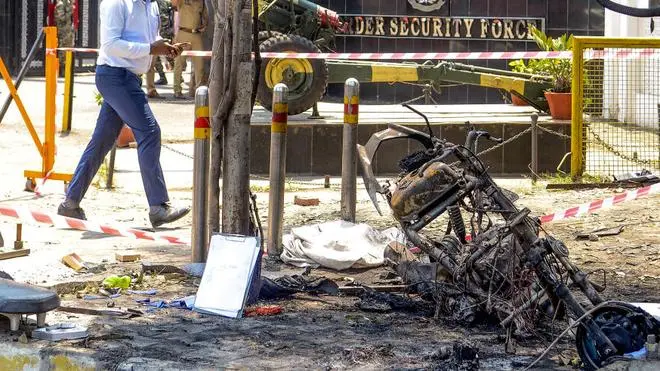
Two low-intensity explosive attacks near military installations in Jalandhar and Amritsar on May 5, 2026, within a span of a few hours, rocked the border state of Punjab, signalling a deliberate escalation in Pakistan’s proxy campaign aimed at destabilising the region. The first explosion occurred near the gate of the Border Security Force (BSF) Headquarters in Jalandhar, around 8 pm on May 5, 2026, when a scooter parked in a busy commercial area exploded as a delivery worker returned after making a parcel delivery. The blast destroyed the vehicle, damaged nearby infrastructure, and caused minor injuries to the worker. Preliminary investigations suggested that the explosive material may have been concealed in a dustbin near the scooter. Approximately two hours later, another explosion occurred near the boundary wall of the Army cantonment area on Khasa Road in Amritsar. The blast damaged a tin sheet installed along the perimeter wall, with preliminary assessments suggesting that an explosive object had been hurled at the site.
The Khalistan Liberation Army (KLA), through a poster circulated on social media, claimed responsibility for the blast outside the BSF Headquarters in Jalandhar, describing it as part of Operation Nawa Savair and linking it to the February 25, 2026, killing of Ranjit Singh in a Police encounter in Gurdaspur. Singh was among the accused in the killing of two police personnel near the Pakistan border on February 22, 2026. The outfit falsely claimed that two BSF personnel were killed and three injured in the blast. Director General of Police (DGP) Gaurav Yadav dismissed the claim and attributed the attacks to Pakistan’s Inter-Services Intelligence (ISI)-backed ‘anti-national elements’, allegedly timed to coincide with the first anniversary of Operation Sindoor.
Earlier, on April 27, 2026, an explosion occurred on a railway track near Bothonia village, between Shambhu and Rajpura in Patiala district, killing a suspected militant, Jagroop Singh, while he was allegedly attempting to plant and detonate an improvised explosive device (IED). The blast caused minor damage to the railway track, which forms part of India’s Dedicated Freight Corridor (DFC). Investigators recovered his dismembered body from the site and seized wires, explosive materials, two motorcycles, and a damaged mobile phone during the subsequent search operation. This was the second attack targeting the freight corridor in 2026. Earlier, on January 23, a blast near Khanpur village in Sirhind, Fatehgarh Sahib district, injured railway employee Anil Sharma and damaged both a freight engine and railway track, just days ahead of Republic Day.
A day after the April 27 railway track blast, the Khalistan Tiger Force (KTF) claimed responsibility through a social media post allegedly issued by Germany-based operative Jaswinder Singh Multani. On April 28, 2026, Patiala police arrested four “highly radicalised” pro-Khalistan operatives – Pardeep Singh Khalsa, Kulwinder Singh, Satnam Singh aka Satta, and Gurpreet Singh aka Gopi – linked to a ISI-backed terrorist module connected to the blast. Security Forces (SFs) recovered a hand grenade, pistols, ammunition, communication devices, and laptops from Tarn Taran district. Subsequent searches on April 29 led to the recovery of a large cache of arms and explosives from Panjwarh Khurd village, Tarn Taran district, including an RPG, RDX, a metallic IED, detonators, grenades, pistols, cartridges, and timer devices.
Initial investigations indicated that the ISI-backed module was directed by a Malaysia-based handler operating under the alias Jujhar Singh, with financial channels allegedly routed through Malaysia. The network reportedly maintained links with US-based fugitive Surinder Singh Thikriwal aka Baba, classified as a “Category-A” criminal, and Pakistan-based Ranjeet Singh aka Neeta, a designated Khalistani terrorist. Police identified Pardeep Singh Khalsa as the alleged kingpin, accusing him of maintaining connections with Malaysia-based pro-Khalistan elements and Pakistan-based arms suppliers. Investigators further alleged that Khalsa facilitated the movement of radicalised youth to Malaysia for training, before assigning them roles in terrorism-related activities. The accused were also believed to have formed a radical outfit, Chalda Vaheer Chakarwarti, Attariye.
On April 1, 2026, a low-intensity explosion occurred outside the Bharatiya Janata Party (BJP) office in Chandigarh after unidentified assailants hurled an explosive device at the premises before fleeing. The banned Babbar Khalsa International (BKI) claimed responsibility for the attack, with Sukhjinder Singh Babbar stating that the blast was carried out in retaliation for the encounter killing of Ranjit Singh in Gurdaspur. Subsequent investigations uncovered an alleged ISI-backed module, leading to the arrest of multiple operatives by the Punjab and Chandigarh Police, reportedly linked to handlers operating from Europe.
On March 30, 2026, a low-intensity blast occurred inside a Police Station complex in the Bhindi Saida area of Amritsar district, after two unidentified bikers allegedly hurled an explosive object into the premises before fleeing. Subsequent investigations led to the arrest of six alleged ISI-backed operatives on April 13, reportedly working under a Pakistan-based handler. Investigators claimed the youths were recruited through ISI-linked networks, with offers of up to INR 400,000 for attacks on Police infrastructure.
Punjab has recorded a series of grenade attacks targeting security establishments and prominent public locations over the past two years. According to Punjab Police records, more than 30 such attacks – predominantly directed at police stations and police posts, particularly in border districts – have been reported since September 2024. DGP Gaurav Yadav stated on December 31, 2025, that 24 grenade attack cases registered since September 2024 had been solved, with the terrorist-gangster networks allegedly responsible dismantled, accused persons arrested, and several foreign-based handlers detained or deported. Investigations further indicated that some of the major modules were allegedly directed by ISI-linked Pakistani gangster Shahzad Bhatti, in coordination with Indian gangsters, including Jeshan Akhtar and Amandeep Singh aka Pannu, as well as fugitive gangsters like Harpreet Singh aka Happy Passia, underscoring the growing nexus between cross-border handlers and domestic criminal and terror networks.
The continuation of attacks despite these successes highlights the resilience and adaptability of the networks involved. The emerging pattern increasingly points to a decentralised “hybrid” terrorist architecture in which small local modules are remotely guided, financed, and ideologically influenced by handlers operating from abroad – particularly from Pakistan, Canada, Germany, Portugal, Malaysia, United Kingdom, United States, and other Western countries with active Khalistani ecosystems.
A defining feature of the present threat landscape in Punjab is the convergence of terrorism, organised crime, narcotics trafficking, and transnational radical networks. The distinction between “gangster” and “terrorist” has progressively blurred, with fugitive gangsters operating from abroad increasingly functioning as terrorism facilitators, arms suppliers, extortion coordinators, and recruiters for ISI-backed operations.
The arrest in the United States of Happy Passia on April 17, 2025, a key gangster-terror operative wanted in India for multiple ISI-linked terror activities, including several grenade attacks, underscored the increasingly transnational nature of this nexus. However, despite requests from Indian authorities, Passia has not yet been extradited to India. Similar roles have been attributed to Canada-based Arshdeep Singh aka Arsh Dala and Lakhbir Singh aka Landa; and Pakistan-based Harvinder Singh Sandhu aka Rinda – all designated as individual terrorists by India. These operatives are believed to continue directing modules in Punjab through encrypted communication platforms, diaspora-linked financing networks, and cross-border criminal channels.
A particularly troubling aspect is the ISI’s renewed strategy, working through organised criminal gangs, to orchestrate violence and chaos to destabilise Punjab. Pakistan-based gangster Shezad Bhatti is believed to have overseen several recent grenade attacks on behalf of ISI, coordinating with local gangsters to recruit locals to execute these operations, while responsibility has been publicly claimed online by various Khalistani groups and criminal gangs. Significantly, few of these recruits appear ideologically radicalised; some, including drug addicts, are reportedly willing to participate for relatively small sums, sometimes as low as INR 20,000.
Although the possibility of a revival of Khalistani militancy remains low, investigations into the recent spate of violence in Punjab indicate the emergence of a more complex pattern of ‘online recruitment’ and operational coordination. In several cases involving the targeted killings of sarpanches, those claiming responsibility asserted that their motives were personal. However, security agencies discern a broader pattern underlying these attacks, arguing that their primary objective is to generate fear, insecurity and public panic within the state.
In a stark example of how foreign-based gangsters are exploiting vulnerable Punjabi youth, the Chandigarh Police on May 6, 2026, arrested a Class 12 student – a minor – allegedly on his way to carry out a murder in Tarn Taran at the behest of gangsters operating from abroad. Investigations revealed that the student had been in contact with gangsters Prabh Dasuwal and Gurvinder Singh aka Afridi Tootawala, through social media platforms. Police disclosed that the minor, who had recently appeared for his board examinations, was allegedly drawn into the network after seeking revenge for a local assault, and was later groomed to target a personal rival, with funds reportedly transferred to him multiple times.
This reflects a broader ISI strategy of “low-cost destabilisation.” Instead of rebuilding the large hierarchical militant structures of the 1980s, the present model relies on modular violence: small cells, local criminals, lone operators, gang affiliates, radical sympathisers, and disposable recruits capable of conducting sporadic attacks that collectively create a climate of fear and instability. The killing of two Policemen at a border village Police Post on February 22, 2026, illustrates the continuing lethality of these modules. The attack triggered heightened security operations across border districts and reinforced concerns that Pakistan-backed groups were testing the State’s security preparedness through selective high-impact operations.
The recent shift in target selection in grenade attacks is particularly significant. Earlier incidents largely focused on police stations and local policing infrastructure. The emerging pattern – involving BSF facilities, Army-linked locations, railway corridors, and national political establishments – suggests an effort to enhance the psychological and strategic impact of such attacks. The targeting of economic infrastructure, including railway freight networks, appears aimed at attracting wider media attention, generating public anxiety, and reviving narratives of militancy in Punjab.
Moreover, the increasing use of drones represents a critical tactical evolution. Drones reduce the need for physical infiltration, lower operational risk for handlers across the border, and enable repeated delivery of small but lethal consignments. This has allowed ISI-backed modules to maintain operational continuity despite improved border fencing and surveillance mechanisms.
Another significant trend is the renewed ideological mobilisation among sections of pro-Khalistan elements in Punjab. In a notable development, hardline Sikh organisations, including Dal Khalsa and Shiromani Akali Dal (Amritsar), released a policy document Khalistan: Principles, Legacy and Future on April 29, 2026 – marking the 40th anniversary of the 1986 Khalistan Declaration Day. The document sought to reposition the Khalistan demand as a long-term political and ideological project, rather than merely an emotive slogan, reflecting renewed efforts at ideological consolidation within sections of the hardline separatist spectrum.
In another significant development marking the 40th Khalistan Declaration Day, Gurpatwant Singh Pannun, chief of Sikhs For Justice (SFJ), announced the launch of voter registration for the so-called “Khalistan Referendum” for Sikhs residing in India, while speaking from the Karachi Press Club, Pakistan. SFJ claimed that over 1.8 million Sikhs globally had participated in the referendum process and stated that the registration drive in India would be conducted in phases through gurdwaras, beginning in Delhi, Himachal Pradesh and Haryana.
While the recent blasts triggered a political row in Punjab, opposition parties accused the ruling Aam Aadmi Party (AAP) government of failing to contain the deteriorating law-and-order situation, while AAP, in turn, blamed previous state governments and the BJP for pursuing divisive and election-driven politics. Rejecting attempts to portray Punjab as a disturbed state, DGP Gaurav Yadav asserted, “Punjab is the most peaceful state in the country. Only a handful of ISI-backed elements want to create disturbance here. We will crush such elements.”
However, the danger lies not in the immediate possibility of a mass insurgency, but in the cumulative impact of persistent low-intensity attritional violence. Repeated grenade attacks, targeted killings, extortion threats, and symbolic strikes against security establishments risk creating an atmosphere of insecurity that can gradually erode investor confidence, deepen communal anxieties, and provide propaganda value to extremist networks.
As the operational space for ISI in Jammu and Kashmir has come under increasing pressure, there are growing concerns that the agency is seeking to intensify destabilisation efforts in Punjab by leveraging Khalistani networks and organised criminal syndicates. The recent surge in violent incidents suggests a concerted attempt to revive militancy and create instability in the state. Intelligence agencies warn that, in the coming years, Khalistani-linked and gangster elements may increasingly employ covert recruitment, targeted violence, and psychological intimidation to sustain unrest and undermine public security.
Punjab’s history demonstrates both the devastating consequences of militancy and the resilience of its society. The present phase does not approach the threat of a full-scale insurgency, but it unmistakably reflects a renewed and adaptive destabilisation campaign. The ISI’s objective appears less about territorial separatism in the immediate term and more about perpetuating instability, sustaining anti-India narratives, and keeping Punjab strategically unsettled through a prolonged shadow war. Without addressing the overseas enablers and hybrid nexus decisively, sporadic low-intensity actions risk normalising insecurity in a strategically vital state.
Note: The author of this article is Nijeesh N, Research Associate, Institute for Conflict Management. Only the headline of the article has been changed by The Pamphlet.

