
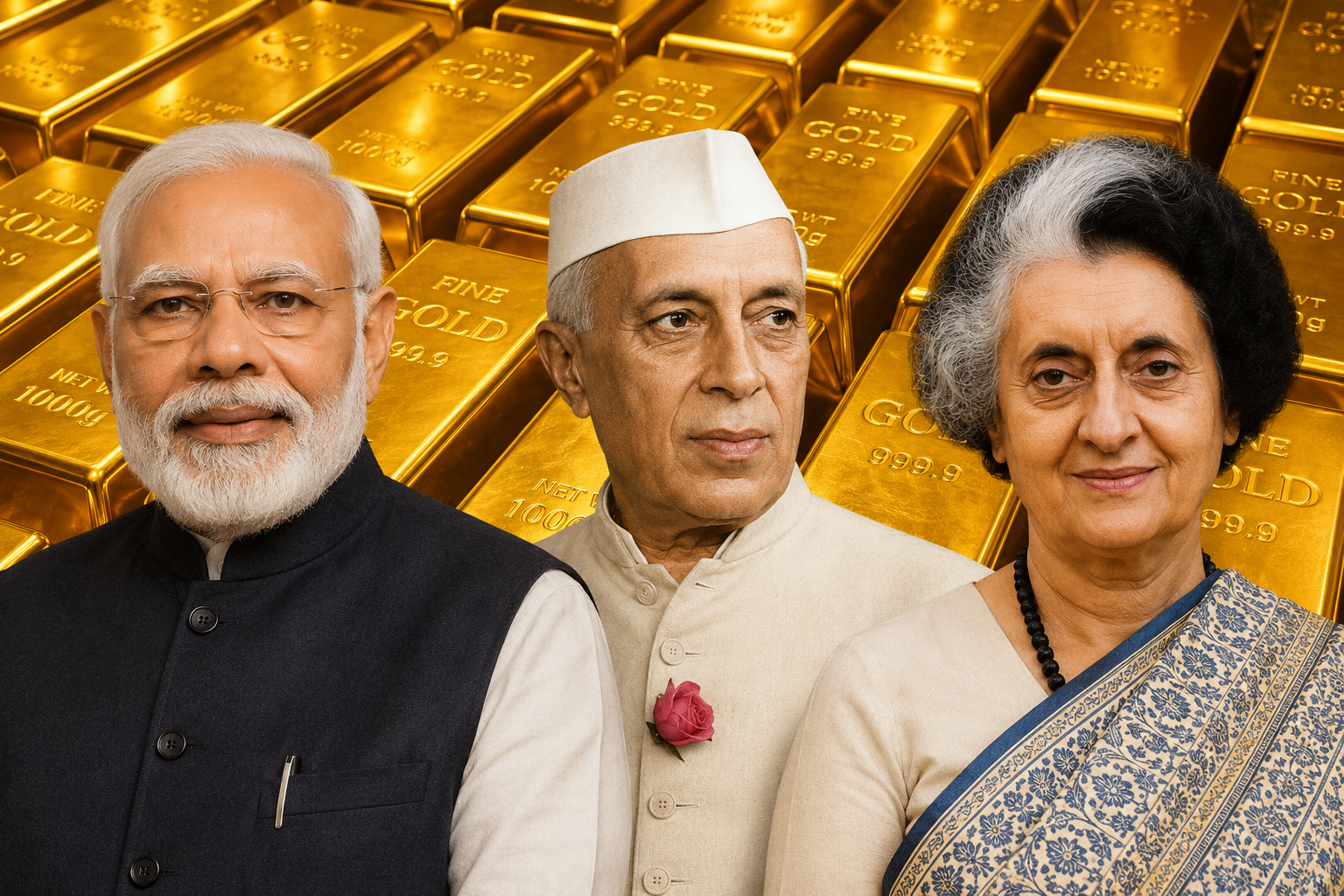
The recent appeal for austerity measures by Prime Minister Modi represents a significant rhetorical shift in Indian economic governance. Addressing a public gathering in Secunderabad, the Prime Minister requested that citizens voluntarily defer gold purchases, avoid foreign travel, consider working from home, among other measures aimed at encouraging austerity.
This appeal, which included suggestions to optimize fuel consumption and utilize remote work, was framed as a strategic response to external volatility. The Prime Minister cited the escalating conflict in West Asia and the potential disruption of the Strait of Hormuz as primary risks to national economic stability.
For a nation that imports approximately 85% of its crude oil through this specific maritime corridor, the preservation of foreign exchange reserves is a matter of strategic necessity. However, to understand the significance of this voluntary appeal, it must be contrasted with the compulsory gold controls of the mid-twentieth century. While both eras addressed foreign exchange concerns, the underlying economic health and the methods employed reveal two fundamentally different philosophies of governance.
Voluntary restraint in a resilient economy
The current administration’s approach is characterized by transparency and the absence of coercion. The government has simply framed conservation as a participatory act of national interest.
The economic data supporting this request is compelling:
- India’s gold import bill rose 24% in the 2025–26 fiscal year, reaching $72 billion. The country consumes 700 to 800 tonnes of gold annually and produces almost none domestically.
- Roughly 50% of India’s crude imports and 60% of its LNG transit through the Strait of Hormuz.
- Every billion dollars spent on gold right now is a billion dollars not available to cushion an oil shock that analysts have described as ‘historically large with asymmetric macro risks.’
- This is a government reading an external situation and asking its citizens to respond intelligently.
With a real GDP growth rate of 7.8% and a narrowing fiscal deficit targeted at 4.4%, the Indian economy is currently positioned from a point of strength. The IMF, in its 2025 Article IV consultation, commended India’s ‘very strong economic performance and resilience’ and noted that ‘the financial and corporate sectors have remained resilient, supported by adequate capital buffers and multi-year low non-performing assets.’ Inflation is subdued, falling below the lower tolerance threshold of the Reserve Bank of India. S&P Global recently upgraded India’s long-term sovereign credit rating. The country is negotiating and signing free trade agreements with major economies.
Contrary to what the doomsday projections would like for us to believe, the appeal by GoI is a fundamentally strong economy asking its citizens to exercise collective discipline in the face of a genuine external storm.
A trip down the memory lane
Bear in mind, this is not the first time, the Prime Minister has put forward its ‘expectation’ from the country regarding reducing gold purchases. It happened previously too. Only the circumstances were starkly different.
The contrast with the respective regulatory environments and economic fundamentals of India of the Nehru and Indira Gandhi administrations is stunning. During that period, the scarcity of foreign exchange was not a result of external warfare, but a byproduct of internal policy.
In 1962, Prime Minister Nehru began tightening restrictions on gold, citing the need to conserve foreign exchange. By 1963, the production of gold jewellery above 14-carat fineness was banned outright. By 1968, the Gold Control Act prohibited Indian citizens from owning gold in bars or coins altogether. Existing holdings had to be converted to jewellery and declared to the authorities. Goldsmiths could not legally hold more than 100 grams of their own trade material. Licensed dealers were capped at 2 kilograms. Citizens were told what to do. Violations carried imprisonment of up to seven years.
The then government congratulated itself that it was conserving foreign exchange and fighting the black economy. The result was the precise opposite: a massive smuggling network flourished overnight, a thriving black market replaced the official gold trade, the Sunar community – goldsmiths by hereditary profession for millennia – took a major blow to their livelihoods, and not a single meaningful amount of foreign exchange was saved.
This emergent black market led to the proliferation of underworld mafia in Mumbai and elsewhere in the nation. As the dreaded mafia extended its tentacles across the 1980s and 90s, its second and third order effects quickly outmaneuvered the state’s capacity. Again, the nation paid the price.
The Gold Control Act survived in this disastrous form for over two decades, not because it was working, but because the government that had introduced it was the same government evaluating whether to repeal it.
Ask yourself: how did India arrive at such desperate measures that it felt compelled to tell its citizens they could not own gold bars? The answer lies in an unbroken chain of self-inflicted policy catastrophes.
The socialism that built the cage
Prime Minister Nehru was not a wicked man. He was, however, an intellectually vain one, and the vanity expressed itself in a near-religious faith in the planned economy at precisely the moment the world’s experience of planned economies was beginning to reveal their structural rot. The Industries Development and Regulation Act of 1951, the cascading Five-Year Plans, the licensing system that required government approval to start a business, expand a factory, or import a machine part – these were the core architecture of an ideology.
The consequences arrived quickly. Agriculture was starved of investment in the Second Five-Year Plan, sacrificed on the altar of heavy industry. The latter, for the record, didn’t see any spectacular growth either. By 1957, food shortages were chronic and the government was desperately implementing price controls on grains, instituting state procurement, and establishing fair-price shops. Families in hundreds of Indian cities were issued ration cards that told them how much rice or wheat they could buy each month.
The open market became the citizenry’s enemy. By the 1960s, price controls had been extended to iron and steel, coal, fertilisers, cotton textiles, cement, kerosene, bicycles, sugar, tyres, soap, matches, and passenger vehicles. The Essential Commodities Act of 1955 gave the government sweeping, effectively unlimited powers over production, supply, and distribution of anything it chose to designate essential. In practice, that meant everything you might want to buy.
Note carefully what was happening in the world outside India during these same years.
The 1960s and 1970s were a period of extraordinary global economic expansion. Western Europe rebuilt itself in a generation under market economies. Japan became an industrial powerhouse. The Asian Tigers – South Korea, Taiwan, Singapore, Hong Kong – were laying the foundations for their economic miracles. The post-war global trading system was generating prosperity across the world. India sat this out, locked behind a wall of licences, controls, and quotas, unable to compete, unable to export meaningfully, unable to attract investment. The foreign exchange shortages that triggered the gold bans and the import restrictions were caused by an economic model that produced a high-cost, low-efficiency, inward-looking economy incapable of earning its own way in the world.
Indira Gandhi and the deepening of the damage
If Nehru built the cage, Indira Gandhi reinforced every bar of it after her hard-left turn in 1969. Having allied herself politically with the socialist fringe, she nationalised the banks, then the coal industry (between 1971 and 1973), then steel, cotton textiles, copper refining, and insurance. The import regime became more restrictive still as foreign exchange shortages deepened following the 1973 oil shock, but rather than confronting the structural inadequacy of the economy, the government’s response was to tighten controls further. The share of non-oil, non-cereal imports fell from 7 percent of GDP in the late 1950s to just 3 percent by the mid-1970s. India was being systematically amputated from the world economy by deliberate policy choice.
The Foreign Exchange Regulation Act of 1973 criminalised unauthorised foreign exchange transactions. Under the Foreign Exchange Regulation Act, 1973, access to foreign exchange was tightly controlled by the state. Indians wishing to travel abroad required prior approval and were subject to strict limits on how much foreign currency they could carry. By the 1980s, the Reserve Bank of India’s Basic Travel Quota allowed only a small amount of foreign exchange – often around $100 per trip for private travel.
In effect, foreign travel was not freely accessible but administratively regulated and financially constrained, reflecting the severity of India’s foreign exchange shortages during that period.
It is worth pausing on that number. One hundred dollars. What sounds like an emergency wartime measure was actually the law of a country in peacetime, in the middle of a global economic boom that India was watching from behind closed doors. So restrictive were these rules that even Indira Gandhi herself had to write to the Reserve Bank of India requesting permission to remit Rs 8,000 for her son Rajiv’s university fees in Cambridge. The rulers of the country had built a system so controlling that they were not free of it themselves.
By the late 1980s, under Rajiv Gandhi, the system had softened at the edges – some import licences were eased, the computer sector was opened up, some industrial controls were relaxed. But the essential architecture remained. Price and distribution controls still existed on 65 categories of goods, including steel, aluminium, paper, sugar, cement, and drugs. The average tariff across all imported goods stood at 113 percent. The peak tariff rate was 355 percent. An Indian who wished to buy a foreign product was not being told no to his face. He was paying the price for his own government’s tried and tested failed policies.
The bill for all of this came due, brutally, in June 1991. India’s foreign exchange reserves fell to less than $1 billion – enough for only three weeks of essential imports. The country was days from defaulting on its international debt. It had to physically airlift 67 tonnes of gold to the Bank of England as collateral for an emergency loan. The humiliation was total. And it was entirely self-authored.
Two Indias, two very different moments
It is worth sitting with that contrast for a moment.
In 1968, a government that had spent two decades dismantling market forces, blocking imports, licensing everything, and running a permanently deficit-ridden economy told its citizens they could not legally own gold bars and threatened them with prison for seven years if they tried. The world around India was prosperous and growing. India’s suffering was a product of its own choices. The controls were not a shield – they were a symptom.
The irony of the current situation is that the very strength allowing the government to make a voluntary request – rather than a forced decree – is a result of moving away from the restrictive philosophies of the past. The 1991 humiliation served as the catalyst for three decades of liberalization that built the $700 billion buffer India enjoys today.
While critics may draw superficial parallels between the two periods, the fundamental difference lies in the source of the problem. In the 20th century, the state asked citizens to sacrifice because the system was broken; today, the state asks for cooperation to ensure a functional system remains protected from an unfolding global story.
Ujjawal Mishra is a political and communications consultant. He tweets @Ujjawal1Mishra

