
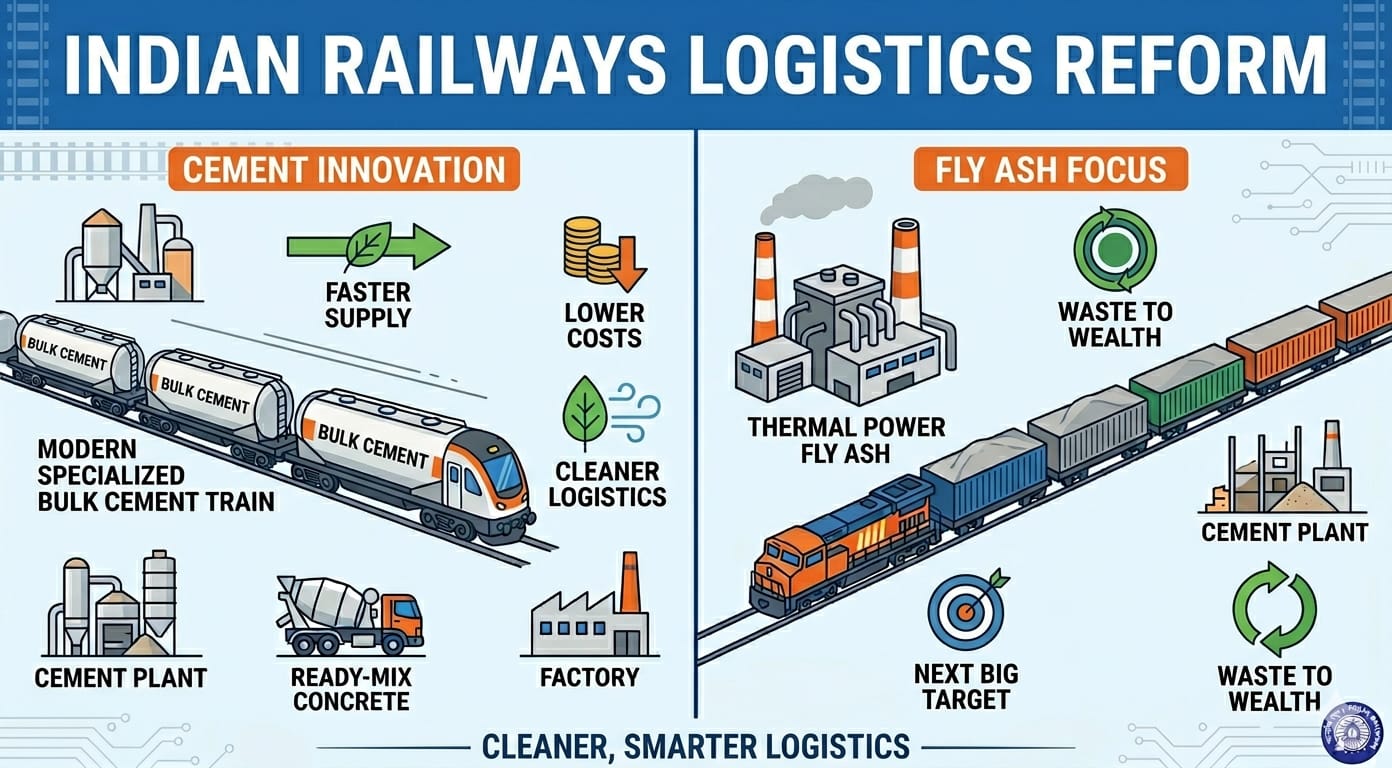
Indian Railways has recorded a remarkable 170 percent increase in cement transportation over the past four months, marking a significant milestone in its ongoing freight reforms.
This surge comes after the introduction of a new bulk cement transportation system in November last year, aimed at shifting cargo movement from road to rail while improving efficiency, reducing costs, and minimizing environmental impact. The reform is quickly emerging as a game changer for both the logistics and construction sectors.
At the core of this transformation is the introduction of specialized bulk cement tank containers and a new terminal policy that enables seamless multimodal logistics. These containers allow cement to be transported directly from manufacturing plants to construction sites without the need for multiple handling stages.
Unlike traditional bagged transport, which involves repeated loading and unloading, the new system ensures that cement moves in a streamlined, closed-loop process, significantly reducing wastage and operational delays.
The impact is already visible on the ground. With standardized containers that are compatible with Ready-Mix Concrete machines, cement now reaches its destination in a ready-to-use form.
This eliminates two major stages in the supply chain, leading to faster turnaround times and lower logistics costs. For construction companies, this means improved project efficiency, while for consumers, it can translate into more affordable housing and infrastructure development.
The economic implications of this reform are substantial. Cement is a critical input in construction, and any reduction in its delivery cost directly affects the overall cost of building homes, roads, and infrastructure projects.
By making logistics more efficient, Indian Railways is indirectly supporting the government’s goal of affordable housing, especially for middle- and lower-income groups. The reform is not just about transportation—it is about strengthening the entire construction value chain.
Equally important are the environmental benefits. Bulk transportation through sealed containers reduces dust pollution during loading and unloading, a long-standing issue in traditional cement handling.
Additionally, the shift from road to rail cuts fuel consumption and lowers carbon emissions, contributing to cleaner and more sustainable logistics. Reduced dependence on trucks also helps ease congestion on highways, improving overall transport efficiency.
Encouraged by the success in cement logistics, Indian Railways is now turning its attention to another underutilized resource—fly ash. Produced in massive quantities by thermal power plants, fly ash has long been treated as industrial waste despite its valuable applications in cement production, brick manufacturing, and road construction. Currently, out of nearly 300 million metric tonnes generated annually, only about 13 million tonnes are transported by rail.
The government now sees this gap as a major opportunity. By expanding rail-based transportation of fly ash, it aims to convert waste into a valuable economic resource. Efficient movement of fly ash to industries and construction sites can reduce pollution, promote recycling, and lower the cost of building materials. This “waste to wealth” approach aligns with India’s broader push toward sustainable development and circular economy practices.
The larger vision behind these reforms is clear. Indian Railways is not just upgrading its freight systems but redefining how bulk commodities move across the country. The introduction of innovative container solutions, improved policy frameworks, and a focus on end-to-end logistics is helping create a more efficient, scalable, and environmentally responsible transport network.
As the cement success story shows, even targeted reforms in one sector can have ripple effects across the economy. If the same model is successfully applied to fly ash and other bulk materials, it could significantly enhance India’s logistics capabilities while supporting infrastructure growth and sustainability goals at the same time.

