
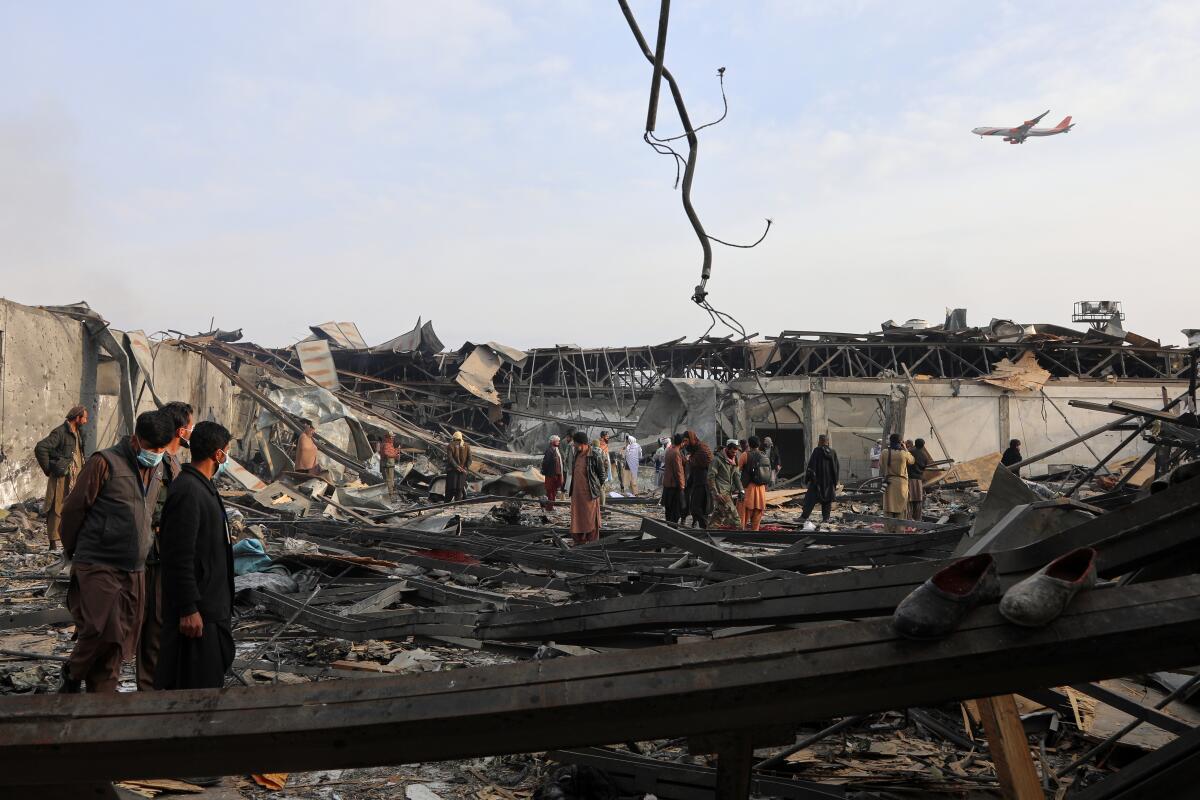
The United Nations has so far confirmed the killing of 269 Afghan civilians in Pakistan’s attack on a treatment center in Kabul.
The United Nations Assistance Mission in Afghanistan (UNAMA) has confirmed that more than 260 civilians were killed in Pakistan’s airstrike on a drug treatment center in the capital, Kabul.
A UNAMA spokesperson told the media: “The United Nations Assistance Mission in Afghanistan has so far determined the deaths of at least 269 civilians and the wounding of 122 others in the airstrike carried out on March 16 on the drug treatment center named Omid.”
UNAMA adds that the death toll may be even higher. According to them, investigations are ongoing and updated information on this matter is scheduled to be released at the end of the current calendar month.
The United Nations Assistance Mission in Afghanistan had earlier confirmed the killing of 143 civilians in its initial investigations, but the Taliban government puts the number of civilian deaths at more than 400.
The Taliban government in Afghanistan blames Pakistan for the attack, but Pakistan claims it targeted military installations and that this treatment center was destroyed in explosions of explosive materials.
They have now proposed to Russia that it send a professional team to assess these claims and the site of the incident.
Russia is the only country that has officially recognized the Taliban government in Afghanistan.
Suhail Shaheen, the Taliban government’s ambassador in Qatar, told the media: “Besides Russia, this request has also been made to human rights and other international organizations.”
In the latest Afghanistan-Pakistan crisis, Pakistan’s airstrike on the “Omid” drug treatment center in Kabul was one of the deadliest incidents.
What has drawn the attention of observers, especially Richard Bennett, the UN Special Rapporteur on Human Rights for Afghanistan, is the extremely low level of international reaction to this incident.
Mr. Bennett told, “When the Americans bombed a school in Iran, many voices were raised that it should be condemned, and the Human Rights Council held a special session on that matter.
But there was almost no international reaction to a similar attack on the health center at Camp Phoenix.”
He adds that this relative silence is concerning and warns that such lack of attention could pave the way for the recurrence of similar incidents. He has called for independent investigations into this attack.
At the same time, Pakistan is trying to position itself internationally as a key diplomatic player by mediating international conflicts.
In Afghanistan, however, some believe that this very role could cause Pakistan’s military actions and their consequences inside Afghanistan to be overlooked and left unanswered.
At the site of the attack, the accounts still tell stories of deep pain. Survivors recall scenes that are hard even to imagine.
But beyond that attack, civilians have also been killed and wounded in airstrikes in other parts of Afghanistan, including Kabul, and families whose homes were destroyed say their lives have been completely shattered.
International affairs experts warn that when a country falls out of global attention, the mechanisms for monitoring and accountability weaken along with it.
International affairs analyst Malik Setiz says, “Afghanistan has fallen out of the focus of key global players, including the U.S. and Europe, while Pakistan has recently gained many concessions, and this has emboldened Pakistan to commit all kinds of violations in Afghanistan.”
Journalists and observers also say that Afghanistan is often overshadowed by larger crises, and this is why even deadly incidents go unnoticed.
Pakistani officials and the Taliban government have not responded to the media on this matter.
While diplomatic roles and international equations are shifting, many in Afghanistan are worried that civilians will pay the price for these changes.
For them, the danger is not only airstrikes, but also that these attacks will become a normal reality, without attention or accountability.
By- Laiba Yousafzai

