
You can worship the Devi in every street and abandon the woman in every institution. In Bengal, that is apparently not a contradiction anyone in power finds uncomfortable enough to address.
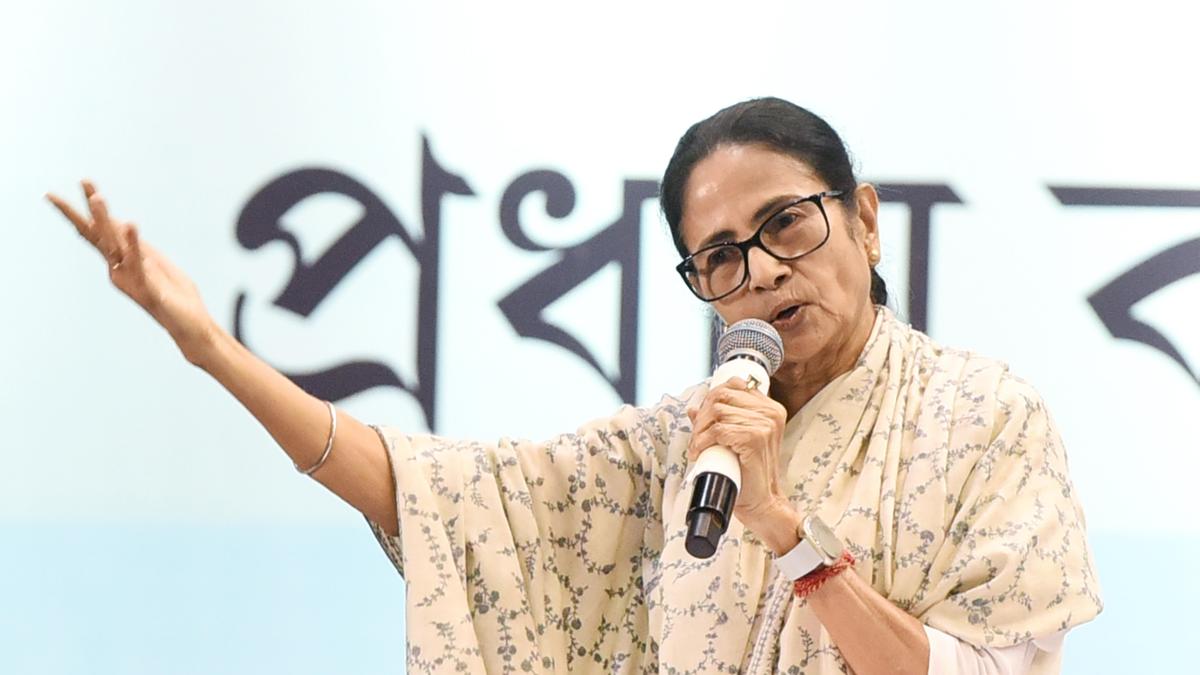
In 1992, a young politician named Mamata Banerjee did something that power rarely tolerates. She made herself inconvenient. She carried a disabled rape survivor up the steps of Writers’ Building, the colonial-era fortress from which West Bengal had been governed for decades, and she demanded that the Chief Minister look at what his state had done to this woman.
The state eroded its inconvenience by dragging Mamata Banerjee off the steps and arresting her on the pavement outside. At that moment, she made a vow: she would not enter that building again until she entered it as Chief Minister.
She then entered Writers’ Building as Chief Minister in 2011, governing West Bengal for fifteen unbroken years since.
In those fourteen years — fourteen years under the woman who was once dragged off those steps for demanding justice for a rape survivor — West Bengal has achieved a conviction rate for crimes against women of 3.7%. Second lowest in India. The state has perfected the machinery of impunity. The backlog of unresolved cases: 3.68 lakh, growing. Acquittals in a single year: 19,005 — the highest of any state in the country, more than double the year before. The system is not slow. It is not broken. It is working exactly as it has been allowed to work.
In Bengal, two people run the same calculation every morning.
A man has decided to commit sexual violence. It is the only crime with no legal defence, no moral argument, no human justification anywhere, under any circumstance. He knows and chooses to commit it anyway. He has never read an NCRB report. He doesn’t need to, for the state’s blatant victim blaming tells him what the data confirms: the legal machinery is not coming for him. His probability of conviction is a meagre 3.7% and chances of acquittal seem to increase with every year.
A woman runs the same numbers in reverse. She calculates the risk of stepping out of her house. The probability of survival, of being believed. The probability of a consequence, or prevention by the state. Which route home has more light. Whether to take the phone call now or pretend to be on one. Whether the auto driver’s eyes in the rearview mirror are calculating something she needs to know about. How long to hold the keys before reaching the door.
On August 9th, 2024, a 31-year-old doctor named Abhaya stopped running that calculation.
The crime that could not be contained
Abhaya was not a goddess. She was a postgraduate trainee physician at RG Kar Medical College and Hospital in Kolkata. On the night of August 8th, 2024, she had been on her feet for 36 consecutive hours in service of the state hospital she worked at and the patients who needed her. Around 2am, she sought sleep in a seminar room inside the hospital grounds. A government building. She was, by any reasonable understanding of the social contract, in the safest place available to her.
Her body was found that morning. She had been raped and murdered. Inside a government institution. While on duty. After 36 hours of service to a state that would, in the hours that followed, prioritise protecting itself over protecting her memory.
What happened next was not justice. It was its systematic undoing.
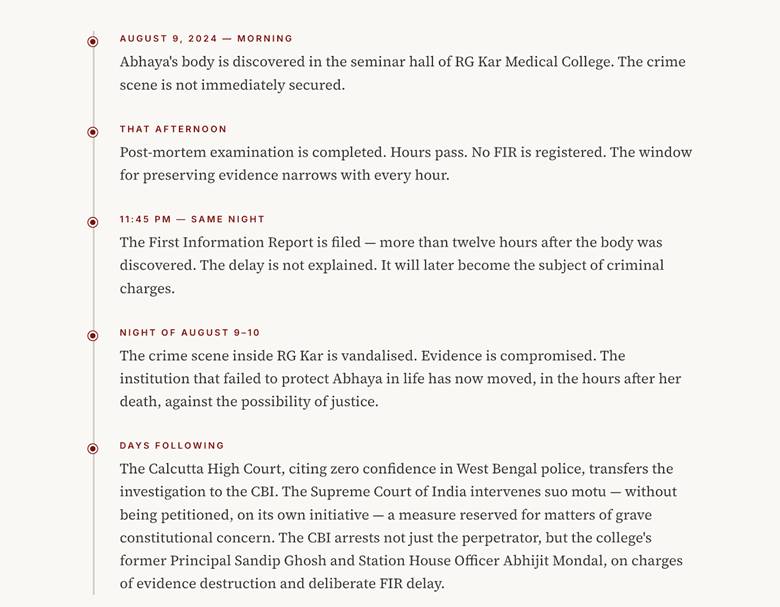
The Kolkata Police registered the First Information Report hours after the post-mortem had already been completed, a procedural sequence so inverted that the Supreme Court bench would later demand an explanation for the timeline. The college principal, Sandip Ghosh, initially told the family their daughter had died by suicide. He then held a meeting with hospital staff before informing the police. Days later, on the night of August 14th, a mob descended on the hospital and vandalised the crime scene, with police standing by.
The man who raped and murdered Abhaya was a civic volunteer named Sanjay Roy, attached to the Kolkata Police. He knew, from his proximity to the institution of law enforcement, precisely how that institution functioned when it was forced to investigate itself. Roy’s calculation was right: the crime scene would not be secured. The FIR would be delayed. The family would be misdirected. The principal would hold a staff meeting before calling the police. And when pressure became sufficient to force an investigation, that investigation would be conducted by the same police force whose systemic failures had created the conditions for the crime in the first place.
He had to be wrong about one thing: He did not anticipate that the protests would be large enough, and sustained enough, to force a CBI transfer, a Supreme Court intervention, and his own conviction.
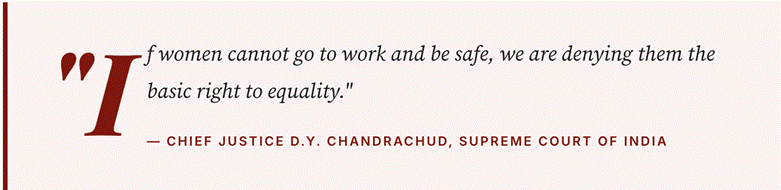
Three institutions of the Indian state — the High Court, the Supreme Court, and the CBI — had to be deployed to overcome the resistance of one state government. On August 13th, the Calcutta High Court transferred the investigation to the CBI, stating that the Kolkata Police’s handling did not inspire confidence and flagging the possibility of evidence destruction. On August 18th, the Supreme Court took suo motu cognizance of the case. A three-judge bench headed by Chief Justice DY Chandrachud heard the matter on August 20th and was openly alarmed by what the CBI’s status reports revealed. The court criticised the state government and Kolkata Police over their mishandling, ordered security forces to be deployed at the hospital, and set up a nine-member National Task Force on doctor safety.
The CBI subsequently arrested Sandip Ghosh and Abhijit Mondal, the Station House Officer of Tala Police Station, on charges of evidence tampering and misleading the investigation.
That Sanjay Roy was ultimately convicted is important. That the conviction required the mobilisation of India’s highest court to overcome the resistance of a state government is the story.
The protests that followed were the largest Bengal had seen in years. Doctors struck for 42 days. Students occupied the streets. Demonstrations erupted across 130 cities in 25 countries. At the “Reclaim the Night” march on Independence Day, the bitter irony of the date escaping no one, thousands of women held torches and walked through the streets of a city that had failed one of their own.At the “Reclaim the Night” march in Kolkata on Independence Day, the bitter irony of the date escaping no one, thousands of women held torches and signs and walked through the streets of a city that had failed one of their own.
Millennials had the Nirbhaya case. Gen Z has RG Kar. Will every generation of Indian women need a case that breaks them open — just to be reminded that nothing has changed?
The number behind the name
To understand why Abhaya’s murder was not a tragedy in isolation but a tragedy made structurally inevitable, you need to understand the state she lived and worked and died in.
The Trinamool Congress has one phrase it deploys with the regularity of breathing: zero tolerance. After the Durgapur gang rape case in late 2025, a year after the harrowing RG Kar case, Chief Minister Banerjee said — for the cameras— “In Bengal, we have zero tolerance for such crimes.” She then advised young people not to venture out at night.
There is a word for a government that tells women the solution to unsafe streets is to vacate them. It is not feminism. It is the oldest patriarchal bargain in existence, dressed in the language of protection, extracting the same price it has always extracted: your freedom, for the illusion of your safety.
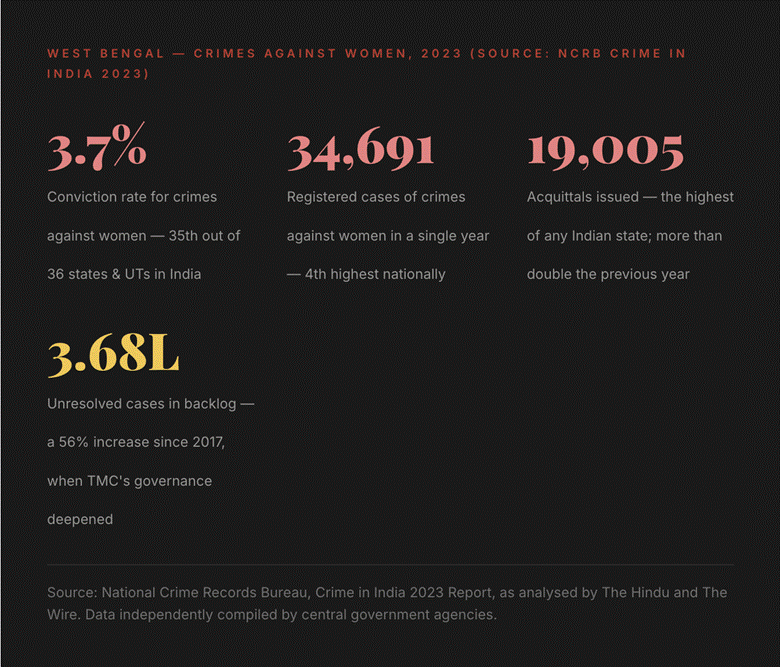
West Bengal’s conviction rate for crimes against women stood at 3.7% in 2023. This figure comes from the National Crime Records Bureau, an arm of the central government with no institutional incentive to embarrass any particular state. It places West Bengal 35th out of 36 states and union territories. The national average that year was 21.3%.
In 2023, West Bengal’s courts issued 19,005 acquittals for crimes against women. The highest of any state in India. More than double the 7,996 acquittals issued the year before. Behind those acquittals: a backlog of 3.68 lakh unresolved cases, grown 56% from the 2.34 lakh cases pending in 2017. The state’s rate of crimes against women stands at 71.3 cases per lakh female population, significantly above the national average of 65.3.
Behind those acquittals: a backlog of 3.68 lakh unresolved cases, grew 56% from 2017.
Behind that: five consecutive years of leading the nation in acid attacks. In 2023 alone, the state accounted for more than one in four acid attacks recorded across the entire country.
One state. One government. One consistent, unbroken record, across five years, of leading the nation in a crime category that has no second interpretation.
To hold these numbers together is to understand something no press conference has managed to obscure: the problem in Bengal is not India’s problem at scale. It is a specific, local, authored failure. Other states do better. Most states do better. Bengal, under the government that has governed it for fourteen years, with a woman at its head and the protection of women as its loudest promise, does not
Each acquittal the system produces is a lesson, delivered publicly, by a court, on the record, to every man in the state paying attention. Zero tolerance does not look like this, zero accountability does.
The Playbook is old. Only the fonts have changed
What happened to Abhaya was not Bengal’s first encounter with this species of horror. It was, in some ways, its most recent repetition of a pattern old enough to have its own case law.
30th May, 1990 Bantala, West Bengal : The Blue Print
Three women health officers —a Deputy District Extension Media Officer for the West Bengal Health Department, her senior colleague, a UNICEF and WHO representative — were returning to Kolkata after inspecting an immunisation programme in Gosaba. At 6:30pm, near Bantala on the Eastern Metropolitan Bypass, their car was stopped by a mob, overturned, and set on fire. The driver who tried to resist was beaten with 43 separate wounds across his body. He died four days later. The three women were dragged to a paddy field and raped. The Deputy District Extension Media Officer , who resisted, was murdered. She was found with a metallic torch inserted into her body. The examining doctor fainted at the discovery.
The state’s response was delivered by then Health Minister Prasanta Sur, who defended the mob — which included members of his own political party — by suggesting the women may have been “mistaken for child-abductors.” Chief Minister Jyoti Basu moved to trivialise the incident. It has since been speculated that these women were targeted because they had been documenting the misappropriation of UNICEF funds by locally affiliated panchayat members. When the mob set the car on fire, the evidence burned with it.
Six men were convicted. No CPI (M) figure faced a single consequence.
In 1990: a government officer investigating corruption, raped and murdered, her evidence destroyed, the state’s response a shrug dressed as an explanation. Ruling party: CPI(M).
In 2024: a doctor, raped and murdered in a government hospital, the crime scene vandalised, her death described to her family as a suicide before it was described as a crime. Ruling party: TMC.
CPI(M) and TMC are Bengal’s great political enemies. Each has spent decades positioning itself as the antidote to the other’s poison. TMC was built, in significant part, on the promise that the era of CPI(M) impunity was finished.
The welfare mirage
To understand how TMC has thrived for fourteen years on a record the NCRB data renders indefensible, you must understand what the Trinamool Congress has built in place of safety. An extraordinary facade of empowerment, a mere fig tree leaf that covers up the failures of the government.
Kanyashree. Lakshmir Bhandar. Rupashree. Direct benefit transfers aimed at girls and women across the state. They have reached real beneficiaries. They have kept real girls in school and put real money into real hands.
They have also been, for fourteen years, the alibi.
When the conviction rate is raised: the welfare schemes are the answer. When the acid attack statistics are raised: the welfare schemes are the answer. When a doctor is raped and murdered in a government hospital: the welfare schemes are, eventually, somewhere in the government’s response, the answer.
Abhaya was the perfect product of those welfare promises. Educated. Professionally qualified. Employed in government service. By every metric the TMC welfare architecture exists to celebrate, she was a success story, the living evidence of the investment. And she was raped and murdered inside a government hospital, after 36 hours of service to the state, which then spent the ensuing hours suppressing evidence of what had been done to her body.
What good is a scheme that empowers a woman to build a career, if the state refuses to guarantee her life within it? The government offered Abhaya the door. It just couldn’t be bothered to make sure there was a floor on the other side.
Now examine the fiscal architecture underneath. West Bengal’s outstanding debt has grown from approximately Rs 1.9 lakh crore when TMC took office in 2011 to an estimated Rs 6.9 lakh crore by 2024-25.
The state’s share of national GDP has declined from 6.8% in 1990-91 to approximately 5.8% today.
Per capita income sits around 20% below the national average, lower than states like Rajasthan and Odisha.
The welfare programmes are being funded with borrowed money that will take the next generation to repay. A state that was historically an economic engine is now a fiscal dependent.
A woman who knows that her attacker has a 3.7% chance of conviction does not enter the public sphere with the same confidence as a man, who knows that his crime bears no consequences. Every woman whose calculations bind her to her home, is a subtracted economic unit, a withdrawn ambition, an education that went somewhere and then stopped.
And the fear manifests in West Bengal’s female workforce participation rate, which sits at 22.3%. The reason is not a mystery. A justice system that produces a 3.7% conviction rate and a backlog of nearly 400,000 unresolved cases communicates something to every woman considering whether to enter the public sphere. It communicates: we cannot protect you there.
The architecture of deflection
Every government that fails its women eventually reaches for the same set of tools. In Bengal, those tools have been refined across fourteen years into something approaching an art form.
Step one: reframe the crime as a conspiracy.
After RG Kar, the government’s first instinct was to characterise the protests — the hundreds of thousands who flooded streets across 130 cities in 25 countries — as a conspiracy to damage Bengal’s reputation. Not: we failed to protect a woman we employed. But: someone is using her death against us. The Police Commissioner called public grief a malicious media campaign against Kolkata Police. When a government frames a rape and murder as a threat to its own image, the victim has been failed twice: once in the seminar room, and once in the press conference.
Step two: legislate theatrically.
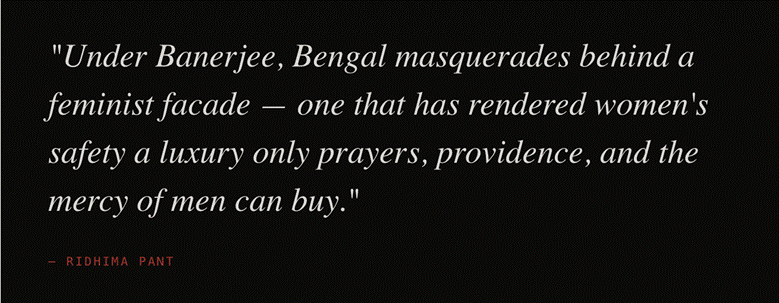
The Trinamool government produced the Aparajita Bill, named, with exquisite irony, for the very woman its system had failed to protect. Retired Supreme Court Justice Ashok Ganguly called it what it was: a political exercise to divert attention. Legal experts confirmed the bill contained unconstitutional provisions, operationally impossible timelines, and penalties so severe they risked deterring survivors from reporting in the first place. The bill awaits presidential assent. The conviction rate remains 3.7%.
Step three: minimise. Consistently. By name.
The Park Street rape was a fabricated story. Rising assault numbers were attributed to the natural result of men and women mixing freely. “ an open market with open options” argued Mamata Banerje. A 14-year-old gang-raped in Hanskhali was reduced to a love affair. And for the latest blot on Bengal’s crime record, the Durgapur 2025, the chief minister advised girls not to go out at night.
This is not a pattern of mistakes. This is a philosophy, a government’s revealed understanding of what rape is: not a crime the state must prosecute, but an event whose meaning is negotiable, whose cause can be located in the woman’s behaviour, and whose political fallout can be managed with sufficient skill.
A condemnation without party lines
The Indian Medical Association accused the TMC government of systematic cover-up. Congress’s own Adhir Ranjan Chowdhury — the party’s state president and one of the TMC’s most consistent opponents from the left — stated that the state government “seems intent on helping the accused.” Congress leader Renuka Chowdhury stood publicly alongside the protesting doctors. The Calcutta High Court expressed zero confidence in the West Bengal police force.
When a government’s critics are not political opponents but Supreme Court judges, state High Courts, medical associations, and elected representatives of every party across the aisle, and the youth of India, who protested across states and countries — the failure is no longer partisan. It is civilisational. The scale of the response was its own data point: a republic registering, in terms that cannot be misread, that something fundamental had been violated.
A Mother’s Answer
Indian politics is not built for amateurs.
It is built for dynasties, for cadres, for people who have spent decades learning which hand to shake and which back to watch. It is built for people who understand that in a state like West Bengal, where political violence is not a metaphor but a documented phenomenon, where booth capturing is an electoral tradition and where switching parties has historically carried physical consequences, contesting an election requires a specific kind of fluency that takes years to develop.
Ratna Debnath has none of it.
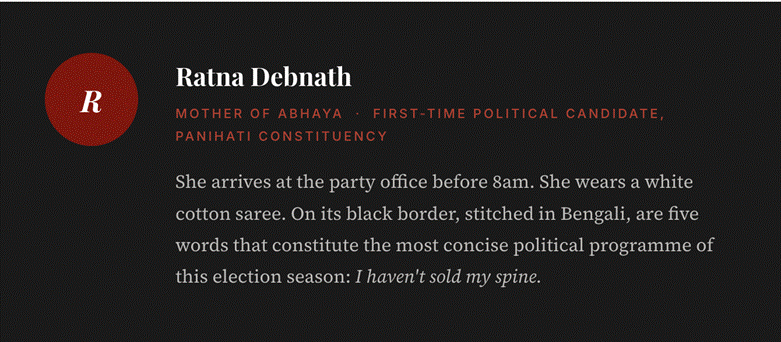
She is Abhaya’s mother and also now a political candidate , contesting on a BJP ticket, not from ideological conviction, she says plainly, but from strategic necessity.
The courage she has shown is unparalleled. We are all standing here for a mother to bring justice for her daughter,” senior BJP leader Smriti Irani, who too accompanied Ms. Debnath, said.
She surveyed the field and concluded that no mechanism existed to hold the Trinamool accountable. So she filed her nomination. A grieving mother looked at fourteen years of governance data, the facts of her own daughter’s murder case and made a decision.
“As Ms. Debnath made her way into the crowd, mothers hugged her, cried and wiped tears with their saaris. The crowd empathised with her, the sentiment of “it could have been our daughter” echoed through it” reported The Hindu
“There is misgovernance in West Bengal,” she has said, on the record, to anyone who will listen. “There is no safety or respect for women. After an incident, women are told not to stay out late or work late. The person who says this is our Chief Minister, our Home Minister, our Police Minister. My appeal is that people should be aware of their rights, which have been taken away.”
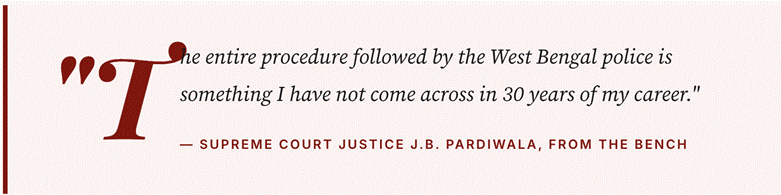
That is not a campaign slogan. It is testimony delivered under oath to history. A woman whose daughter was raped and murdered at a government hospital, whose evidence was then systematically compromised by government officials, who watched the Supreme Court conclude that what had happened to her child was unlike anything three decades of judicial experience had prepared it for.
The TMC candidate in Panihati, the very constituency where Ratna Debnath campaigns from , told voters cheerfully: “Kolkata and Bengal is the safest. Women are working night shifts. There is no problem.”
This is the 2026 west bengal elections in essence for all women in bengal.
Whatever you believe about parties and politics, that woman’s choice demands to be reckoned with. Her campaigning stands as a verdict, that the TMC has failed the women of Bengal, and that justice can only be served by the aggrieved mothers who have lost their daughters because of Banerjee’s incompetence.

