
The United States of America is locked in a conflict with Iran in West Asia which is now in the middle of a fragile ceasefire. The main issue of contention now is control of the crucial Strait of Hormuz and its reopening. Notably, the strait was always open before US led strikes hit Iran on February 28 this year.
The strait still remains blocked weeks later and so far, US and Iran have failed to reach an agreement over its reopening.
While its main focus is apparently on the Strait of Hormuz, US may be making its move to take greater control of another important narrow sea passage, the Strait of Malacca. The critical trade chokepoint connects the Indian Ocean and the Pacific Ocean.
Indonesia, Malaysia, and Singapore collectively manage this passage through which much of the world’s trade takes place. While most of South-East Asia is heavily reliant on this strait for exports and imports, China, in particular is dependent on this strait. Much of China’s exports and its energy imports take place through this strait.
A fresh defence arrangement between the United States and Indonesia has triggered speculation that the US’ may be looking to exert greater influence in Strait of Malacca. if US gets greater control of the strait, it will be able to pressurise China as the strait is the lifeline of Chinese trade.
The agreement with Indonesia gives US military aircraft expanded operational access to Indonesia’s airspace. By getting access to the Indonesian airspace, US will have greater surveillance and operational capabilities in the Malacca Strait..
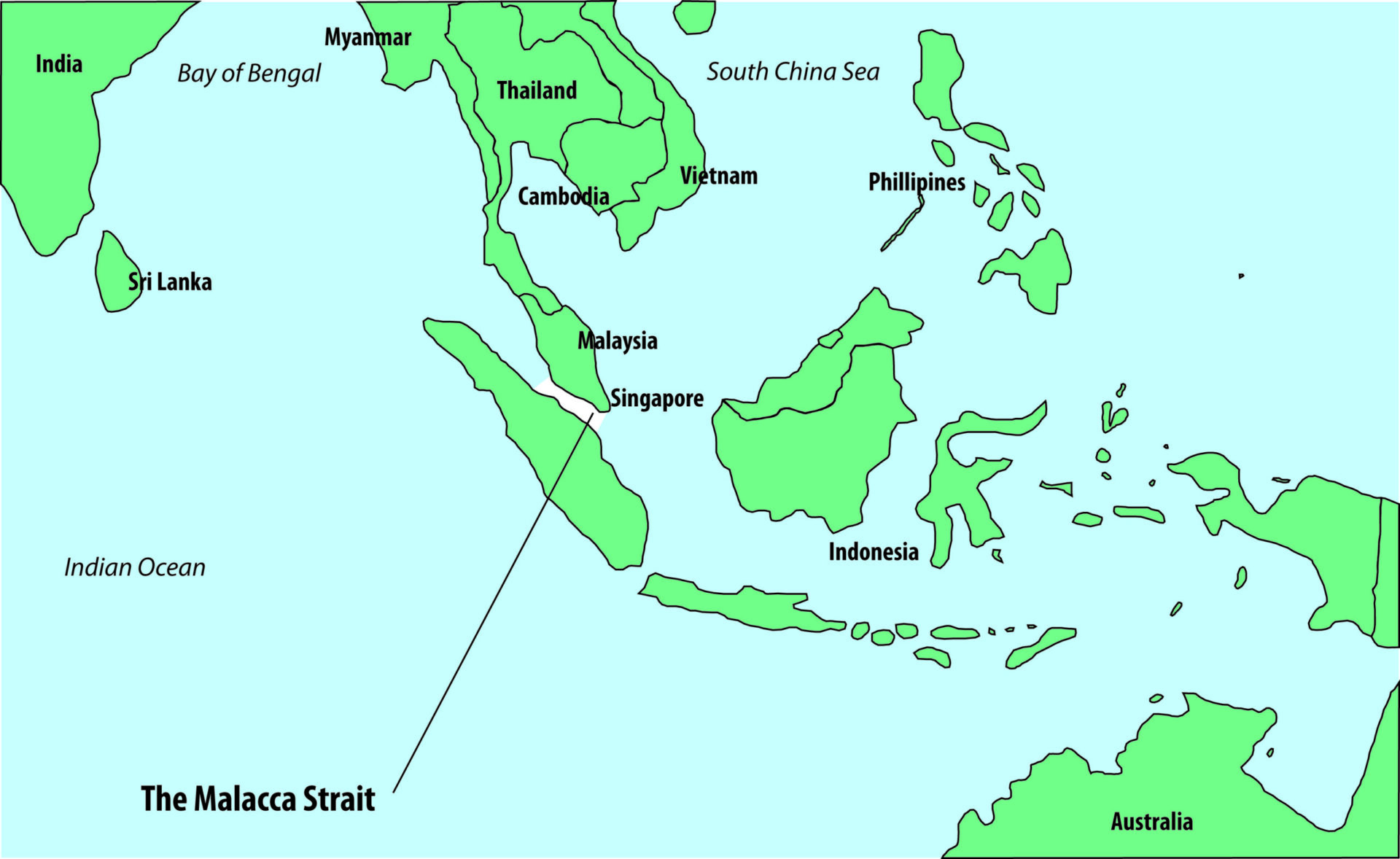
Location of the Malacca Strait
It is located in Southeast Asia, sandwiched between the Malay Peninsula (part of Malaysia) and the Indonesian island of Sumatra. The strait connects the Indian Ocean to the South China Sea, effectively serving as a vital maritime corridor between the Middle East, Africa, and Europe on one side, and East Asia on the other. It stretches roughly 800 kilometers in length and narrows to just about 2.8 kilometers at its tightest point, making it a natural chokepoint for global shipping.
India’s Andaman and Nicobar islands are just 150 KMs from the northern entrance to this strait making it strategically important for India as well.
The strategic importance of the strait
The Strait of Malacca is one of the most significant routes in world trade. It is one of the busiest shipping lanes globally, with nearly one-third of all international maritime trade passing through it. A significant portion of the world’s oil shipments, especially from the Persian Gulf to major Asian economies like China, Japan, and South Korea, travels via this route. This makes it a critical artery for global energy security.
Unlike Strait of Hormuz, which primarily serves to transport Oil, Malacca strait also facilitates the movement of manufactured goods, raw materials, and food supplies. Major trading economies depend heavily on this route for exports and imports, making it indispensable for maintaining global supply chains. Its strategic importance also makes it a focal point for geopolitical interests, with countries closely monitoring its security and stability.
However, the narrow width also makes it a target for blockades. With just 2.8 KM wide at its narrowest point, the strait is a trade chokepoint.
If the United States gains greater control of this strait, it will be able to directly impact China economically. Now, by increasing its influence in Indonesian airspace, US may have sent the warning bells ringing in Beijing.
India will also be looking at these developments carefully in its neighbourhood. India is already planning to develop Nicobar islands to increase its influence just to the west of the strait, but America’s moves in the region may just accelerate that project.

