
For three winter days in early December, India’s aviation network was effectively held hostage by a single airline’s internal planning choices, as IndiGo cancelled over 2,500 flights and delayed around 1,850 more, stranding lakhs of passengers across the country.
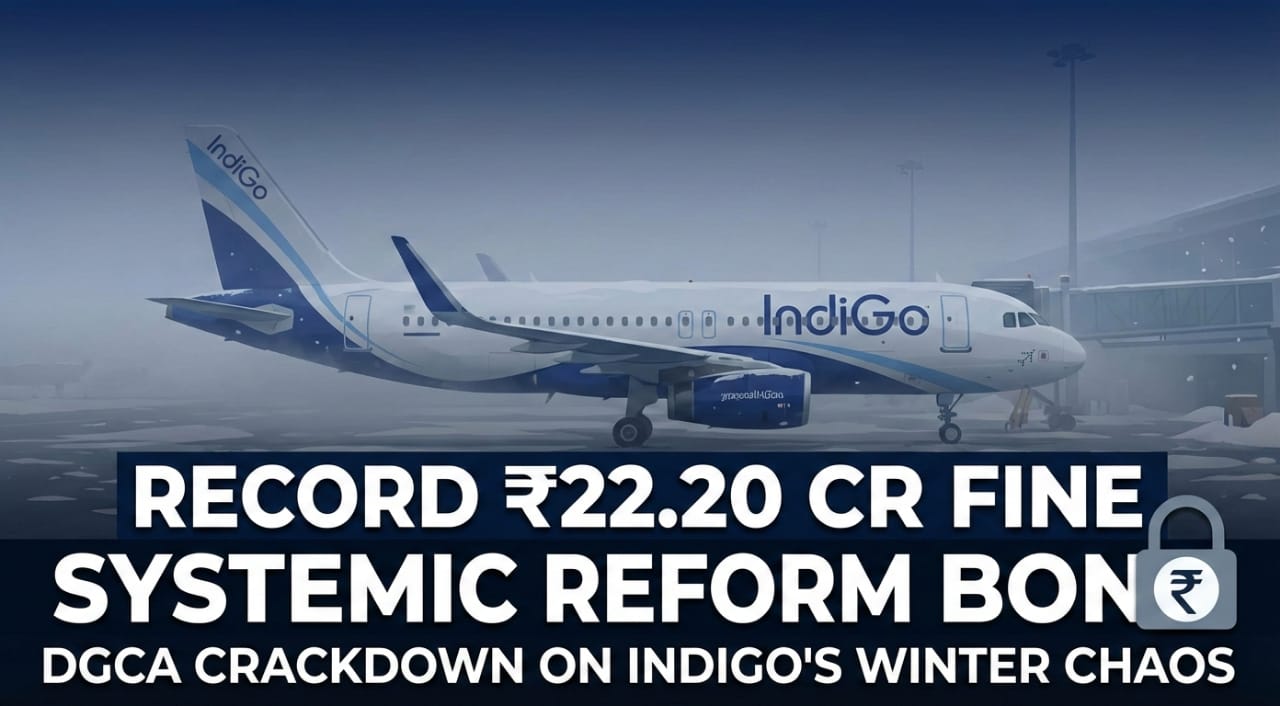
The bill for that chaos has now arrived: The Directorate General of Civil Aviation (DGCA) has imposed a record financial penalty of Rs 22.20 crore on IndiGo and, more unusually, forced it to lock up Rs 50 crore in a reform-linked bank guarantee that will be released only if the airline proves, over many months, that it has actually fixed its systems.
The enforcement action flows from a four-member DGCA inquiry committee set up after the meltdown between December 3 and 5, when more than 1,600 of IndiGo’s roughly 2,300 daily flights were cancelled on a single day, exposing how fragile the backbone of a 65% market-share carrier can be when buffers are stripped to the bone.
The committee’s brief went well beyond a routine audit: it examined network planning, crew rostering, software support, management oversight and compliance with the revised Flight Duty Time Limitation (FDTL) rules that tightened pilot rest norms from the Winter 2025 schedule.
What the committee found cuts through the convenient narrative of “unforeseen regulatory shock” that some in the industry tried to float in the early days of the crisis. It concluded that IndiGo had over-optimised operations to maximise utilisation of aircraft and crew, while failing to maintain adequate operational buffers or robust software support for the new FDTL provisions. Crew rosters were routinely stretched to the upper limits of duty periods, with heavy reliance on dead-heading, tail swaps and extended duty patterns, leaving almost no recovery margin once the new fatigue rules kicked in and winter fog delays were layered on top.
In plain language, the regulator is saying this was not an act of God but an act of management. According to the Ministry of Civil Aviation, the airline’s leadership “failed to adequately identify planning deficiencies, maintain sufficient operational buffers, and effectively implement the revised FDTL provisions,” directly causing widespread delays and cancellations. The crisis was serious enough for Civil Aviation Minister K Rammohan Naidu to publicly promise that action would “set an example,” signalling that this was now a test case of how the Indian state deals with a privately run, systemically important airline.
The financial architecture of the punishment reflects that ambition. IndiGo has been hit with six one-time penalties of Rs 30 lakh each—totalling Rs 1.80 crore—for specific counts of non-compliance, but the real sting is a daily penalty of Rs 30 lakh for 68 days, from December 5 to February 10, adding up to Rs 20.40 crore and taking the cumulative fine to Rs 22.20 crore, the highest ever levied by DGCA on any airline. Sources have pointed out that this number is slightly higher than IndiGo’s average daily net profit for 2024–25, signalling a deliberate attempt to pierce the comfort of “cost of doing business” thinking.
Even more revealing is the Rs 50 crore bank guarantee framework, branded the IndiGo Systemic Reform Assurance Scheme (ISRAS), which effectively converts regulatory anger into a long-term performance bond. Under this, Rs 10 crore will be released only after DGCA certifies reforms in leadership and governance within three months, Rs 15 crore is tied to manpower planning, rostering and fatigue-risk management over six months, another Rs 15 crore depends on upgrades to digital systems and operational resilience within nine months, and the final Rs 10 crore will be freed only if there is sustained board-level oversight and compliance over a 9–15 month horizon.
This structure quietly acknowledges a reality many TV debates ignore: IndiGo cannot simply be “punished” out of existence because its 65% domestic share makes it too central to India’s connectivity, but it can be forced into a monitored reform regime that treats operational stability as a quasi-public obligation.
Accountability has also been personalised at the top. DGCA has cautioned CEO Pieter Elbers for inadequate overall oversight of flight operations and crisis management, and warned COO and accountable manager Isidre Porqueras for failing to properly assess the combined impact of the Winter 2025 schedule and the new FDTL circular, leading to the network-wide disruption.
In a sharper move, the regulator has ordered that Senior Vice President (Operations Control Centre) Jason Herter be relieved of his current operational responsibilities and barred from any future “accountable position,” effectively indicting the nerve centre of IndiGo’s daily operations. A few other senior officials have also received formal warnings, underscoring that this is being treated as a layered command failure, not just a “software glitch”.
The crisis also triggered consequences beyond the balance sheet and HR files. On January 9, IndiGo was ordered to cut its approved domestic flight schedule by 10%, a rare step for a regulator that has usually been accused of being too deferential to market leaders.
DGCA stationed oversight teams at IndiGo’s headquarters to monitor network and crew operations in real time and issued show-cause notices to the CEO and COO at the height of the meltdown, even as it sacked four of its own flight operations inspectors responsible for overseeing IndiGo’s preparedness for the new FDTL rules. That last action is a quiet admission that the crisis was not just an IndiGo failure but also a regulatory one, and the Ministry has confirmed an internal DGCA inquiry to identify systemic gaps within the regulator itself.
For passengers, much of this played out as queues, missed weddings and broken plans, but the paper trail tells a more structural story: an airline that pushed utilisation hard, a regulator that believed its assurances, and a market so concentrated that when one carrier stumbled, the system had no real redundancy.
DGCA has acknowledged that IndiGo did move quickly to stabilise operations once temporary exemptions were granted for certain night-duty FDTL provisions up to February 10, and that refunds and compensation were processed as per the rules. But in return, the state has demanded something rare in Indian corporate regulation—verifiable reform milestones, board-level engagement and a multi-quarter test of whether those promises endure after the headlines fade.
IndiGo’s board, unusually, chose to respond in its own name, saying that an “in-depth review” of internal processes had already been underway and that the airline was committed to emerging “stronger” from what it framed as an aberration in an otherwise 19-year record.
The more uncomfortable question, which most press releases and prime-time debates skip, is whether a company that carries nearly two out of every three domestic flyers can continue to run ultra-lean rosters and software-dependent optimisations that leave no room for regulatory shock or weather, and then expect the public to treat the fallout as a mere service glitch.
The DGCA’s Rs 22.20 crore fine and Rs 50 crore reform bond suggest a different answer: in India’s new aviation politics, IndiGo is no longer just a private airline, it is a systemic institution—and systemic institutions cannot be allowed to gamble with fatigue, buffers and the basic reliability of the skies.

