
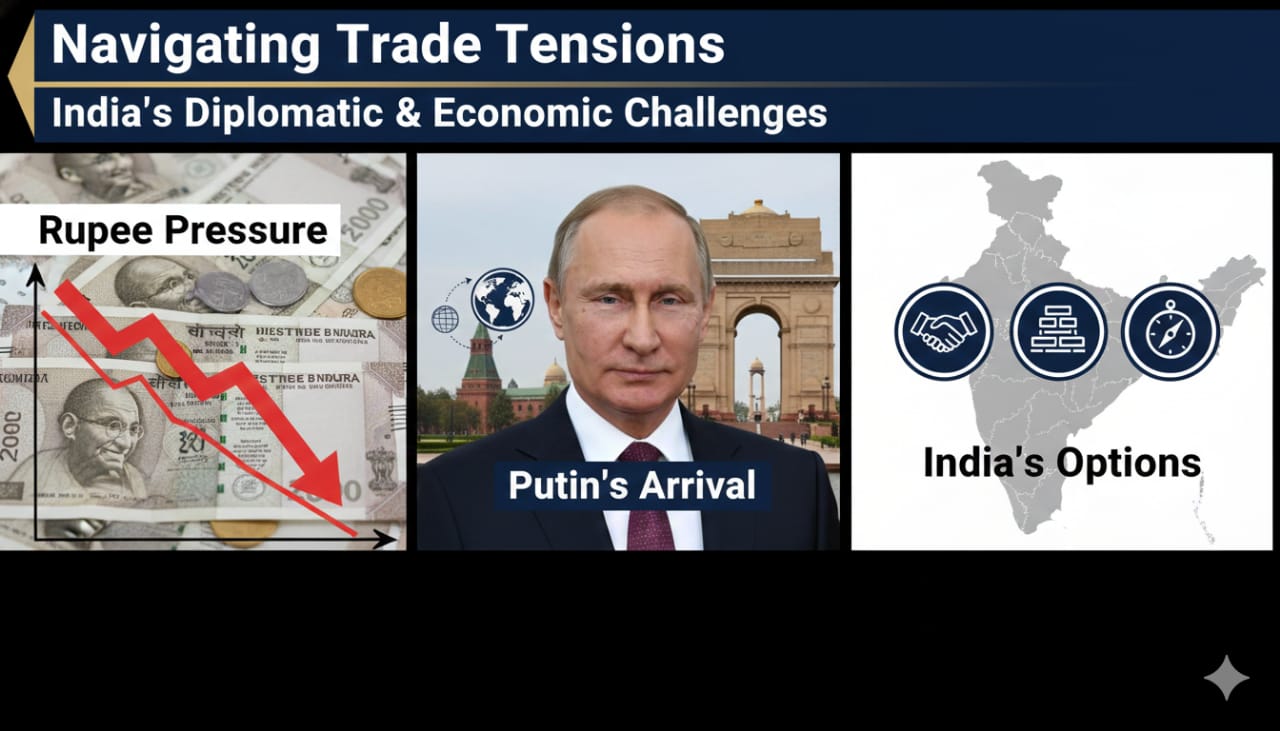
With the US trade deal stuck, the rupee breaching 90 per dollar, and Vladimir Putin on a state visit to India, is New Delhi carefully choreographing strategic pressure on both sides?
When the Indian rupee finally slipped past the psychologically loaded 90-per-dollar mark this week, questions immediately followed: is this just a market story, or is geopolitics quietly writing the script? Analysts quoted by The Economic Times and Reuters link the rupee’s fall to a cocktail of foreign portfolio outflows, persistent trade deficits and, crucially, uncertainty around a stalled US–India trade deal. If delays in concluding a crucial trade pact with Washington are helping push the rupee down, does that automatically create more space for Russia to walk in as an economic and political hedge for New Delhi?
On the trade front, India’s own senior officials have publicly said they “expect” a deal with the United States by the end of the year, suggesting that most technical issues are resolved even if a final political handshake is missing. Yet, the same period has seen the Trump administration escalate tariffs on Indian exports to as high as 50 percent, in response to India’s continued imports of discounted Russian oil and its role in broader non-Western groupings, as documented in open diplomatic analyses of the 2025 US–India trade and diplomatic crisis. If Washington is using tariffs and trade access as pressure tools, can New Delhi be faulted for reminding America that India has other powerful partners—especially when one of them is literally landing in Delhi?
Vladimir Putin’s visit to India on 4–5 December 2025 is not an informal drop-by; it is a formally announced State Visit for the 23rd India–Russia Annual Summit, confirmed in black and white by India’s Ministry of External Affairs (MEA). The MEA press release notes that Putin, at the invitation of Prime Minister Narendra Modi, will hold talks with the Indian leadership to “review progress” and “set the vision” for strengthening the “Special and Privileged Strategic Partnership” while exchanging views on regional and global issues. When such language comes from an official government communiqué, the question naturally arises: is this timing accidental, or is India purposefully placing the Russia card on the table just as trade bargaining with the United States gets tougher and the rupee gets weaker?
Look at the currency backdrop again: reports tracking the 90 breach highlight how lack of progress on the US trade deal has dented market sentiment and invited speculative bets against the rupee. Commentaries explain that high US tariffs, fear of prolonged friction with Washington and a risk-off mood among global investors have combined to hit India’s currency, even though macro indicators like forex reserves and growth remain relatively robust. If markets are effectively punishing India for uncertainty with the US, could showcasing a deepening Russia relationship be New Delhi’s way of signalling that it is not cornered, that it has room to maneuver and alternative economic corridors—from oil to defence and possibly local-currency trade—on the horizon?
Official and media narratives around the visit also underline energy and trade as core themes, with explainers and diplomatic briefs noting that India–Russia trade has grown sharply since Western sanctions on Moscow, particularly via discounted crude supplies routed through Indian refiners. In that context, does Putin’s presence in Delhi during a period of dollar strength and rupee weakness hint at quiet discussions on insulating at least part of bilateral trade from US currency dominance—through rupee-rouble mechanisms, local-currency settlements or expanded use of third-country currencies? None of this is openly admitted in official text, but the pattern of oil flows, trade numbers and summit agendas reported by reputable outlets makes the question unavoidable.
Another angle emerges from coverage by CNN and other global outlets, which frame the moment as India trying to “have it both ways”: pursuing a trade framework with Washington while rolling out the red carpet for Putin. Is this really fence-sitting, or is it India’s way of asserting itself as a genuinely autonomous pole that will neither abandon Russia under Western pressure nor accept punitive US tariffs as the price of partnership? Seen this way, the choreography looks less like confusion and more like calibrated signalling: the US is reminded that overplaying the tariff-and-sanctions card could push India deeper into non-Western economic networks, while Russia is reminded that India is not a junior partner, but a swing power actively courted by Washington.
So, is there a direct “deal” linking the rupee at 90, a delayed US trade pact, and Putin’s arrival in Delhi? Official statements, especially from the MEA, do not say so; they carefully frame the visit as part of an ongoing annual summit process focused on reviewing ties and setting a long-term vision. Yet, when the currency breaks a historic level in the same week, when Reuters and Indian business media explicitly tie that weakness to stalled US trade talks, and when Russia’s president is in the capital under a banner of “Special and Privileged Strategic Partnership”, it is hard not to see a strategic tapestry. The more Washington uses trade and tariffs as pressure points, and the more markets react by punishing the rupee, the more rational it becomes for New Delhi to keep Moscow visibly close—not as an emotional choice, but as a deliberate reminder that India still has options in a world of contested dollars and contested deals.

