
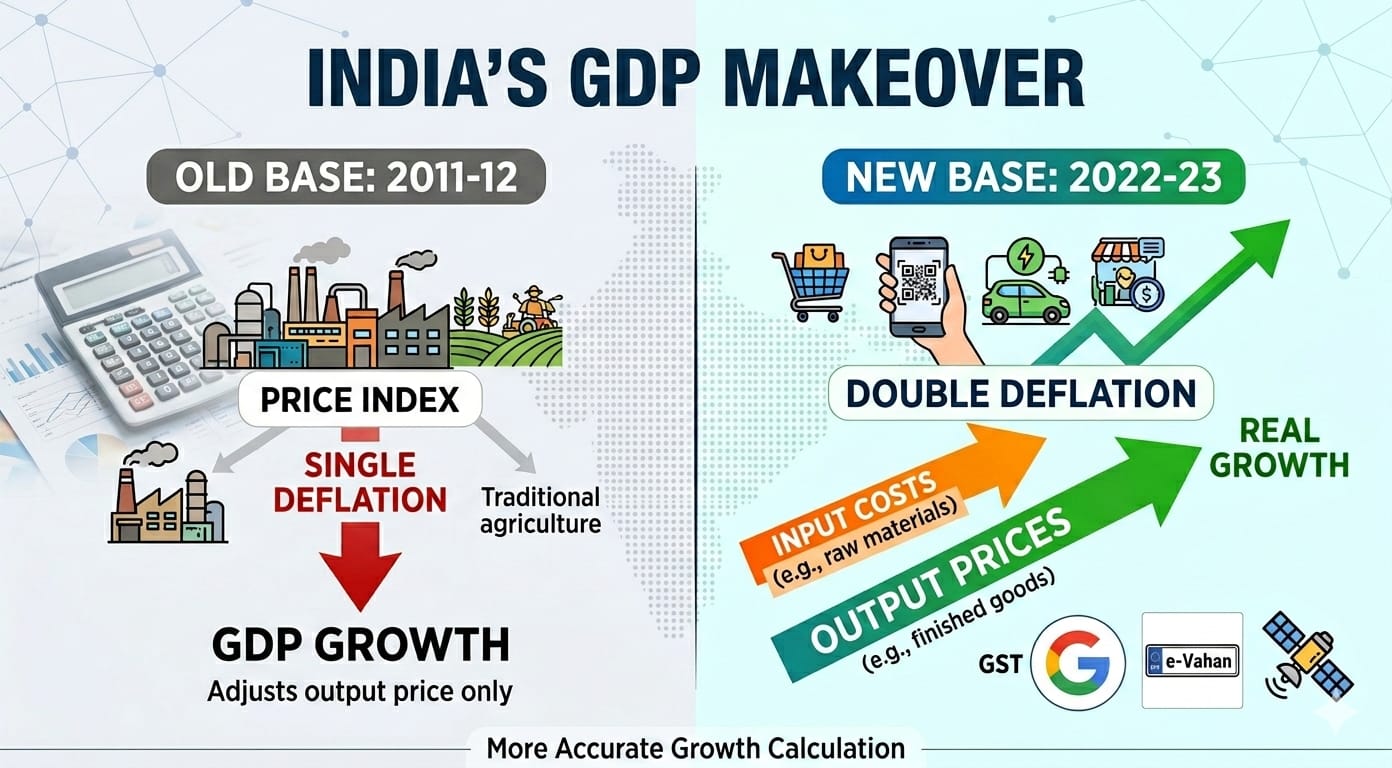
After more than a decade, India’s GDP is finally getting an update, and the new numbers are expected to show how much the economy has truly changed in recent years. The Ministry of Statistics and Programme Implementation (MoSPI) is releasing a completely revised GDP series with 2022-23 as the new base year, replacing the older 2011-12 base.
This change may sound technical, but it affects how we understand the size of India’s economy, its growth rate, and the performance of crucial sectors like manufacturing, services, and agriculture. Essentially, it gives India’s economic thermometer a fresh calibration to match today’s environment.
Since 2011-12, India’s economy has transformed dramatically. Entirely new industries—like e-commerce, digital payments, and app-based services—have emerged and expanded. Others, such as agriculture and manufacturing, have evolved with new technologies and value chains. Yet, the GDP formula being used till now did not fully capture these shifts. That’s why updating the base year is necessary. It helps measure growth using prices, data, and economic structures that are relevant to the present, just like updating the software on your phone keeps it compatible with new apps and features.
A key highlight of this revision is the full adoption of the “double deflation” method. In simple terms, this method separates price adjustments for the goods a sector produces (its output) and the materials it uses (its inputs). Think of it as calculating a bakery’s performance: you compare how the price of cakes sold has changed, but you also need to check how the prices of flour, sugar, and butter have moved. If flour becomes cheaper while cakes become pricier, the bakery’s real production growth would look stronger than before. Using the same price adjustment for both inputs and outputs—the old “single deflation” method—could hide these differences, often exaggerating or undervaluing growth.
By widely adopting double deflation in key sectors like manufacturing and others, and phasing out single deflation, India is moving closer to global statistical practices.
Another major change lies in the scale of data being used. The new series will use nearly 600 detailed item-level price indicators to adjust for inflation—up from about 180 earlier. This means statisticians will track a much larger set of goods and services while computing real GDP. For example, instead of using an average price index for all vehicles, they can separately account for small cars, electric bikes, and heavy trucks, ensuring that diverse trends are properly represented. International organisations, including the IMF, have long encouraged such granular data systems to improve the quality of national accounts.
MoSPI has also widened the data sources and reduced reliance on estimates and proxies. The new GDP series will extensively use datasets from the Goods and Services Tax (GST) network, the e-Vahan platform for vehicle registrations, the Public Finance Management System (PFMS), and large-scale surveys like the Annual Survey of Unincorporated Sector Enterprises (ASUSE) and the Periodic Labour Force Survey (PLFS).
For instance, GST data will help assign the correct value of private corporate activity across states, while e-Vahan will reflect household spending on transport more precisely. Even the economic contribution of domestic workers—drivers, cooks, and household helpers—will now be explicitly counted, acknowledging their crucial role in India’s service economy.
The first set of GDP data based on the new base year will cover quarterly and annual estimates from 2022-23 up to 2025-26. Policymakers and economists will be able to compare how growth trends look under the updated system. However, the “back-series” of GDP data, which will rework figures for earlier years using the new methods, will take more time and is expected by December 2026. This back-series will eventually stretch back to 1950-51, offering continuity for long-term comparisons.
The revision also brings some behind-the-scenes technical improvements that make quarterly GDP estimates more stable. MoSPI has replaced the older “pro-rata benchmarking” method with a statistically stronger “Proportional Denton” technique, which better aligns quarterly data with annual benchmarks. Likewise, the use of direct estimation in place of fixed-ratio assumptions will make growth measurement more reflective of actual ground-level data.
So, what does all this mean for the average citizen? Simply put, the new GDP series will help tell a more reliable story about India’s economic performance. Whether growth turns out to be slightly higher or lower than previous estimates is less important than making sure it’s based on stronger, modern foundations. Just as updating measuring instruments improves the precision of any scientific observation, this statistical revision will improve how India tracks its progress—sector by sector, price by price, and year by year.

