
India’s ambition to become a leading global power requires a wider understanding of national security. Military strength, diplomatic influence and technological capability are essential. Equally important is the organisation of the economy: who controls its critical infrastructure, how widely its productive capacity is distributed, and whether essential services can withstand external pressure.
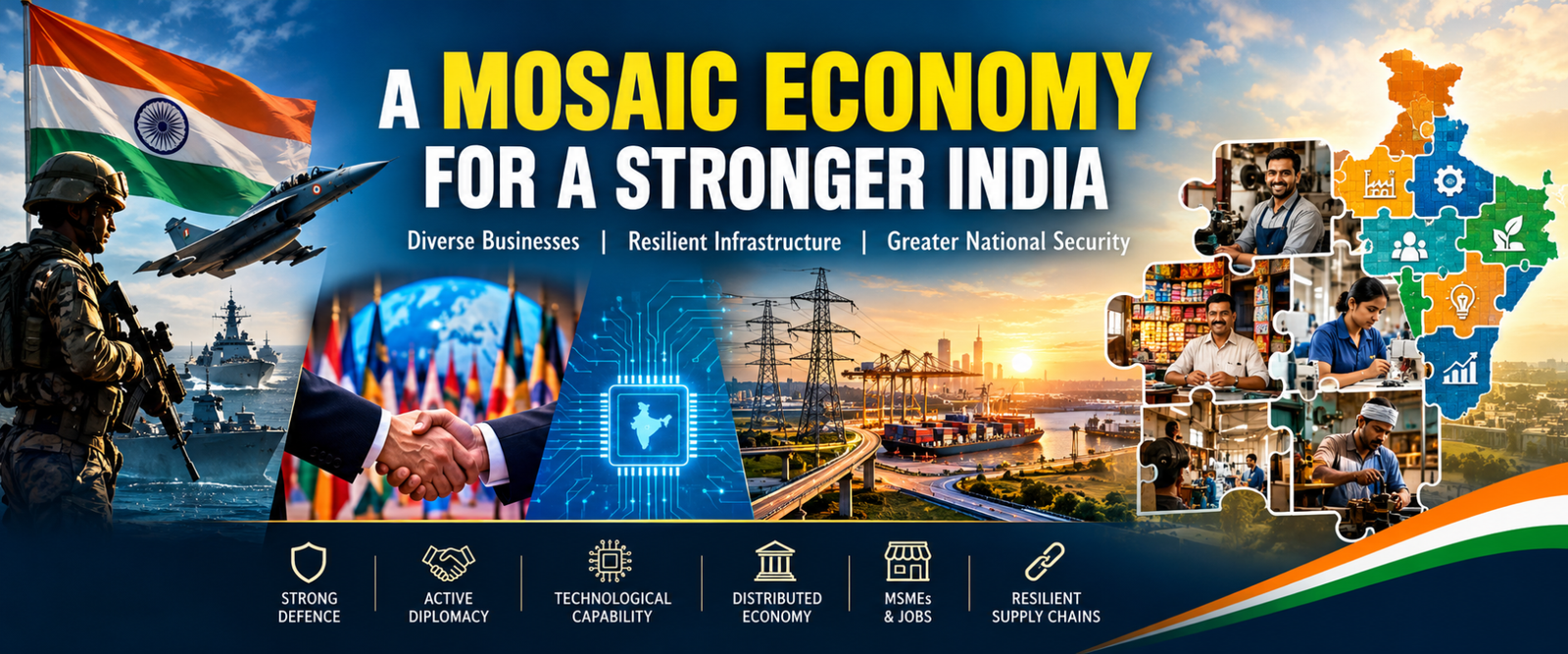
An economy can expand rapidly while becoming increasingly vulnerable at particular points. If a handful of business groups controls indispensable networks and services, pressure on those groups can acquire consequences far beyond their balance sheets. India should therefore consider a “mosaic economic policy”: a coordinated national framework supported by diverse ownership, multiple centres of production and strong participation by micro, small & medium enterprises.
The underlying principle is straightforward. A country becomes harder to destabilise when its essential capabilities are distributed across institutions and enterprises that can continue functioning independently.
Iran’s mosaic defence doctrine offers a limited but useful analogy. It emphasises dispersed capabilities and decentralised decision-making so that disruption of senior leadership does not automatically disable the entire system. Claims that Iran conclusively defeated the United States, or that decentralisation alone ensured the survival of its political system, go beyond what this analogy can establish. The relevant lesson for India is the value of continuity under pressure.
Economic systems need that capacity too
A telecommunications network, electricity system, port or logistics corridor is more than a commercial asset. It enables the functioning of the state and society. When ownership of several such assets converges within the same corporate group, an operational failure, financing crisis or external restriction can spread across sectors.
Foreign exposure adds another dimension. A large company may depend on overseas borrowing, imported technology, foreign markets or assets held abroad. Those relationships can support growth, but they can also become channels of pressure. A foreign power seeking concessions may find it easier to influence a commercially exposed enterprise than to negotiate directly with a sovereign government.
That possibility should be treated seriously without turning suspicion into an allegation. Foreign investment, regulatory proceedings or litigation do not, by themselves, prove a coercive campaign. Any claim against a particular government or company requires evidence. Nevertheless, national policy should anticipate vulnerabilities before a crisis demonstrates their cost.
India already possesses a constitutional foundation for addressing harmful concentration. The Preamble commits the republic to economic justice. Article 38 directs the State towards welfare and reduced inequality. Article 39(b) concerns the distribution of the community’s material resources for the common good, while Article 39(c) directs policy against concentration of wealth and means of production to the common detriment.
These Directive Principles do not make every large enterprise unconstitutional. They do require policymakers to ask whether the organisation of economic power serves the public.
A mosaic economy would give that question practical expression
First, competition in critical sectors should be assessed alongside resilience. Authorities should examine whether acquisitions and concessions create dependencies that leave essential services exposed to the difficulties of one corporate group. Separate company names offer little protection if ultimate control remains concentrated.
Second, essential infrastructure should support fair access. Smaller businesses cannot compete effectively if dominant operators control the networks, terminals or facilities they need to reach customers. Transparent access conditions and credible independent regulation can allow substantial infrastructure investment while preserving competition.
There must also be realism about scale. Certain networks have natural-monopoly characteristics, and duplicating them may be wasteful. In those circumstances, public oversight, enforceable access obligations and backup arrangements become especially important. The policy objective should be reliable service and accountable control.
Third, India should make MSMEs central to its strategic economic planning. The Economic Survey 2025–26 reports that MSMEs contribute approximately 31.1 per cent of GDP, 35.4 per cent of manufacturing and 48.58 per cent of exports. Their importance extends beyond these figures. They spread entrepreneurship, skills and employment across towns, districts and regions.
India should strengthen this employment base through policies that help smaller firms survive, become more productive and grow. Affordable working capital, timely payment and predictable regulation matter more than ceremonial recognition of their contribution.
Public procurement can help. Where feasible, contracts should be divided into packages that capable smaller enterprises can execute. Shared laboratories, testing facilities and technology centres can reduce costs that individual firms cannot bear. Stronger payment enforcement can prevent large buyers from financing themselves at the expense of small suppliers.
Finally, diversification should include financing, technology and supply chains. Multiple domestic operators may remain collectively vulnerable if they all depend on the same overseas supplier or funding channel. Resilience requires examining these underlying relationships as carefully as ownership.
A mosaic economy would still need national coordination, common technical standards and substantial investment. Large Indian enterprises would retain an important role. Their success should help build a wider ecosystem of capable businesses, with opportunities for new competitors to emerge.
India’s strategic autonomy will depend partly on whether its economic strength is broadly rooted. A country with many productive centres, competing enterprises and dependable alternatives is better placed to absorb shocks and resist coercion.
The road to great-power status should therefore run through millions of capable businesses, supported by institutions that keep essential systems open, reliable and accountable. Economic justice and national security meet at that point…….(The author is By Maninder Gill)

