
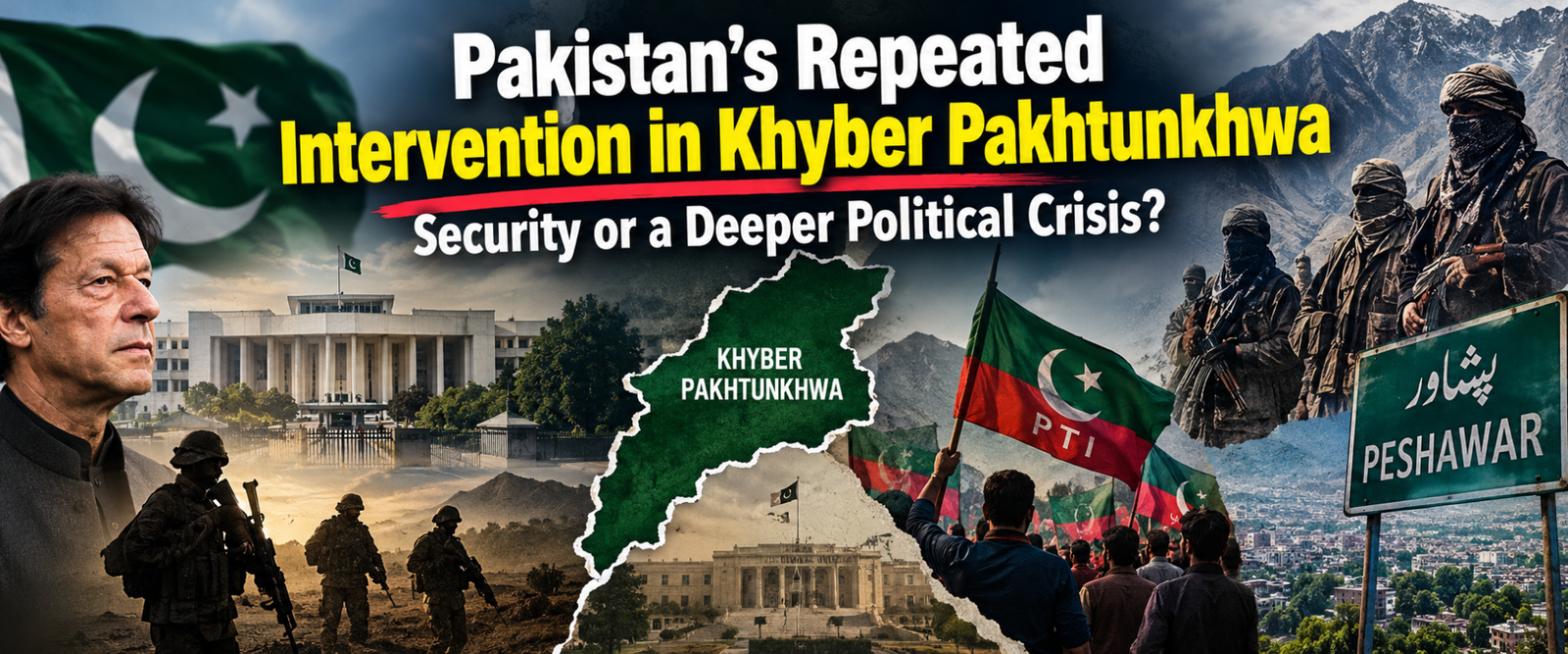
Pakistan’s history of federal intervention in provincial governments reveals a recurring contradiction in its approach to national security. Islamabad has repeatedly sought to manage political tensions through administrative control often at the cost of weakening the institutions that give provincial populations a stake in the state. In Khyber Pakhtunkhwa, where decades of militancy, military operations and political upheaval have already strained relations between the state and local communities this approach carries consequences that extend well beyond the corridors of power in Peshawar.
The federal government’s decision to impose Governor’s Rule in Khyber Pakhtunkhwa on October 11, 2026 by removing the PTI-led government of Chief Minister Sohail Afridi and then subsequently arresting him has revived this old dilemma. Islamabad has justified the intervention by citing escalating militant violence and the provincial government’s alleged failure to cooperate adequately with counterterrorism efforts. PTI has rejected these allegations describing the move as politically motivated and an attempt to overturn its electoral mandate.
The security crisis in Khyber Pakhtunkhwa is real. But the central question is whether removing an elected provincial government will help contain militancy or deepen the political alienation that makes the state’s security challenges harder to resolve. Pakistan’s history suggests that when constitutional powers are used to overcome political opposition the immediate gain in administrative control can come at the expense of public trust that fuels support for insurgency.
Bhutto’s intervention and the precedent of 1975
The first major post-1973 constitutional episode of Governor’s Rule in the then North-West Frontier Province occurred under Prime Minister Zulfikar Ali Bhutto. On February 16th, 1975, the federal government removed Chief Minister Sardar Inayatullah Khan Gandapur’s government following the assassination of senior provincial minister Hayat Muhammad Khan Sherpao in a bomb blast at the University of Peshawar.
The assassination demanded a serious investigation and an effective security response. However, the federal intervention unfolded amid a much wider confrontation between Bhutto’s Pakistan People’s Party and the National Awami Party which had a substantial political base in the province and neighbouring Balochistan. The NAP was banned in 1975 and the confrontation between Islamabad and its nationalist opponents escalated into a broader political crackdown.
The dismissal therefore had implications beyond the immediate security crisis. It reinforced the perception that the federal government could use extraordinary powers to displace provincial leadership when political relations deteriorated. The episode did not, by itself, cause the insurgencies that subsequently affected the region but it illustrated a pattern in which political disagreements were increasingly handled through centralised authority rather than political accommodation.
The distinction matters because the province’s later security problems were shaped by several interconnected developments including the Afghan jihad, the expansion of militant networks and Pakistan’s own regional security policies. Yet the weakening of representative institutions made the broader challenge of maintaining political confidence more difficult.
The 1994 intervention: partisan politics and provincial autonomy
A second episode occurred on February 25th 1994, when Prime Minister Benazir Bhutto’s government imposed Governor’s Rule in the province removing Chief Minister Pir Sabir Shah’s PML-N-led administration. The intervention ended on April 24, when PPP leader Aftab Ahmad Khan Sherpao became chief minister.
Unlike the 1975 episode, the 1994 intervention was not primarily triggered by a major security emergency. It emerged from the political confrontation between the PPP-led federal government and its opponents. The transfer of power to a chief minister from the party governing at the centre strengthened the perception that Governor’s Rule could serve partisan objectives.
This episode is particularly relevant to the present controversy because it illustrates the vulnerability of provincial autonomy when Islamabad and Peshawar are controlled by rival political forces. Even when federal action is presented in constitutional terms its legitimacy suffers as the public perceives it as an attempt to alter the provincial political balance.
How the security crisis became entrenched
The roots of Khyber Pakhtunkhwa’s present crisis extend far beyond Governor’s Rule. The Soviet invasion of Afghanistan in 1979 transformed Pakistan’s western border into a centre of international jihadi proxy warfare. The infrastructure built to support the Afghan mujahideen outlasted the conflict that created it contributing to a regional environment in which armed networks, ideological mobilisation and cross-border militancy became increasingly difficult to contain.
The emergence of Tehreek-e-Taliban Pakistan in 2007 marked a major escalation of violence inside Pakistan. Swat, South Waziristan, North Waziristan and other districts experienced militant control, military operations and mass displacement. The merger of the former Federally Administered Tribal Areas with Khyber Pakhtunkhwa in 2018 brought these territories into the province’s constitutional framework but the delivery of justice, development and effective administration has remained uneven.
The insurgency cannot be explained by political alienation alone. Militant organisations have their own ideological objectives, operational networks and sources of support, while Pakistan’s security policies and the instability across the Afghan border have also shaped the conflict. But political alienation remains an important factor because counterterrorism depends on public cooperation, credible civilian institutions and the willingness of communities to share information with the state.
For communities that have endured decades of cross border violence and the consequences of security operations the expectation has largely been straightforward, that the state should provide protection, justice and accountable governance. Pakistan establishment’s strategy on the other hand concentrates on controlling provincial institutions without addressing these expectations and hence risks treating the symptoms of instability while leaving important political grievances unresolved.
Sohail Afridi’s dismissal and the new confrontation
The current intervention carries particular significance because of PTI’s electoral strength in Khyber Pakhtunkhwa. The party has governed the province since 2013 and retained a strong political base in the 2024 general elections. Its provincial government also provides an institutional platform for supporters of former prime minister Imran Khan whose confrontation with Pakistan’s federal establishment has become a defining feature of the country’s politics.
Sohail Afridi became chief minister in 2025, succeeding Ali Amin Gandapur. His government was therefore an elected administration with a substantial political constituency. Its removal has consequently raised questions about whether the federal government is responding proportionately to the security crisis or using extraordinary constitutional powers to weaken a political opponent.
The intervention has been followed by a period of heightened confrontation between PTI and the federal coalition. Afridi had led a protest march towards Islamabad demanding Imran Khan’s release while political talks between the two sides had broken down. The federal government subsequently invoked Articles 232 and 234 of the Constitution, citing the severity of militant violence and the provincial administration’s alleged failure to respond effectively.
Federal ministers have accused the provincial leadership of failing to take ownership of the counterterrorism effort while some have made more serious allegations concerning its relationship with militants. PTI has rejected these claims calling it a motivated political agenda and a disproportionate response to political differences between the Federal government and the PTI.
When political control comes at the cost of public trust
The consequences of the intervention will depend partly on how it is implemented, how long it lasts and whether the federal government can demonstrate a tangible improvement in security. But its political impact is already significant as PTI supporters view the removal as another attempt to override the electoral preferences of a province where the party enjoys considerable support. That perception has deepened mistrust between Islamabad and Peshawar as the intervention is seen as a means of governing the province without the consent of its elected representatives.
Pakistan’s experience shows why this distinction matters. Security operations by and large have failed to disrupt militant networks and the lasting stability equally depends on effective civilian administration, credible justice, local cooperation and political institutions that command public confidence. In Khyber Pakhtunkhwa’s case people’s grievances have no meaningful political outlet and the state’s ability to isolate insurgents has become more difficult.
The rise of insurgency in Pakistan has multiple causes yet it is equally mistaken to assume that political interventions have no bearing on the environment in which insurgencies operate. A government that weakens representative institutions risks creating additional grievances without resolving the security failures that prompted its intervention and for Pakistan that mostly has been the case.
Pakistan’s establishment has repeatedly demonstrated that it is more comfortable exercising control over political institutions than confronting the consequences of its own security policies. In Khyber Pakhtunkhwa, the removal of an elected government risks repeating a familiar cycle of centralised power, marginalised political opposition, deepening public resentment and then treating the resulting instability as a justification for further coercion. The establishment cannot manufacture stability by weakening the very democratic institutions that give people a stake in the state nor can it expect a population to remain politically invested when its electoral choices are overridden whenever they challenge the interests of the centre. If Islamabad believes that Governor’s Rule will contain militancy it must answer a more uncomfortable question, how does the systematic erosion of provincial autonomy help defeat an insurgency that feeds on mistrust of the state? Until Pakistan’s establishment abandons the assumption that political dissent can be managed through administrative force it will continue to mistake obedience for legitimacy and control for stability, leaving Khyber Pakhtunkhwa to bear the consequences of a strategy that has repeatedly failed to deliver lasting peace.
(About Author: Raja Muneeb is a journalist and a columnist who covers topics on Geopolitics and National Security extensively. He can be reached at X ID: @rajamuneeb email: raja.muneeb@gmail.com )

